
Doce fino: the Algarve's fruit, sculpted entirely from almonds
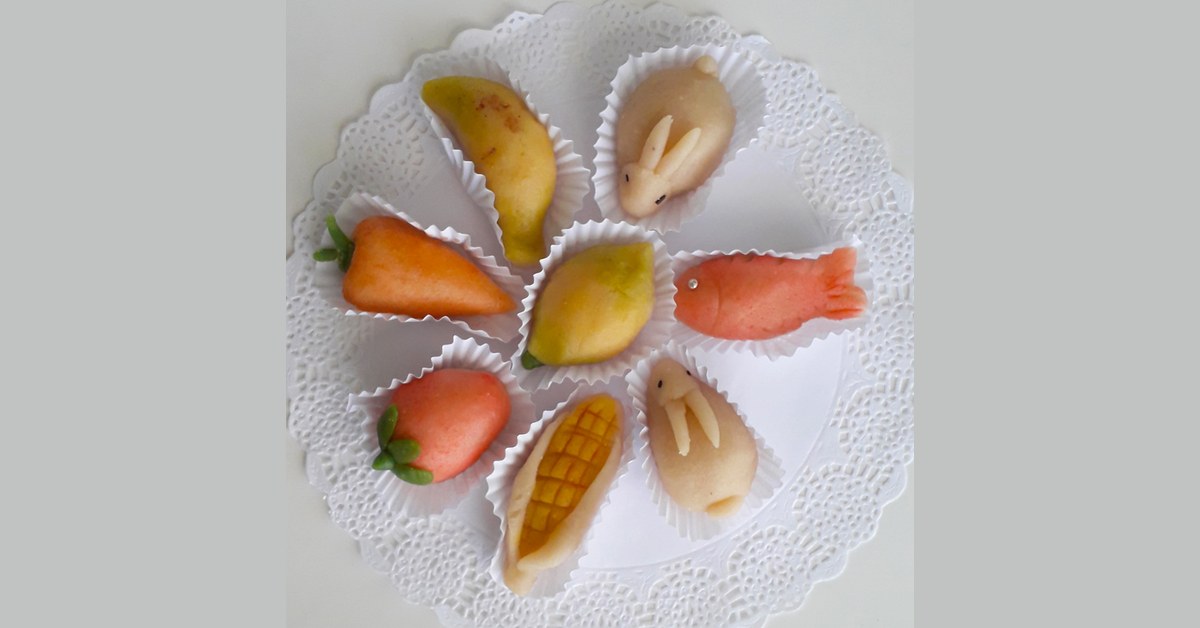
On the doily sit a speckled banana, a split ear of corn, two white rabbits upright on their haunches, a carrot with green leaves, a pink fish and a strawberry. The whole display fits in one hand. And none of it is what it appears to be: not fruit, not vegetable, not animal. It is grated almond, sugar and an egg white. In the Algarve this is called doce fino, and it is probably the only Portuguese pastry people spend longer looking at than eating.
Three ingredients, a thousand shapes
The recipe fits on a single line. Equal weights of grated almond and sugar, one or two egg whites to bind, worked until it forms a supple, off-white paste. It never becomes perfectly smooth: the almond stays faintly grainy, and it is that grain against the teeth that identifies a piece made by hand.
What follows has less to do with baking than with sculpture. You roll a ball, hollow out a cavity and fill it with doce de ovos, the thick cream of egg yolks and sugar that runs through the whole of Portuguese doçaria. You close it up, then you shape it. Leaves, stems, roots, the carrot's green top are all modelled separately, still in almond paste, then attached one by one. Colour comes last, applied with food colouring or chocolate, laid on the way a painter would rather than a pastry chef.
A finished piece measures four to five centimetres and weighs around fifty grams. Exactly the size of one mouthful, and of an ornament.
A catalogue of the countryside
The repertoire of shapes owes nothing to chance. These are not abstract motifs or invented flowers: they are the things you could see out of the window. The fig and the ear of corn, the carrot and the strawberry, the hen and the pig. The best workshops go further still, imitating whole cheeses or cheeses cut into wedges, and even cured meats. From a distance, a tray of doce fino can pass for a savoury platter.
This is where pastry turns into a game. Doce fino is an edible prank: you hold out the plate, the guest hesitates one second too long, and the carrot cracks into sugar. In a region where the almond tree was long the most dependable form of wealth, turning that almond into a hen, a cob and a fig amounted to filing away the entire countryside in a sweet box.
Arab inheritance or convent sweet?
The origin is disputed, and both accounts have their defenders. The first traces doce fino back to the Arab heritage of southern Portugal. Working almond together with sugar, the perfumed pastes, the small hand-shaped pieces all belong to a tradition established in the Algarve long before the region became Portuguese.
The second links it to the doçaria conventual of the eighteenth century, the pastry of convents that had sugar, eggs in quantity and the time such minute work demands, all at once. It is the same lineage found behind the ovos moles of Aveiro, another sweet born in a convent before it became the emblem of a whole town.
Both stories are probably right at the same time. The Algarve had the almond, of which the region is a significant producer, and the convents had the technique. The meeting of the two explains doce fino better than either story on its own. It is the same logic that produced, a little further west, the morgado of fig and almond: the same raw material, an entirely different gesture.
The almond first
To understand doce fino you have to understand what the almond tree means in the Algarve. Every year, between January and February, the hills of the interior turn white in a matter of days. The blossom is brief and spectacular, and it produced a legend the region still tells: a Moorish king is said to have planted thousands of almond trees so that his wife, who came from the north and was pining for the sight of snow, would have a white landscape in the middle of winter.
What the legend really says is this: in the Algarve, almond is not one ingredient among others. It is the product an entire pastry tradition was built around. Doce fino is its most demonstrative form: the one where almond stops being a flavour and becomes an image.
A pastry passed down by hand
Doce fino now appears in the official inventory of Portuguese traditional products, under the name doçaria fina do Algarve, and its modern reputation remains attached to the workshops of the coast, around Portimão. But no machine has ever replaced the hand on this product. Every fig, every rabbit, every slice of false cheese comes out of a thumb and a forefinger. That explains the price of these small mouthfuls, and it also explains why you never find mountains of them.
At Wooly, in Brussels
Doce fino is not in our display cases: it is a workshop speciality, it travels badly and it is made to order. But the family it comes from, that of almond, egg yolk, sugar and a great deal of patience, takes up a good part of our counter. The barquinhos de Aveiro are its direct cousin: the same almond paste, the same doce de ovos centre, the same handwork, in the shape of a little boat rather than a carrot.
You can find them in our four Brussels shops: rue des Tongres in Etterbeek, in Stockel, in Uccle and in Waterloo. Our opening hours and full addresses are on our shops page. Do ask us for a taste: it is still the best way to understand why, in Portugal, a pastry chef is judged on what they can do with a single almond.
Photo: doces finos from the Algarve. Cardoazul, Wikimedia Commons, licence CC BY-SA 4.0.
Read next
The ponto de açúcar: the fingertip test that decides everything
Thread, pearl, blown, sand: Portuguese has nine words for the moment a sugar syrup is ready, and not a single number.…
Bolo de bolacha: the Portuguese cake that never sees an oven
It never goes into the oven. Three things are enough — Maria biscuits, strong coffee, buttercream — plus one night in…
Confeitaria Nacional: the Lisbon pastry shop open since 1829
At dusk, on the corner of Praça da Figueira, the red sign lights up before the street lamps do. Below it, a row of…
Dom Rodrigo: the Algarve sweet you unwrap like a candy
A rustle first. You pull at two corners of metallic paper, the golden ball appears, sticky, dusted with cinnamon. Dom…
Uvada: the harvest sweet they boiled at night, without sugar
There is no sugar in uvada. Not a gram. This Portuguese harvest sweet draws all of its sweetness from the grape itself,…
Tigelada: the dessert baked in the village bread oven, after the bread
The oven has just given up its bread. The vault is still glowing, the embers pushed to the back: that exact moment is…
Brisas do Lis: the Leiria cake that had to change its name
They were called the little kisses of the Lis, until the jokes at the counter forced Leiria to find another name. The…
Ceylon cinnamon: the bark the Portuguese found by accident
On a pastel de nata that is still warm, it comes last, in a gesture lasting one second. Yet this brown powder has…
Find our artisan pastries in our Brussels stores or order online.
Order now Our foodtruck for your events Our stores