
Ovos Moles: The Convent Sweet Aveiro Never Stopped Making
They call Aveiro "Portugal's Venice," which is both wrong and oddly right. Wrong, because nothing really looks like Venice. Right, because its canals, worked by moliceiros (the long, painted boats once used to harvest seaweed) give the town an unhurried, almost maritime rhythm, in a region where the sea is only a few kilometres away anyway. It was here, in the 16th century, that one of Portugal's quietest and oldest desserts was born.
The story starts, as so many Portuguese convent sweets do, with egg whites. At the Convento de Jesus in Aveiro, nuns used egg whites to starch their habits, a common practice in convents of the time. That left a considerable surplus of yolks, too precious to throw away. Their solution was to cook them slowly with sugar until the mixture turned smooth, golden, almost silky. As early as 1502, King Manuel I granted the convent an annual allowance of sugar from Madeira, proof that word of these sweets had already travelled well beyond the cloister walls.
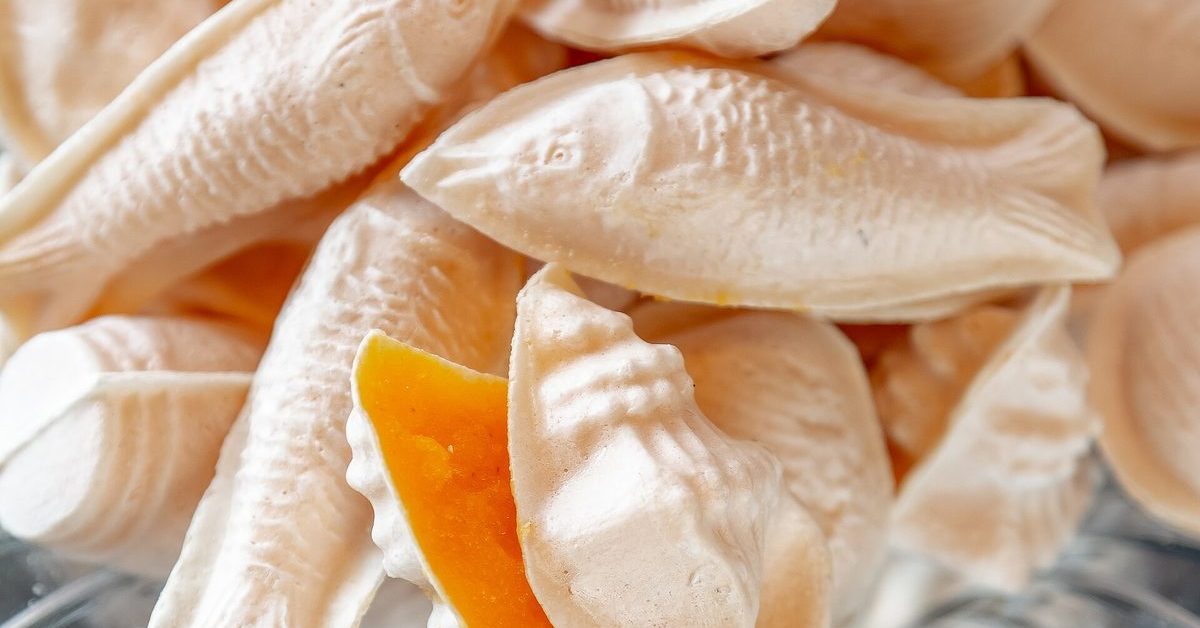
What sets ovos moles apart isn't just the cream itself (an almost austere mix of egg yolk and sugar syrup, with nothing extra added) but how it's served. Sealed inside a thin wafer shell, shaped like a shell, a little fish, or a tiny wooden barrel, in direct memory of the lagoon's fishing life. Today they're sold by weight or in small wooden casks, a quiet nod to a maritime history the town has never let go of.
There's something we recognise in that gesture, something we do several times a day in our Wooly shops. Fresh egg yolk, cooked patiently until the texture is just right, no shortcuts, no artificial fixes: that's exactly the principle behind our pastel de nata, the more famous cousin but not so far off from ovos moles in its DNA. Both come from the same Portuguese convent instinct: waste nothing, turn the simple into something precious through patience, the same thing we try to keep alive in Brussels, one shop at a time.
Ovos moles are not yet in our display cases in Stockel, Etterbeek (Rue des Tongres), Uccle or Waterloo. But next time you walk into one of our shops and watch the cream spill out of your pastel de nata on the first bite, spare a thought for that nun in Aveiro, five centuries ago, who refused to throw her egg yolks away. In a small way, she's who we're still serving.
What exactly are ovos moles?
Two elements, no more: a cream of egg yolks and sugar, and a shell of wafer paper, the same thin white unleavened sheet used for communion wafers. The cream is sealed inside the shell, which is moulded into the shape of a shell, a fish, a barrel or a scallop.
There is no flour, no butter, no milk, no leavening. The taste is that of egg yolk cooked in sugar, direct and very sweet, and the wafer adds little beyond a dry texture that cracks and then dissolves.
Why egg yolks, and only yolks?
This is the origin of the whole Portuguese doçaria conventual. In the convents, egg whites were used to clarify wine and to starch religious habits. That left large quantities of yolks, which the nuns learned to turn into sweets.
It explains an entire family of Portuguese pastries built on the same principle: ovos moles, fios de ovos, papos de anjo, toucinho do céu, and the pastel de nata itself, whose custard is also a matter of yolks.
Aveiro, the canals and the protected name
Aveiro is a lagoon town, crossed by canals travelled in moliceiros, the colourful boats with raised prows. The traditional shapes of ovos moles (shells, fish, barrels) borrow the vocabulary of that lagoon.
Since 2006, Ovos Moles de Aveiro have held a European protected geographical indication. The name may only be used for production from the Aveiro region that meets the specification. Along with the pastel de Tentúgal, it is the only Portuguese sweet with that protection.
The traditional recipe for the cream
The recipe below is the traditional version of the cream, from Portuguese cookbooks. It is not ours: that one stays our secret. The wafer shells are bought: nobody makes those at home.
Ingredients (about 30 pieces)
- 12 egg yolks
- 250 g sugar
- 125 ml water
- 1 cinnamon stick (optional)
- Wafer sheets for the shell
The method
- Cook the syrup. Bring the water, sugar and cinnamon to the boil and cook to ponto pérola, around 105 °C: a drop pressed between two fingers forms a short thread.
- Take off the heat and let it cool. This is the step everyone skips. Syrup that is too hot cooks the yolks instantly and gives lumps you cannot rescue.
- Add the yolks. Sieve them first to remove the chalazae, then pour them in a thin stream into the warm syrup while whisking continuously.
- Cook gently. Return to very low heat and stir without stopping until the cream thickens and comes away from the base, five to eight minutes.
- Cool completely. Spread the cream in a cold dish, cover with film touching the surface and leave for several hours.
- Fill the shells. Fill the wafer half-shells, seal the edges with a little water, and trim flush.
Where it goes wrong: the syrup temperature
Nine failures out of ten come from the same move: yolks poured into syrup that is still boiling. They set at once and the cream turns grainy. The syrup must be warm, around 40 to 50 °C, and the yolks added in a thin stream, never all at once.
The second trap is the opposite: a cream that is undercooked, stays runny and soaks the shell within hours. It must clearly come away from the base of the pan before you take it off the heat.
Ovos moles, ovos de coco, fios de ovos: not the same thing
Ovos moles are the yolk cream in a wafer shell, from Aveiro. Ovos de coco, which we make, are soft little cakes of coconut and egg yolk, with no shell. Fios de ovos are threads of egg cooked in syrup, used as decoration.
All three come from the same convent logic and the same surplus of yolks, but they are three different preparations.
How they are eaten
At the end of a meal, by hand, one or two pieces with a coffee. They keep for a few days at room temperature, never in the fridge: cold soaks the wafer shell and ruins the contrast of textures that is the whole point.
Sources: Direção-Geral de Agricultura e Desenvolvimento Rural, “Ovos Moles de Aveiro IGP”; Wikipédia (pt), “Ovos moles de Aveiro”.
Photo : Luísa Paulos, CC BY-SA 4.0, via Wikimedia Commons
Read next
The Sardinhada: Lisbon's Summer Ritual of Grilled Sardines
A grill set right on the cobblestones. A cloud of oily smoke curling up between two façades strung with paper garlands.…
Bolo de Arroz: The Little Cake Standing Between Lisbon and the Loss of Its Cafés
Standing at the counter, an espresso gone in three sips, a small golden cake in hand: that's the most ordinary, most…
Ginjinha: The Tiny Cup That Sums Up Lisbon
The first time, someone hands you a plastic cup barely bigger than a thimble. You knock it back in one go, standing on…
Arroz Doce: The Portuguese Rice Pudding That Ends Every Family Table
I still remember the first time someone handed me a bowl still faintly warm, with a fan of cinnamon traced across the…
The Queijada de Sintra: the little cake people once used to pay their taxes
A crust that snaps the moment you bite into it, a warm filling of fresh cheese and cinnamon, the queijada de Sintra was…
Pastel de Belém Just Won World's Best Pastry: Here's What That Means for Us
The first time someone told me a custard tart from a Lisbon monastery bakery was the best pastry on earth, I thought it…
Travesseiro de Sintra: The Pillow Pastry That Conquered a Hillside Town
I still remember the first time someone handed me a travesseiro straight out of its paper wrapper, still warm, dusted…
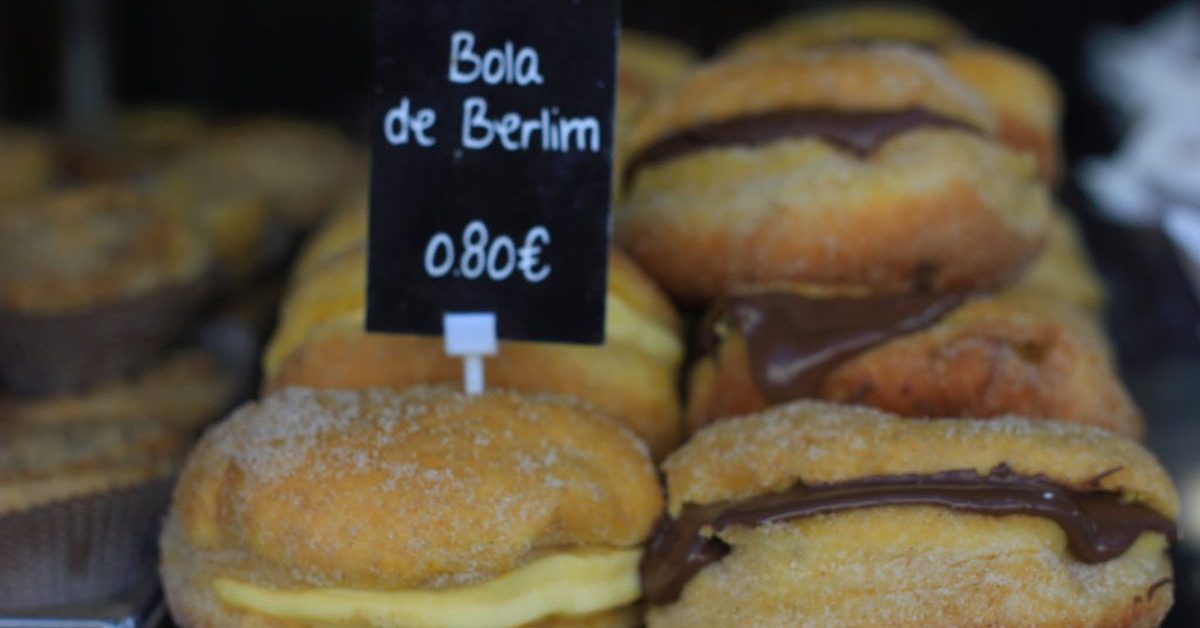
Bola de Berlim, the Pastry that Tastes Like Portuguese Summer
Flaky, golden, and generously filled with custard cream: the bola de berlim is the pastry that carries Portuguese…
Find our artisan pastries in our Brussels stores or order online.
Order now Our foodtruck for your events Our stores