
Desfolhada: the night when a red corn ear was worth a kiss
Start with the sound. Dozens of hands tearing dry leaves open all at once, under a late-September moon. No engine, no machine: only the rustle of husks pulled off the corn ears, and the voices carrying over them.
This is a desfolhada, a husking. In northern Portugal, across the Minho, the Douro Litoral and the Beira Litoral, that is the name for the night when a village gathers to strip the corn of its leaves before it goes to dry. Late September, early October. Always after dark.
Work nobody could do alone
The daylight hours went to cutting. Stalks were felled in the fields, carried on the shoulder or loaded onto ox carts, and everything ended up in the same place: the eira, the paved threshing floor that serves a farm as its common square. By nightfall the heap of corn was waiting there, enormous.
No one was getting through it alone, so you called the neighbours. Each house took its turn and returned the favour a few days later: a system of mutual help that never needed to be written down to hold. Women and men sat around the heap, children moved between them, and the work went ear by ear until late.
The red ear
And then there was the rule. Among thousands of yellow ears, one occasionally turned up in reddish, almost burgundy tones: the milho-rei, the king ear. Whoever found it had to hold it up and shout it out loud — milho-rei! — and earned the right to kiss, or at least embrace, everyone present.
It helps to know what that meant at the time. Convention did not allow a boy and a girl to touch in public before marriage. The red ear, though, was pure chance: nobody could hold anything against a person the draw had chosen. The young waited for that moment all evening, which is probably why the desfolhada stayed in people's memories far better than the rest of the harvest work.
They sang to keep going
The gesture is simple and it lasts for hours: take the ear, open the leaves, pull, throw the bare cob to one side and the husk to the other. Nothing to occupy the mind. So they sang. The cantigas ao desafio — improvised duels in which two singers answer each other in verse and try to corner one another — found an ideal setting here: a seated audience, a whole night ahead, and plenty to laugh about. The music was not entertainment added to the work. It was part of it, and it set the pace.
Nothing was wasted either. The stripped leaves became bedding for the animals, and the best of them ended up stuffed into mattresses.
What was eaten at a desfolhada
The breaks were substantial, and they were half the reason for coming. Caldo verde was ladled out, the soup of finely shredded cabbage, in earthenware bowls, with a thread of olive oil, slices of chouriço and a piece of broa de milho, the dense corn bread with a tight crumb and thick crust, made from exactly the grain being husked. The region's vinho verde went round the rows.
And the night closed on the doces. The Minho's are not Portugal's most spectacular, no sculpted almond paste and no egg threads, but they are the sweets you can make in quantity with whatever the house holds: arroz doce, rice pudding patterned in cinnamon; leite-creme with its sugar crust burnt shut under a red-hot iron; formigos, rabanadas, pears stewed in wine. Saucepan desserts, designed for a crowd at once.
Where the corn went
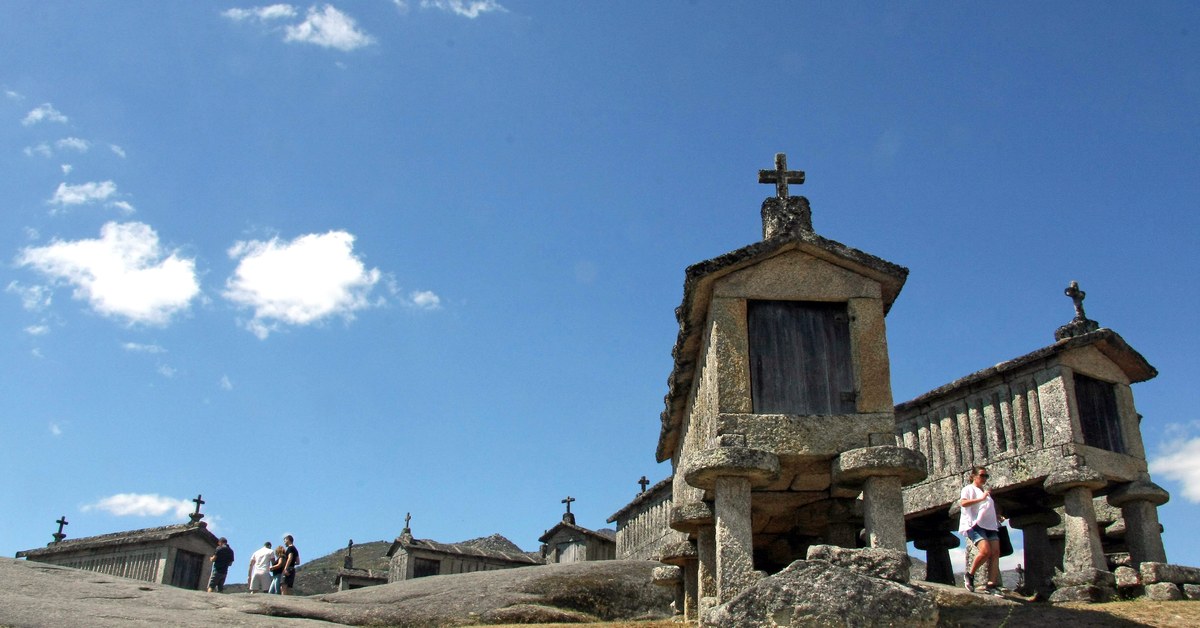
Once stripped, the ears went up into the espigueiros. These are the granite granaries on stone stilts you see lined up at Soajo or Lindoso, in the Peneda-Gerês national park: narrow stone boxes, slatted along the sides so air passes through, raised so rodents cannot climb in, often topped with a cross. The corn dried there all winter, out of the rain and within reach.
Corn has not always been there, though. It arrived from the Americas, and northern Portugal took it up so thoroughly that it became the daily bread. The broa, the soup you dip into it, the espigueiros on the hillside, the husking night itself: a whole landscape and a whole calendar grew out of a plant from somewhere else.
What is left of it
Machines took over the work, and a heap of corn no longer brings anyone together. Yet the desfolhada has not vanished: several villages in the Minho stage it again each autumn as a festival, with the heap in the middle, the singing, the caldo verde in its cauldron and a red ear hidden somewhere. It is no longer an agricultural necessity; it has become a way of remembering what held a village upright.
In Brussels we have neither an eira nor a red ear. But the idea that a dessert exists first of all to gather people made the journey with the Portuguese families. It is why we keep faith with cakes made for sharing, the ones you set down in the middle and cut for everybody, like the pão de ló ouro, soft and golden, which only makes sense with several people around it. Our shops in Etterbeek, Stockel, Uccle and Waterloo are built for that: people rarely come in for a single piece. Addresses and opening hours are on the page for our shops.
Photo: the espigueiros of Soajo, by Vitor Oliveira (CC BY-SA 2.0, via Wikimedia Commons).
Read next
The suitcase home: what Portuguese families bring back in August
In late August the same scene plays out in kitchens all over Brussels: a suitcase open on the tiles, a bathroom scale…
Doce fino: the Algarve's fruit, sculpted entirely from almonds
A banana, an ear of corn, two white rabbits and a carrot complete with its leafy top, all laid out on a paper doily.…
The ponto de açúcar: the fingertip test that decides everything
Thread, pearl, blown, sand: Portuguese has nine words for the moment a sugar syrup is ready, and not a single number.…
Bolo de bolacha: the Portuguese cake that never sees an oven
It never goes into the oven. Three things are enough — Maria biscuits, strong coffee, buttercream — plus one night in…
Confeitaria Nacional: the Lisbon pastry shop open since 1829
At dusk, on the corner of Praça da Figueira, the red sign lights up before the street lamps do. Below it, a row of…
Dom Rodrigo: the Algarve sweet you unwrap like a candy
A rustle first. You pull at two corners of metallic paper, the golden ball appears, sticky, dusted with cinnamon. Dom…
Uvada: the harvest sweet they boiled at night, without sugar
There is no sugar in uvada. Not a gram. This Portuguese harvest sweet draws all of its sweetness from the grape itself,…
Tigelada: the dessert baked in the village bread oven, after the bread
The oven has just given up its bread. The vault is still glowing, the embers pushed to the back: that exact moment is…
Find our artisan pastries in our Brussels stores or order online.
Order now Our foodtruck for your events Our stores