
Leite-creme: the red-hot iron that cracks Portuguese custard
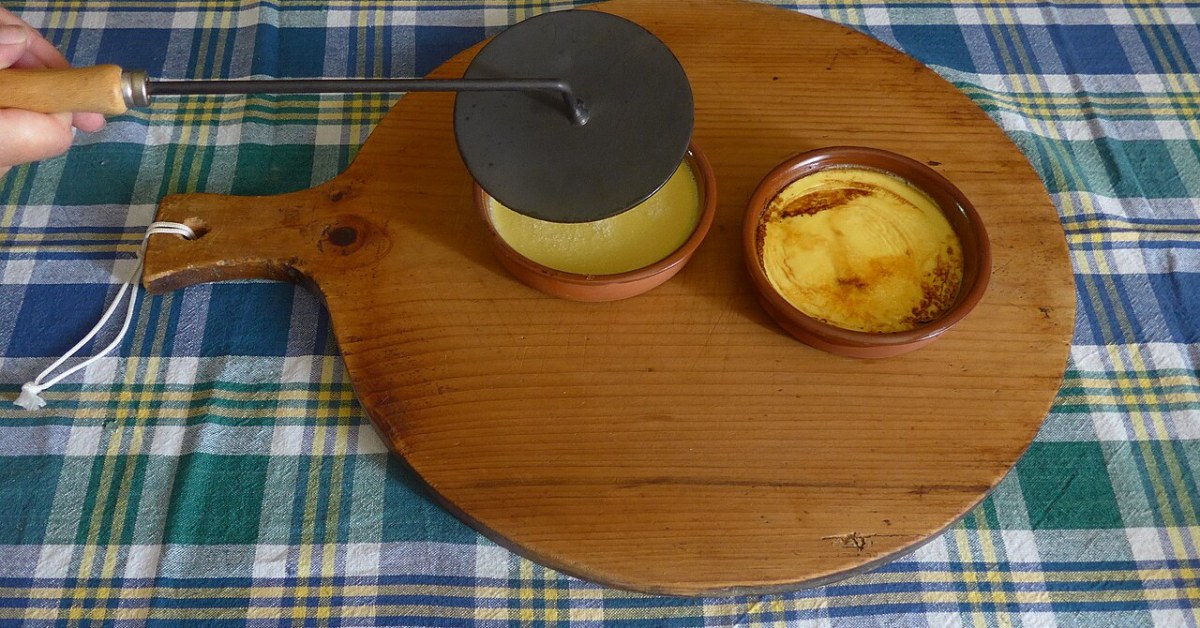
You hear it before you taste it. The spoon presses, the sugar crust gives way with a dry crack, and underneath there is nothing hard left: a cool, yielding custard of egg yolks, scented with lemon and cinnamon. Leite-creme lives entirely in that two-second contrast.
A custard that never sees an oven
That is the first thing separating it from its European cousins: leite-creme is made in a saucepan. Milk, egg yolks, sugar, a little starch, a strip of lemon peel and a cinnamon stick left to infuse and then lifted out. You stir, constantly, over a low flame, until the custard coats the spoon. No water bath, no oven: the whole cooking happens in the wrist.
The custard is then poured into a wide, shallow dish, often earthenware, and left to cool. It thickens without ever setting like a flan. Leite-creme is eaten with a spoon, never cut with a knife, and that texture is precisely what an oven would have destroyed.
The ferro de queimar
That leaves the sugar. A thin layer is scattered over the cold custard, and then comes the object that gives the dessert its character: the ferro de queimar, also called a pá de queimar. A cast-iron disc on a long handle, heated red over a flame or embers and laid flat on the sugar.
The contact is short, violent and loud. The sugar melts, browns, smokes, and sets into a sheet of glass barely thicker than a page. A blowtorch does roughly the same job, but not quite: the iron only heats what it touches. The custard underneath stays cold. That is why the crust on a good leite-creme is so thin, and why the first spoonful makes that sound.
In many Portuguese families the ferro is not something you buy. It is handed down, blackened by decades of service, kept at the back of a drawer and brought out for the meals that matter.
A quarrel nobody has settled
You cannot discuss leite-creme without someone at the table saying the words "crème brûlée". The resemblance is real, the kinship likely, the origin unprovable.
What is known amounts to very little: the earliest known written mention of crème brûlée appears in a French cookbook of 1691, François Massialot's Nouveau cuisinier royal et bourgeois. A written mention is not an invention: it proves only that at that date somebody bothered to write down a recipe others may have been making for far longer. Domestic desserts rarely leave archives behind. The Catalans put forward their crema catalana with the same arguments and the same conviction.
The tangible difference, though, is not in dispute: crème brûlée bakes in an oven, in a water bath, in its own ramekin. Leite-creme cooks on the hob, in a pan, and never goes near an oven. Two methods, two textures, one idea, sugar and fire laid over an egg custard.
Convents, egg yolks and cinnamon
If Portuguese pastry counts so many yellow desserts, that is not a matter of taste but a consequence. In Portuguese convents, egg whites went out by the litre: they were used to starch linen and habits, and to clarify wine. What remained were the yolks, in quantity, in the hands of nuns who had sugar, time and skill. The whole family of doces conventuais comes from there, and so does that very Portuguese habit of wasting no part of an egg: yolks into the custard, whites whipped and poached in milk.
Cinnamon arrived by sea. Portugal held trading posts along the spice route through much of the sixteenth and seventeenth centuries, and canela was standing in Portuguese kitchens before it became a rare perfume elsewhere in Europe. It has never left the desserts since: on leite-creme, on arroz doce, on a pastel de nata straight out of the oven. In Portugal cinnamon is not an addition: it is part of the dessert.
An everyday dessert
Leite-creme is not a celebration dessert. You find it on the board of a tasca as the sobremesa do dia, behind the counter of a pastelaria, on the family table at Sunday lunch. It costs little, is made with what is already in the house, and can be prepared the day before. It is a dessert of the home kitchen, which probably explains why nobody ever thought to draw up its birth certificate.
It does have grander cousins in the same register of milk, eggs and slowly worked sugar, the pudim Abade de Priscos is its exact opposite: same family, reverse ambition.
At Wooly, in Brussels
An egg-yolk custard, sugar, fire, cinnamon: that is exactly what gives our pastel de nata its flavour. The red-hot iron becomes the heat of the oven, the earthenware dish becomes a shell of puff pastry, but the logic does not move: caramelise the top, keep the inside creamy. It is also why a pastel de nata is best eaten warm, and not after three hours in a bag. In Brussels you will find them on the Rue des Tongres in Etterbeek, as well as in Stockel, Uccle and Waterloo.
Photograph: Celeda, Wikimedia Commons, licence CC BY-SA 4.0.
Our pastéis de nata, in seven flavours, can also be ordered online, with home delivery in Brussels and to neighbouring countries.
Sources: Direção-Geral de Agricultura e Desenvolvimento Rural (Produtos Tradicionais Portugueses), “Creme Queimado”; Wikipédia, “Crème brûlée”.
Read next
Pudim Abade de Priscos: the Portuguese pudding with no milk
A dark, dense Portuguese pudding born in a presbytery near Braga, whose original recipe contains not a drop of milk.…
Fios de Ovos: The Portuguese Egg Thread That Conquered Siam
Egg yolk falling in a thin stream into boiling syrup, and coming out as golden thread. Fios de ovos may be the most…
Cavacas: The Hollow Cake the Cavaqueiras Sold From Wicker Baskets
A matt white glaze that shatters under your teeth, and almost nothing underneath. The cavaca is a Portuguese cake built…
Torta de Azeitão: the golden roll that came from the Alentejo
The fork meets no resistance, the thin sheet of sponge gives way, and the egg cream appears. A torta de Azeitão hides…
Meias-luas of Viana: the pastry you bought without seeing a soul
A coin laid on a wooden tray, a half turn, and the pastry appears without you ever seeing the hand that made it. In…
Doce de gila: the squash you smash on the ground to make a dessert
You do not cut it open, you throw it on the ground. And what comes out of the broken squash looks nothing like a…
Pastel de feijão: the Portuguese pastry that hides beans
You bite into it looking for almond, and you find almond. What you never find is the white bean that makes up half the…
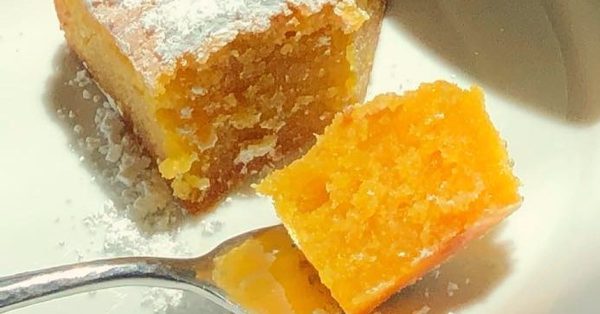

Toucinho do céu: the cake named after an ingredient it no longer contains
Its name means "bacon from heaven". The lard disappeared from the recipe long ago, but the name stayed, and so did the…
Find our artisan pastries in our Brussels stores or order online.
Order now Our foodtruck for your events Our stores