
Empanada, chamuça, rissol: which is which?
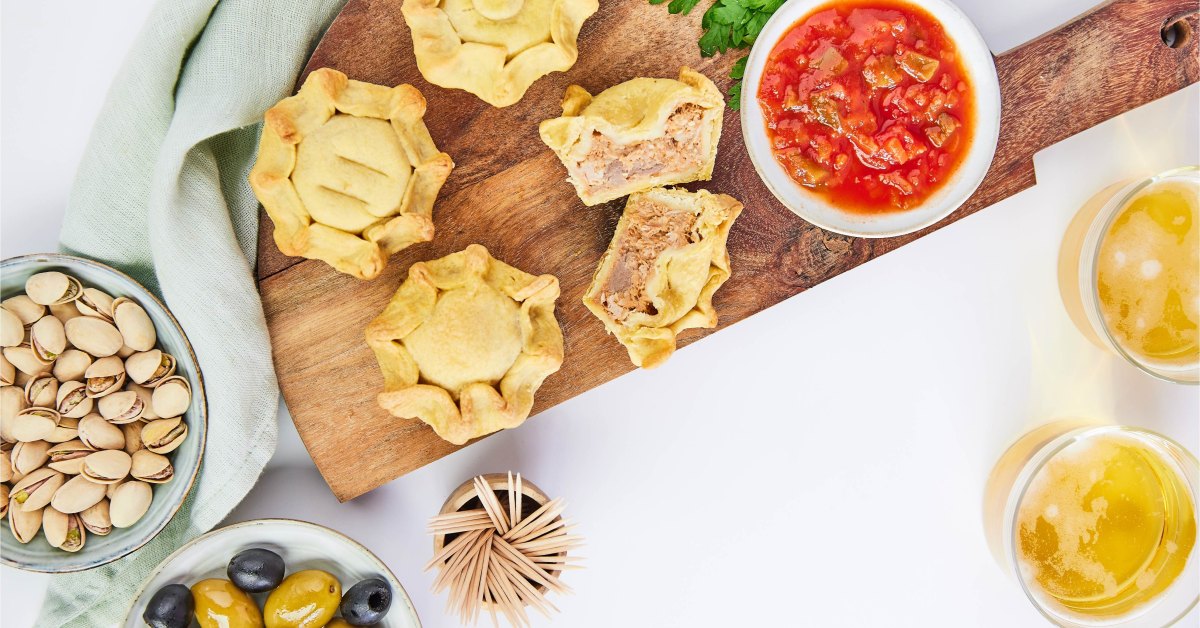
At a Portuguese counter, four savoury parcels look alike and have almost nothing in common: the empanada, the chamuça, the rissol and the empada. They get confused constantly. Here is how to tell them apart at a glance, what is inside each, and where each one comes from.
The table that settles it
| Name | Shape | Dough | Cooking | Typical filling |
|---|---|---|---|---|
| Empanada | Half-moon, twisted edge | Raw dough, often leavened | Oven | Tuna, meat, vegetables |
| Chamuça | Triangle | Very thin sheet | Deep-fried | Spiced meat, vegetables |
| Rissol | Half-moon, pressed edge | Water-cooked, breaded | Deep-fried | Prawn, suckling pig |
| Empada | Small round basket | Shortcrust | Oven | Chicken, veal |
The shortcut that almost always works: triangle = chamuça, breaded half-moon = rissol, unbreaded golden half-moon = empanada, round with a lid = empada.
The empanada: the baked one
The empanada is a parcel of raw dough, folded into a half-moon and baked. Its surface is golden and matt, never breaded. The edge is often twisted by hand — that braided rope is its signature.
The word comes from empanar, "to wrap in bread". It is associated mainly with Galicia and Latin America, but it circulates throughout the Portuguese- and Spanish-speaking world, with fillings that change from country to country: tuna and pepper in Portugal and Galicia, minced beef and olive in Argentina, chicken in Chile.
Unlike the rissol and the chamuça, it never sees the fryer. It is the only one of the four you can make without oil.
The chamuça: the fried triangle
The chamuça is the samosa of the Portuguese world, and its name says so: chamuça comes from the same word as samosa. It reached Portugal through Goa, Mozambique and Portuguese India, and has been part of the landscape for so long that people have forgotten.
It is unmistakable: it is the only triangular one. Its dough is a very thin sheet, folded concertina-style around the filling, then fried. The classic filling is spiced minced meat — often beef or chicken, with onion, curry and coriander — but vegetable versions are just as common.
Its texture has nothing in common with the rissol's: the chamuça cracks, the rissol crisps and then melts.
The rissol: the breaded half-moon
The rissol is the only one of the four that is breaded. Its surface is grainy, covered in crumbs, which makes it impossible to mistake once it is in your hand. Its dough is cooked in boiling water before being rolled out, and its filling is bound with béchamel — hence the creamy centre.
The two classic fillings are prawn and suckling pig. It is the most technical of the four to make.
The empada: the little basket
The empada is the only one that is not folded. It is a small shortcrust basket, baked in a fluted mould, filled and topped with a disc of pastry. It is eaten cold or warm.
The best known is the empada de galinha, with chicken, a speciality of the Lisbon region. Its shape places it closer to a pie than to a turnover.
When they are eaten
All four belong to the salgados, the Portuguese savouries. They are eaten standing at the counter, with a coffee, between breakfast and lunch or late in the afternoon. It is neither a meal nor quite a snack: it is a moment of its own, with its own name and its own hours.
They are also the backbone of every Portuguese aperitif table — christenings, communions, weddings. On those tables they are served mixed together, and that is exactly where the confusion starts for newcomers.
Which to choose if you do not know them
If you try only one, have the prawn rissol: it is the most characteristic of Portugal, and the one with no equivalent anywhere else. The chamuça is close to the samosa you may already know, the empanada to the Spanish turnover.
If you take three, take one of each: it is the fastest way to understand in one go what a table needs paragraphs to explain.
We make them in Brussels, in our four shops — prawn and suckling pig rissóis, meat chamuças, empanadas and pastéis de bacalhau. They also go out on platters for receptions.