
Bilharacos: the pumpkin Christmas sweet from Lousada to Aveiro
A kitchen in Lousada, in the Sousa valley, in the district of Porto. Nobody reads a recipe here: you watch the hands. In 2007, a crew from Vale do Sousa TV came to film it during the Christmas season. Ermelinda Oliveira lists the ingredients without hesitating: abóbora menina, lemon, sugar, flour, eggs, cinnamon, salt, port wine, pine nuts and walnuts.
As a child she never made bilharacos. She picked up the habit through the family of her children. That is how this sweet travels: from house to house, from generation to generation, without ever being written down.
Two names for one Christmas sweet
Bilharacos have at least two names. Wikipedia describes them as a traditional Portuguese sweet, typical of the Aveiro region, also known as bilhareco. It is a kind of sweet pastel made from pumpkin paste, characteristic of the Christmas season. In Lousada the same sweet is called bolinhos de jerimu, little pumpkin fritters, and it appears on the table of the ceia, the Christmas dinner.
Aveiro, on its lagoon, and Lousada, in the Sousa valley, are not neighbours. Yet the sweet has found its place on the Christmas table on both sides. There is no single recipe between the two, but a shared way of cooking pumpkin for a feast.
A pumpkin, a cooking, a liquid to watch
Everything starts with the pumpkin. The Lousada film dwells on the gestures: the choice of abóbora menina, the attention paid to the water that drains out after cooking, the right moment for the dough. Nothing spectacular, and yet everything else depends on it.
Gestures like these are not learnt from books. You learn them by repeating the same recipe every year, next to someone who already makes it. In the film, the woman speaking is transmission itself: she names the ingredients from memory, the way one recites a prayer one knows by heart.
The list looks like the contents of a kitchen cupboard, and that is exactly what makes it touching. Lemon brings freshness, cinnamon the perfume, port wine the roundness, pine nuts and walnuts the crunch for those who want it. Nothing is exotic; everything is at hand, at the right time of year.
Fry, dust, serve with a glass of port
The dough is rolled into small balls and fried in very hot oil. Once drained, they receive the sugar and the cinnamon. This is the moment the film shows most, the one the whole family waits for, and the one that fills the kitchen with a warm, sweet smell.
At the table they are served the way they always have been: with a glass of port and the conversation that carries the feast on. The sweet is not eaten alone. It is an excuse to stay seated a little longer, while the house is still full of people.
The family of the filhós
Anyone who knows filhós and sonhos will recognise the family: they too are sweet fried doughs that come back on Portuguese Christmas tables. We wrote about them in Filhós and sonhos: two fried balls, two doughs, one Portuguese Christmas, which reads very well straight after this one.
What the film says today
The report dates from 2007. Vale do Sousa TV republished it at the end of 2025, in its archive series « Um Arquivo com História ». Almost twenty years later, the images have taken on another dimension. You hear saudade in them, that Portuguese longing English only partly captures: the people, the gestures, the slow rhythm of the sentences.
The channel's text says it simply: many of those who learnt this way still make these bilharacos, others are no longer with us, and others still will discover the recipe on a screen. It is a transmission that now also passes through the image, when the house alone can no longer keep it.
A sweet we tell, in Brussels
We do not claim to reproduce the bilharacos of Lousada or of Aveiro. This sweet belongs to family kitchens, and the best way to respect it is to tell it properly. What we can do is show you what Portuguese Christmas tables share, in Porto as in Brussels.
If you want to taste a Portuguese festive pastry in Brussels, our four shops are the starting point. The pastel de nata is our classic, in Stockel, Etterbeek, Uccle and Waterloo alike. Opening hours and addresses are on our shops page.
Sources: Wikipedia, “Bilharaco” ; Vale do Sousa TV, “Um Arquivo com História: os bilharacos de Lousada” ; 1001 Ideias, “Aprenda a fazer os famosos Bilharacos”.
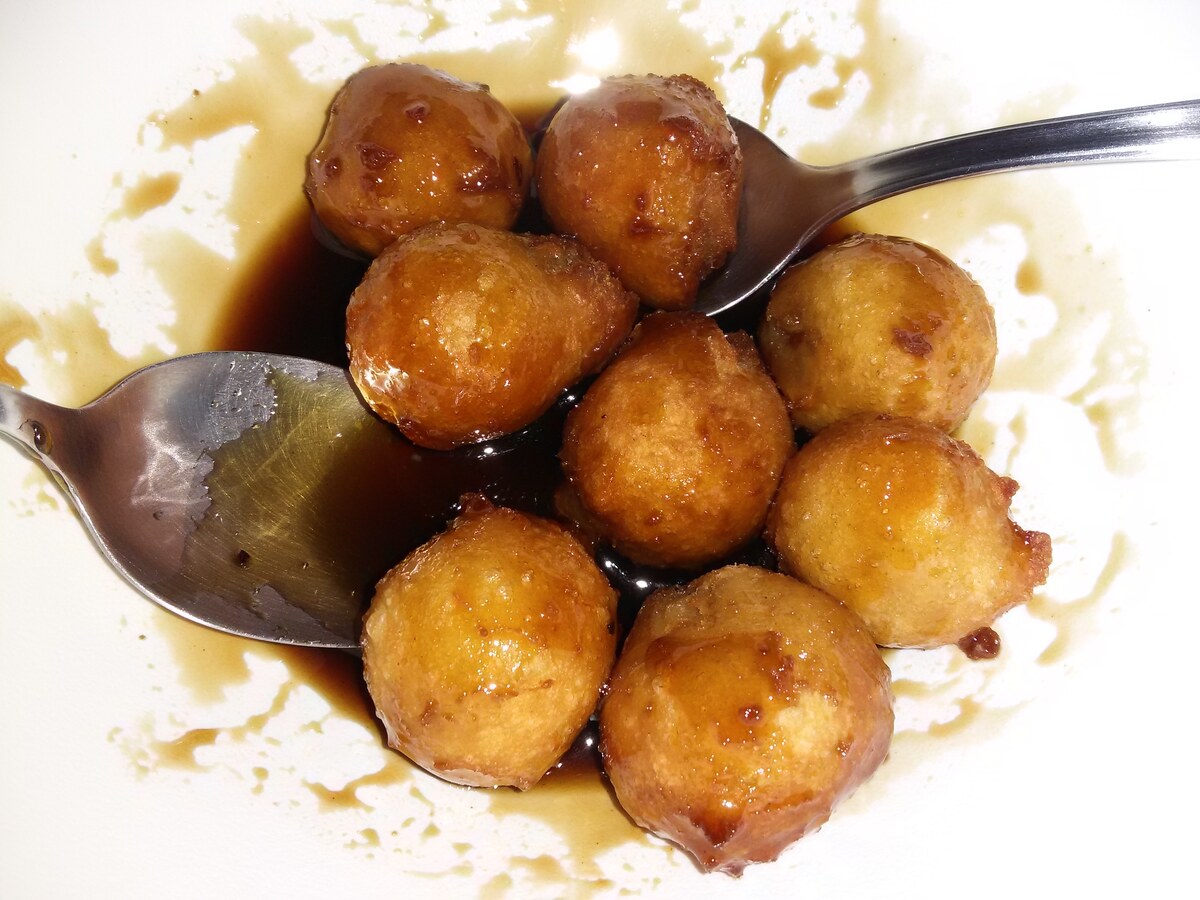
Photo: Rhalah, filhós au mel de engenho, Wikimedia Commons, CC0. A fried cousin of the bilharaco, as no photo of the sweet itself was available.
Read next
Tremoços: the poor man's seafood that goes with beer
On the table of a tasca, before the beer even arrives, there is often a small bowl of yellow seeds. Raw, tremoços are…

Tomar's Trays Festival: bread carried on the head
Every four years in Tomar, in central Portugal, young women in white dresses walk through the streets with a tray…
Fogaça: the sweet bread that young girls carry on their heads
You don't cut it like a cake: you carry it. Every 20 January in Santa Maria da Feira, young girls walk the streets with…
Barriga de freira: the nun's belly sweet from Portugal
A dessert with a name that makes you smile: barriga de freira, a nun's belly. Egg yolks, sugar, bread and cinnamon, a…
Queijinhos do Céu: the heavenly cheese made with neither milk nor cheese
A small white disc wrapped in paper cut like lace, and yet not a crumb of cheese. The queijinhos do céu come from the…
Pão de ló from Alfeizerão: the cake of the Lisbon–Porto road
On the Lisbon–Porto road, drivers used to stop at Alfeizerão for a pão de ló sold ready-wrapped. With no one at the…
Bolinhos de chuva: the fritter made for rainy days
All it takes is a grey sky over Brussels to get the kitchen going. Runny batter, a spoon, hot oil, and golden fritters…
Azulejos in Portuguese pastelarias: the painted tiles that keep Lisbon's cafés
In many pastelarias in Lisbon, your eyes end up looking up at the walls. The painted tiles that cover them have a…
Find our artisan pastries in our Brussels stores or order online.
Order now Our foodtruck for your events Our stores