
Bolo-rei: the Kings' cake where whoever finds the bean pays
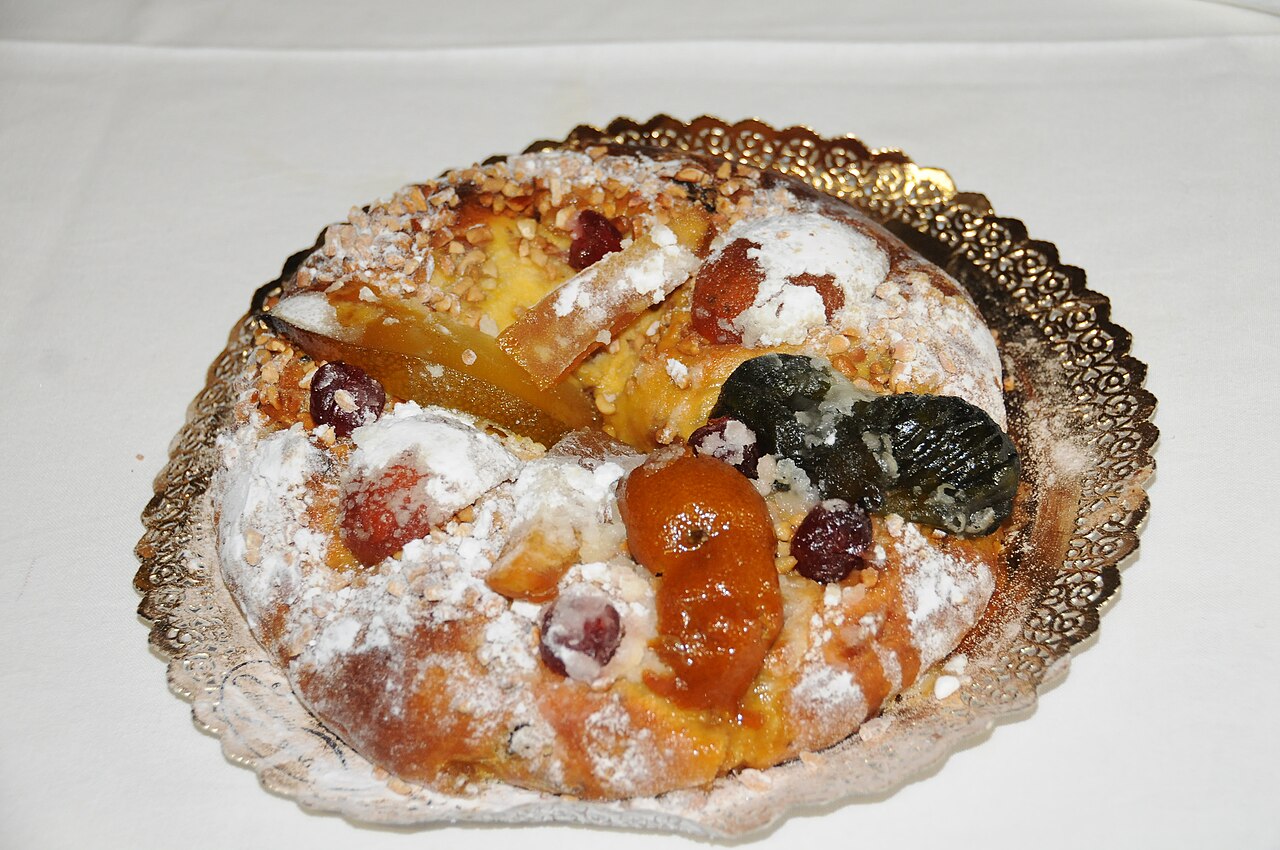
It is shaped like a crown, the crumb is golden, and the top disappears under candied fruit, chopped nuts and icing sugar. But the most important part cannot be seen: when you cut a slice of bolo-rei, you never know what you will find. A dried bean, which commits whoever finds it for a year. Or, if the house has kept the custom, a small gift that promises luck.
A recipe that comes from France
The bolo-rei belongs to Lisbon, and more precisely to the Confeitaria Nacional, opened in 1829 on the Praça da Figueira. On its website the house says that Balthazar Castanheiro Júnior, the founder's son, brought the recipe back from France. It adds that the recipe has not changed since and that only two people know it: the current owner and the house's oldest pastry chef.
The year of its arrival varies by source. The house's website gives 1875; other texts say 1869 or 1870. We do not settle it, and we add no detail that these sources do not give. What does not vary is the kinship: the bolo-rei descends from the French galette des Rois, adapted in Lisbon in the nineteenth century. We have already told the story of the Confeitaria Nacional and its nearly two centuries behind the counter.
A crown for the Three Kings
According to the tradition reported by the public broadcaster RTP, the cake represents the gifts of the Three Kings. That is why it is eaten around the Portuguese Christmas, then until Kings' Day, on 6 January. The dough is soft, almost a brioche; the decoration looks like what the photo in this article shows: candied fruit of different colours, chopped nuts, a snow of sugar.
The bean pays, the charm brings luck
Traditionally the cake hides two surprises in the dough. The first is a dried bean: whoever finds it must pay for next year's bolo-rei. The game is simple and the debt is a happy one, since it guarantees that the cake will come back to the same table. The second is the brinde, a small gift that children love and that, they say, brings luck to whoever receives it.
At the table nobody bites carelessly. People cut slowly, eye their slice sideways, watch their neighbour: the cake being shared becomes a small game, and the bean is the only one that knows who will pay next year. The bolo-rei is rarely shared in silence.
A charm under supervision
The brinde became rare because of a 2011 law on mixing small objects directly into food products. Contrary to what many believed, it does not forbid selling a bolo-rei with a brinde. Pedro Portugal Gaspar, inspector-general of ASAE, the Portuguese food safety authority, made this clear: the sale remains possible, under stricter rules on both substance and labelling.
In practice the small object must stand out from the dough by colour, size or presentation, and be designed to avoid choking, poisoning, perforation or digestive obstruction. Many pastry cooks preferred to give up the brinde. The bean still circulates, and the tradition of paying with it.
In Brussels, at Wooly
The Kings' cake "Bolo Rei" in our catalogue can be ordered online, with candied fruit and nuts, as tradition wants. Yesterday we told you about the rabanadas of the same Christmas table. In Brussels, our shops in Etterbeek, Stockel, Uccle and Waterloo serve the pastel de nata, and all four addresses are gathered on a single page.
Our pastéis de nata, in seven flavours, can also be ordered online, with home delivery in Brussels and to neighbouring countries. For a birthday or a family celebration, we make birthday cakes to order in Brussels.
Sources: Confeitaria Nacional, “A nossa História”; RTP, “Brinde no bolo-rei é tradição, não proibição”; Wikipédia (pt), “Bolo-rei”.
Photo: José Conçalves, Wikimedia Commons, licence CC BY-SA 3.0.
Read next
Rabanadas: the slice of bread Portugal served to new mothers
Day-old bread, milk, an egg, a pan. In Portugal the Christmas rabanada is also called fatia de parida: the slice for…
Filhós and sonhos: two fried balls, two doughs, one Portuguese Christmas
A golden ball dusted with cinnamon, picked up with your fingertips from the Christmas table. In Portugal it is a filhó…
Pudim Molotof: the egg-white dessert named after a fortress
A cloud in a mould, caramel running down the sides, almost nothing under the spoon. Pudim Molotof has two stories: the…
Aletria: the dough threads the Moors left on the Christmas table
First you look: cinnamon draws diamonds across a tender yellow. Aletria is made of dough threads that came from…
Broa de Avintes: the bread women rowed across the Douro to sell
It comes out of the oven dark, damp and almost crustless. Broa de Avintes, made of white corn and rye, once crossed the…
Água-pé: the water poured on the grape skins, served on St Martin's Day
It is poured into a plain glass, a hot chestnut in the other hand. Água-pé is the water poured on the grape skins after…
Pão por Deus: the Portuguese children who knock on doors on 1 November
A small cloth bag and a phrase called out at every door: on 1 November, Portuguese children ask for “Pão por Deus”.…

Medronho: the rough little fruit of the Algarve that ripens as autumn begins
At the end of September, in the hills of the Algarve, a small rough fruit turns from yellow to orange, then red. The…
Find our artisan pastries in our Brussels stores or order online.
Order now Our foodtruck for your events Our stores