
Pudim Molotof: the egg-white dessert named after a fortress
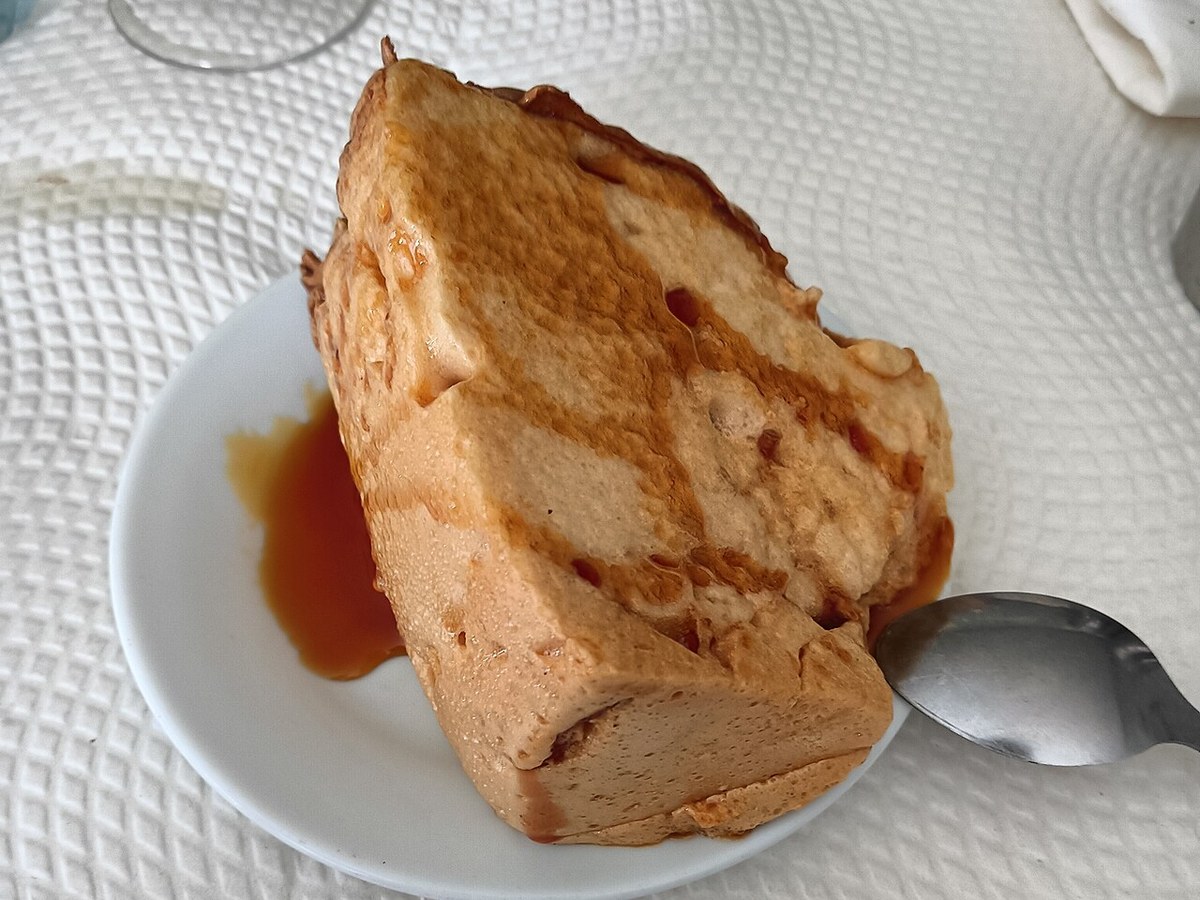
A cloud set in a mould, amber caramel running down its sides, and almost nothing under the spoon: sweetened air. Pudim Molotof looks like a dessert with no past. It has two: the story of eggs that nobody wastes, and the story of a name that changed sides along the way.
The dessert of the egg whites
Portuguese pastry runs on egg yolks. They make the cream of the pastel de nata, the heart of the papos de anjo, the strands of the fios de ovos. But an egg has two halves, and every yolk used leaves a white in the bowl. Molotof is the kitchen's answer to that leftover: it contains only whites.
That is the explanation given by Portuguese sources, among them the language advice service Ciberdúvidas: a dessert designed to use the whites left behind by sweets made with yolks. It has long been said, too, that convents used whites to clarify wine and starch linen, which would explain the abundance of yolks in their recipes. Molotof would then be the missing half of that story. We found no birth date and no house to credit it to, and we would rather say so than invent one.
Whipped whites, sugar, caramel, bain-marie
The principle takes four gestures. The whites are whipped stiff with sugar. The caramel goes into the mixture, lines the mould or coats the dessert, depending on the house. Everything bakes in the oven in a bain-marie (banho-maria), so the heat stays gentle. Then it is turned out, covered in caramel and served.
Very few ingredients, then, and no way to hide: whites badly whipped or an oven too hot, and the dessert collapses. When it is cut, the texture surprises. Not a crisp meringue, not a custard: something in between, firm but full of tiny air pockets, as in the photo for this article, where the caramel runs onto the plate.
Malakof, a fortress in Crimea
The original name is not Molotof. According to those same sources, the dessert was called pudim Malakof. Malakof is the name of a fortress that protected Sevastopol in Crimea during the Crimean War of the mid-nineteenth century. The French general Pélissier took it and received the title Duke of Malakoff.
How a siege name ended up in a Portuguese kitchen, we do not know. The documents that would say are not ones we could read. What remains is the fact: a dessert of egg whites once carried the name of a bastion.
From Malakof to Molotof
The slip comes from the Second World War. Vyacheslav Skryabin, the Soviet foreign minister, was known by the pseudonym Molotov, taken from the Russian word for "hammer". The two names sound alike, and according to the sources the Portuguese confused them: Malakof became Molotof.
The nuance matters. Ciberdúvidas writes "probably through confusion": it is a hypothesis, not a dated fact. Nobody can say when the word tipped over. But that name stuck, and pudim Molotof is now what you read on dessert menus from one end of Portugal to the other.
In Brussels, at Wooly
Molotof is not in our display cases. But the balance it tells of, yolks on one side and whites on the other, is that of Portuguese pastry as a whole. In Brussels, our shops in Etterbeek (rue des Tongres), Stockel, Uccle and Waterloo live on the pastel de nata, whose traditional cream is made with egg yolks. Find our four addresses on the Portuguese pastry in Brussels page.
Photo : Super nabla, Wikimedia Commons, licence CC BY-SA 4.0.
Sources: Ciberdúvidas da Língua Portuguesa (ISCTE-IUL), “A origem do nome «pudim Molotov»”; Wikipedia (en), “Pudim Molotov”.
Read next
Aletria: the dough threads the Moors left on the Christmas table
First you look: cinnamon draws diamonds across a tender yellow. Aletria is made of dough threads that came from…
Broa de Avintes: the bread women rowed across the Douro to sell
It comes out of the oven dark, damp and almost crustless. Broa de Avintes, made of white corn and rye, once crossed the…
Água-pé: the water poured on the grape skins, served on St Martin's Day
It is poured into a plain glass, a hot chestnut in the other hand. Água-pé is the water poured on the grape skins after…
Pão por Deus: the Portuguese children who knock on doors on 1 November
A small cloth bag and a phrase called out at every door: on 1 November, Portuguese children ask for « Pão por Deus ».…
Medronho: the rough little fruit of the Algarve that ripens as autumn begins
At the end of September, in the hills of the Algarve, a small rough fruit turns from yellow to orange, then red. The…
Bolo do caco: the Madeiran bread named after its stone
Cooked on a slab of volcanic basalt, kneaded with sweet potato for want of wheat, spread with garlic butter: Madeira's…
Castanhas assadas: the white smoke that brings autumn to Lisbon
A column of white smoke on a street corner, a smell of embers and salt, a cry: "Quentes e boas!". In Lisbon, autumn…

Arrufada de Coimbra: the sweet bread carried to engagements
Sold from baskets under a white cloth at Coimbra station, left to rise for twenty-four hours under a blanket, the…
Find our artisan pastries in our Brussels stores or order online.
Order now Our foodtruck for your events Our stores