
Aletria: the dough threads the Moors left on the Christmas table
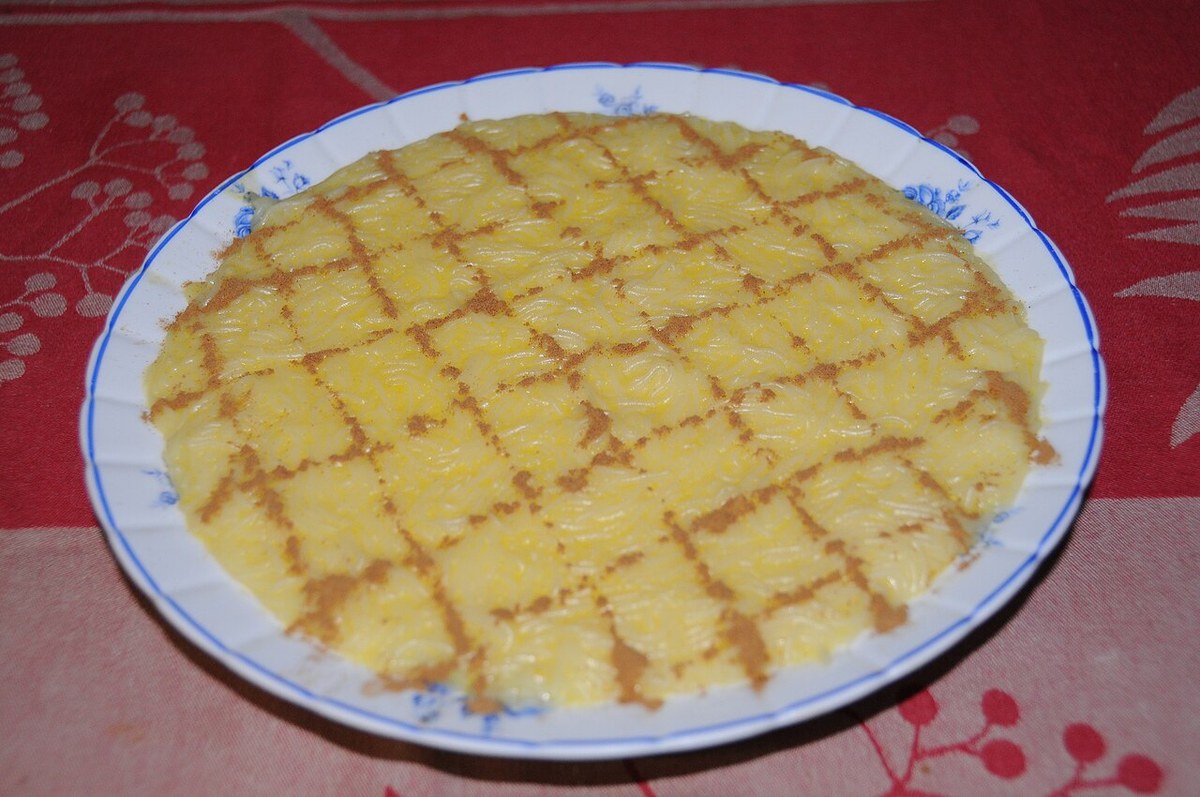
Before the first spoonful, there is the drawing. Across the plate, ground cinnamon traces diamonds, sometimes other patterns, never the same twice: every household has its own hand. Underneath lies a tender yellow, and threads of dough so fine you can barely tell them apart. This is aletria, a Portuguese Christmas dessert that sits on the table next to arroz doce and rabanadas.
An Arabic word for threads of dough
The name comes from the Arabic iṭriyah, which means thin noodles. In Portuguese, aletria simply means vermicelli. The dessert is a legacy of al-Andalus: threaded pasta reached the Iberian Peninsula with the Moors, and the kitchen kept it long after they left, all the way into a sweet dish.
That makes aletria unusual among Portuguese doces. Many tell a story about a convent, a king, a basalt stone or a legend. This one tells the story of a language: an Arabic word that survived intact in a kitchen that speaks Portuguese.
A trace in a fourteenth-century Catalan book
The written source most often cited is not Portuguese but Catalan: the Llibre de Sent Soví, an anonymous recipe collection from the fourteenth century. It mentions "alatria" in two recipes of Arabic origin, one of which cooks the threads in almond milk with honey.
No cow's milk, no cinnamon, no egg yolks, then: we are still far from the Portuguese dish. But the gesture is familiar, threads of dough in a sweet liquid, cooked with patience. Some sources give much older dates for the first recipe; we could not verify them, and we stick to what can be read in this manuscript.
Milk, yolks, lemon, cinnamon: the Portuguese version
In Portugal, sweet aletria is made with milk, sugar, butter, egg yolks, lemon peel and cinnamon. The threads are cooked first in milk flavoured with lemon and cinnamon; the yolks come next and give colour and silkiness. Once the yolks are in the pan, cooking stays brief and it must never boil: that is the whole difficulty of a dessert that looks simple.
Egg yolks run through much of Portuguese pastry, from the doces conventuais to everyday custards. Here they bridge two worlds: the pasta that came from elsewhere and the Portuguese home that adopted it.
Firm in the Beiras, creamy in the Minho
There is no single aletria. In the Beiras it is made compact, firm enough to be cut into slices like a cake. In the Minho it stays creamy, closer to a pudding. Same name, same lemon and cinnamon fragrance, two textures.
The last gesture belongs to the cinnamon. Traditionally the powder is laid down in patterns drawn by hand: a lattice of diamonds, as in the photo for this article, or a design particular to the household. You eat first with your eyes, before the spoon wipes it all away.
A Christmas dessert for a long time
Aletria belongs among Portugal's Christmas desserts, alongside arroz doce and rabanadas; according to some sources it took that place as early as the fifteenth century. It is made more often at home than in restaurants, which may explain why it travels little: it is a family-kitchen dish, found above all in grandmothers' stories and at festive tables.
At the other end of the range of sweet threads are fios de ovos, egg threads cooked in syrup that travelled the world. Two very different ways of working a thread, in the same kitchen, with the same cinnamon on the table. As for the cinnamon itself, its journey is told in our article on Ceylon cinnamon.
In Brussels, at Wooly
Aletria is not our speciality. In Brussels, our shops in Etterbeek (Rue des Tongres), Stockel, Uccle and Waterloo are the home of the pastel de nata. But it is the same blend of milk, egg yolks and cinnamon that makes the taste of Portugal, from a Christmas plate to a neighbourhood counter. Find our four addresses on the page Portuguese pastry in Brussels.
Photo: Joseolgon, Wikimedia Commons, licence CC BY-SA 3.0.
Sources: Wikipédia (pt), “Aletria”; Wikipedia (en), “Aletria”; Direção-Geral de Agricultura e Desenvolvimento Rural, “Aletria (Região Centro)”.
Read next
Broa de Avintes: the bread women rowed across the Douro to sell
It comes out of the oven dark, damp and almost crustless. Broa de Avintes, made of white corn and rye, once crossed the…
Água-pé: the water poured on the grape skins, served on St Martin's Day
It is poured into a plain glass, a hot chestnut in the other hand. Água-pé is the water poured on the grape skins after…
Pão por Deus: the Portuguese children who knock on doors on 1 November
A small cloth bag and a phrase called out at every door: on 1 November, Portuguese children ask for « Pão por Deus ».…
Medronho: the rough little fruit of the Algarve that ripens as autumn begins
At the end of September, in the hills of the Algarve, a small rough fruit turns from yellow to orange, then red. The…
Bolo do caco: the Madeiran bread named after its stone
Cooked on a slab of volcanic basalt, kneaded with sweet potato for want of wheat, spread with garlic butter: Madeira's…
Castanhas assadas: the white smoke that brings autumn to Lisbon
A column of white smoke on a street corner, a smell of embers and salt, a cry: "Quentes e boas!". In Lisbon, autumn…
Arrufada de Coimbra: the sweet bread carried to engagements
Sold from baskets under a white cloth at Coimbra station, left to rise for twenty-four hours under a blanket, the…

Bolo lêvedo: the Furnas bread whose age nobody knows
It cooks on a floured griddle, never in an oven, in a volcanic valley of the Azores. Lenten flatbread, 19th-century…
Find our artisan pastries in our Brussels stores or order online.
Order now Our foodtruck for your events Our stores