
Marmelada: the Portuguese quince that gave marmalade its name
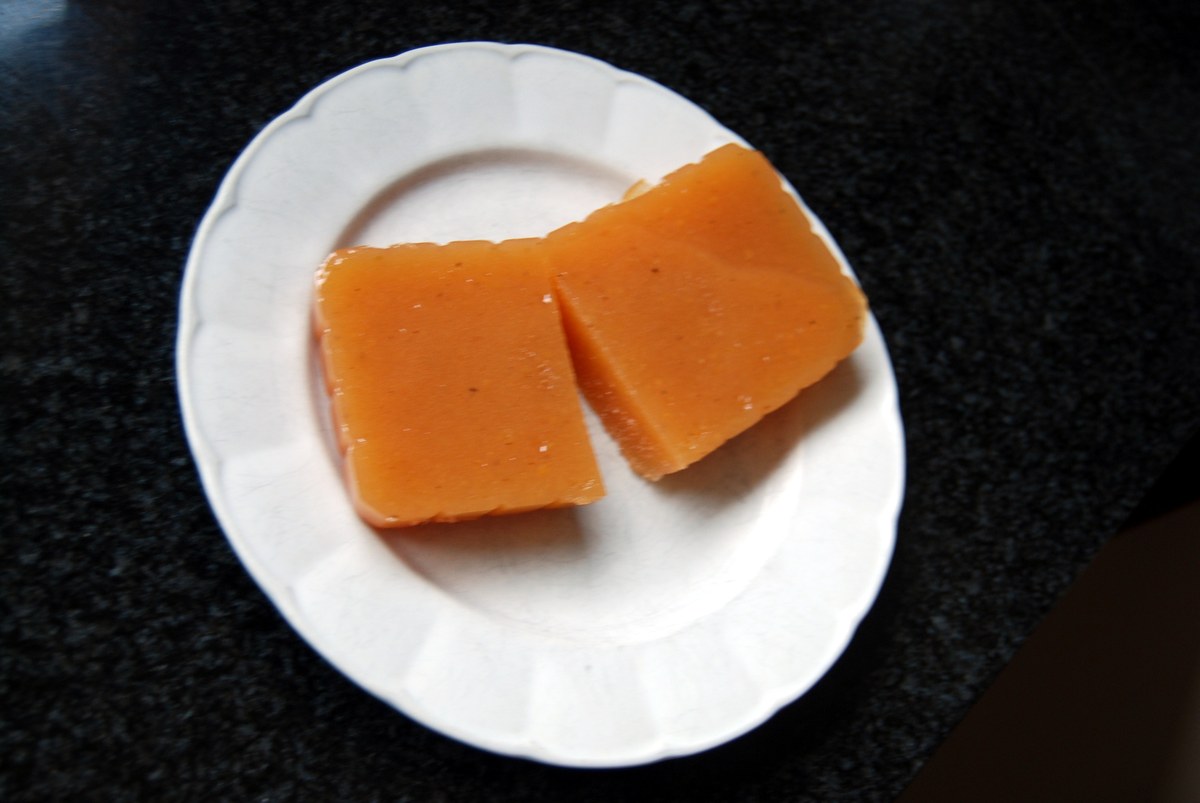
Sitting on a worktop, a quince looks like nothing you would want to eat. It is hard as wood, covered in a grey down you have to rub off, and anyone who bites into it raw gets a dry mouth in about a second. But leave three of them in a closed kitchen: a day later the whole room smells of apple, of pear, and of something floral that neither of them has.
That is the fruit Portuguese calls marmelo. And it is where the word marmelada comes from — the thick, dark quince paste you cut with a knife and eat in slices, never with a spoon. The word then left Portugal, crossed the sea, and changed fruit along the way.
A fruit that refuses to be eaten raw
Quince is an autumn fruit. It is picked when the other trees are already bare, in September and October, and it reaches kitchens at exactly the moment ovens start going again. Raw, its flesh is harsh, firm, almost hostile. It needs fire and time.
Cooking turns it completely around: the pale flesh softens, takes on colour, moves from amber to brick red if you let it go long enough. And above all, it sets. Quince is naturally loaded with pectin — it needs nothing but sugar and patience to become a paste firm enough to stand upright on a board.
That property made the fruit's fortune long before refrigeration. A well-made marmelada keeps for months. It travelled.
The word that left without the fruit
The name goes a long way back. Marmelo comes from Latin melimelum, itself borrowed from Greek melimelon: literally « the honey apple ». From marmelo, Portuguese built marmelada, the way it builds laranjada from laranja.
At the end of the Middle Ages, that Portuguese quince paste sailed north in wooden boxes. It arrived in England, where it was served at the end of a meal, cut into squares, as a luxury sweetmeat. The oldest known trace of the word in English is a letter from May 1480, written from Exeter by a merchant acknowledging receipt of oranges and marmelate. The word entered the language with the goods.
Then it drifted. In England, citrus eventually took the quince's place, and marmalade now means a runny bitter-orange preserve you spread at breakfast. French made the same shift. The word stayed, the fruit vanished — except in Portugal, where marmelada still means exactly what it always meant: quince, sugar, and nothing else.
Odivelas, the marmelada that refuses to brown
Ten kilometres or so north of Lisbon, Odivelas makes a marmelada that is not the colour of any other. Where quince paste usually turns amber or deep red, the marmelada branca de Odivelas stays almost white. That is not a presentation trick: it is the result of a way of working.
Quince browns in the air the moment you open it. To keep the paste pale you have to move fast after peeling, and work the flesh with lemon juice. The official product specification allows only four things: quince flesh, white sugar, water and lemon juice. No colouring, no setting agent, no flavouring. At least 350 grams of quince per thousand grams of finished product.
Once moulded, the marmelada is not finished. It rests at least a day to stabilise, then air-dries in a dry room for a minimum of seven days. That drying gives it its hold: a paste that cuts clean, without sticking to the blade.
The know-how comes from the monastery. King D. Dinis laid the first stone of the Odivelas monastery on 27 February 1295; the building went to the Bernardine nuns of the Cistercian order, and the king was buried there. As in every Portuguese convent, sugar and egg yolk were worked there, and a marmelada was devised that the town still makes.
In September 2022, the European Union entered marmelada branca de Odivelas in the register of Protected Geographical Indications. It may now carry that name only if it is made in the municipality of Odivelas, to that specification. A convent quince paste, protected like a cheese or a wine.
How the Portuguese eat it
Not at breakfast, or rarely. Marmelada is cut into thick slices and eaten as a dessert in its own right, usually at the end of a meal:
- with a dry sheep's or goat's cheese — sweet and salt play against each other;
- on a slice of bread, no butter, simply laid on top;
- on its own, on a small plate, with a short coffee after lunch;
- as a filling, inside a cake or a turnover.
It is an autumn and winter dessert, for long meals and Sundays. It belongs to the same family as all those fruit preserves Portuguese pastry has been making for centuries to cross the empty season: doce de gila, drawn from a squash smashed on the ground, or the morgado of the Algarve, sculpted from fig and almond.
At Wooly, in Brussels
We do not make marmelada — it is a seasonal, local product that belongs to Odivelas. But the same old gesture runs behind our entire counter: sugar, eggs, a fruit, and cooking time. When you push open the door of our shops in Etterbeek, Stockel, Uccle or Waterloo, the pastéis de nata coming out of the oven descend from that same convent tradition, where egg yolks were counted and waiting was part of the craft. Our four shops in Brussels and Walloon Brabant welcome you all week.
And if you come across quinces on a Brussels market stall this autumn, take three. If only for the smell in the kitchen.
Photo: Friviere, Wikimedia Commons, CC BY-SA 3.0 licence.
Read next
Desfolhada: the night when a red corn ear was worth a kiss
In late September, northern Portugal husked its corn after dark. Village work, sung and washed down with wine, and one…
The suitcase home: what Portuguese families bring back in August
In late August the same scene plays out in kitchens all over Brussels: a suitcase open on the tiles, a bathroom scale…
Doce fino: the Algarve's fruit, sculpted entirely from almonds
A banana, an ear of corn, two white rabbits and a carrot complete with its leafy top, all laid out on a paper doily.…
The ponto de açúcar: the fingertip test that decides everything
Thread, pearl, blown, sand: Portuguese has nine words for the moment a sugar syrup is ready, and not a single number.…
Bolo de bolacha: the Portuguese cake that never sees an oven
It never goes into the oven. Three things are enough — Maria biscuits, strong coffee, buttercream — plus one night in…
Confeitaria Nacional: the Lisbon pastry shop open since 1829
At dusk, on the corner of Praça da Figueira, the red sign lights up before the street lamps do. Below it, a row of…
Dom Rodrigo: the Algarve sweet you unwrap like a candy
A rustle first. You pull at two corners of metallic paper, the golden ball appears, sticky, dusted with cinnamon. Dom…
Uvada: the harvest sweet they boiled at night, without sugar
There is no sugar in uvada. Not a gram. This Portuguese harvest sweet draws all of its sweetness from the grape itself,…
Find our artisan pastries in our Brussels stores or order online.
Order now Our foodtruck for your events Our stores