Palha de Abrantes: the golden straw the Tagus carried to Lisbon
Palha de Abrantes: the golden straw the Tagus carried to Lisbon
The Wooly Pâtisserie team
On the Tagus, at Abrantes, a sweet took its name from the straw barges carried to Lisbon. Golden egg threads, an almond heart and egg yolks: a recipe said to have been born behind convent walls.
To understand why a small sweet carries the name of straw, follow the Tagus up to Abrantes, east of Lisbon. For centuries, sailing barges called varinos carried olive oil, cork and bales of straw down the river to the capital, for the horses that pulled carts and filled the city's stables.
The town lived from that trade. It is said that in the sixteenth century there were still around 180 varinos at Abrantes. The street names keep the memory: a Praça da Palha de Cima and a Praça da Palha de Baixo marked the markets where straw was sold. Hence the saying Portuguese still quote: « se queres palha, vai a Abrantes », if you want straw, go to Abrantes.
The sweet itself does not come from the river but from the convents. The most widespread version credits the convent of Nossa Senhora da Graça, run by Dominican nuns. At the time egg yolks were plentiful: the whites were used to starch and gloss the linen and the vestments of the clergy. The convent kitchens had sugar and almonds. From that surplus came a sweet that needed nothing but time and patience.
The stories about how the recipe left the convent have the flavour of kitchen legends. It is said that the washerwomen of Rio de Moinhos, who washed the nuns' linen, earned their trust and sometimes went home with secrets. Another, more dramatic tale places the origin at the convent of São Domingos: a flame too fierce under the syrup, a few drops of yolk falling into the pan, and the threads forming on their own. Historians of convent sweets remind us that these are oral traditions, with no certain date.
What goes into the sweet
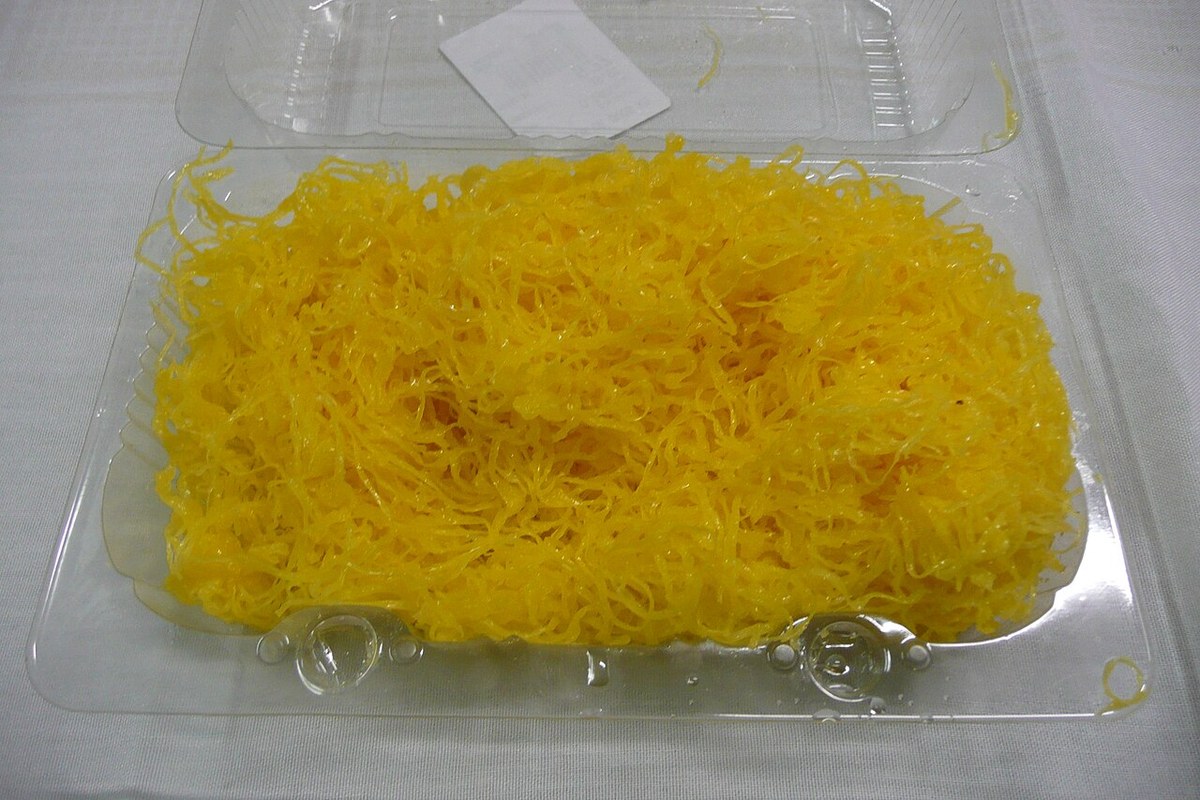
The recipe fits in a few lines. A syrup of sugar and water is made, and beaten egg yolks, pushed through a sieve, are poured into it and set into fine threads: the fios de ovos. The threads are then laid on a base of yolk and ground almond, sometimes flavoured with lemon or cinnamon, set on a leaf of obreia, the thin wafer that carries the sweet without going soft.
Once assembled, the palha goes into a hot oven so that the threads take on a light colour. That moment of heat gives it the colour of toasted straw and its name. The shape is small, about four centimetres across, almost a hedgehog. Its Portuguese name in the old days was ouriço, meaning hedgehog.
The sweet is eaten in one mouthful and sold by the dozen, packed in cardboard boxes. There is sugar in it, but the flavour centres on the yolk, the almond and the faint caramel of the threads. At Abrantes it is served as a dessert, with a coffee, at any hour of the day.
From convent secret to shop window
For a long time the palha remained a secret of convent cooking. It began to be sold to the public in a shop only at the start of the twentieth century: the house Casa Vigia, on today's Largo João de Deus, is cited as the first to offer it, in 1906. Today the confectioners of Abrantes have made it almost a symbol of the town. Anyone who passes through is invited to taste the regional doces, and this is the one that always comes back first.
Each house keeps its own way: the amount of almond and the aroma change with the hands that make it. The gesture itself stays the same: threads fine enough not to dry out, and an oven hot enough to brown them without burning.
And in Brussels?
Portugal has been part of Brussels for a long time. Portuguese families brought their recipes, their celebrations and their tables, and the pastry followed those families across the city, from Flagey to Stockel.
If you pass our shops in Etterbeek, Stockel, Uccle or Waterloo, ask what came out of the oven that day. Portuguese pastry changes with the seasons and the feasts. For the great classic that accompanies almost every table, you will find our pastel de nata in all our shops.
Find the Wooly shop nearest to you and take a moment over a coffee, as people do in Abrantes.
Sources: DGADR, “Produtos Tradicionais Portugueses — Palha de Abrantes” ; Médio Tejo, “Palha de Abrantes, doce maravilha de origem conventual”, by José Martinho Gaspar ; Pastéis de Portugal, “Abrantes Straw”.
Photo credit: LipeFontoura, Wikimedia Commons, public domain
We use cookies that the shop needs to work. With your consent, we also use analytics cookies (Google Analytics) and advertising cookies (Google Ads, Meta, LinkedIn). You can change your choice at any time with the "Cookie settings" link at the bottom of every page. Learn more
A question?
Hello! Tell me what you fancy and I'll take care of the rest.
Your messages are kept for 30 days to check the quality of the answers, then deleted.