
Torta de Azeitão: the golden roll that came from the Alentejo
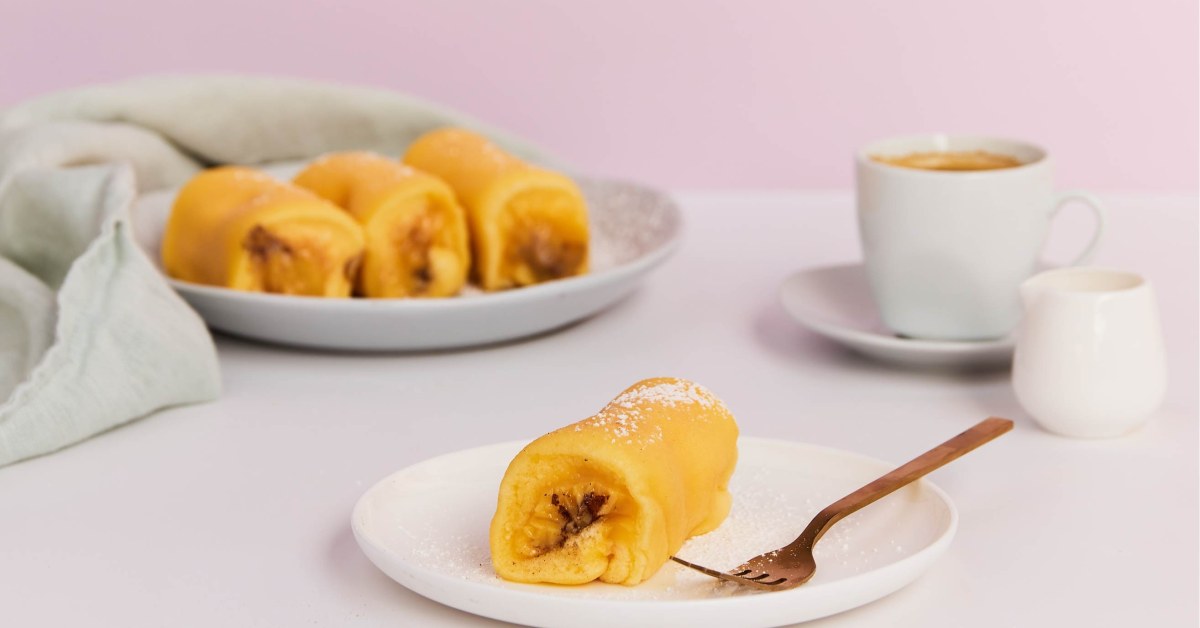
In short: Torta de Azeitão is a Portuguese rolled cake: a very thin sponge sheet and an egg cream, rolled while warm. The recipe came from Fronteira, in the Alentejo, in the late 19th century; in 1901 Maria Albina worked on it at the O Cego house in Vila Nogueira de Azeitão. Wooly Pâtisserie sells it at €5.90.
The roll puts up no fight. The fork slides in, the thin sheet of sponge gives way, and the inside appears: an almost orange egg cream, dense and glossy. That is all a torta de Azeitão is, a wafer-thin sheet of sponge and an egg cream, rolled together. Nothing else. Which is exactly why it is difficult: with only two elements, there is nothing to hide behind.
Azeitão is a village on the Setúbal peninsula, some forty kilometres south of Lisbon, tucked against the hills of the Arrábida. Vineyards, olive trees, flocks of sheep. All of Portugal associates two things with the place: a cheese and a cake. The cheese is queijo de Azeitão, made from sheep's milk and protected by a European designation of origin. The cake is this one.
Except it was not born there
Here is the first twist: the torta de Azeitão does not come from Azeitão. Its recipe arrived from Fronteira, a village in the Alentejo more than a hundred kilometres east, on the far side of the Tagus. It is placed there in the late nineteenth century, before it crossed the river and took the name of the village that adopted it.
That lineage is no accident. The Alentejo is the heartland of the doces conventuais, the convent sweets built on a surplus of egg yolks: the whites went to clarifying wine and stiffening religious habits, the yolks remained, and the convents turned them into an entire repertoire. The sericaia of the Alentejo grew from the same soil, on the same logic, few ingredients, a great deal of hand work. The torta is the one that emigrated.
1901, a shop and a man who loses his sight
In Vila Nogueira de Azeitão, in 1901, Manuel Rodrigues and his wife Maria Albina opened a house. He would go blind, and the nickname the villagers gave the place eventually became its sign: O Cego, the blind man. She, a confectioner, worked the recipe that had come from Fronteira. From that counter, the cake set out to conquer the region.
The shape changed along the way too. At the beginning it was not the individual pastry we know: one large torta was baked and sold by the slice. The short roll, the one that fits in a cupped hand and travels wrapped in paper, came later. Several pastelarias in Azeitão make them today, and the original house, passed through different hands since, is still turning.
One sheet of sponge, and no way to fix a mistake
The batter is a very thin sponge: eggs, sugar, a small quantity of flour, maize flour in some versions, and almond. It bakes in a sheet, and it bakes fast. The filling is a doce de ovos: egg yolks worked with sugar syrup and cooked to the point where the cream just holds on a spoon without setting firm. Cinnamon often finds its way in.
Then comes the gesture, and it lasts a few seconds. The sheet is rolled hot, almost straight from the oven, while it is still supple. Cooled sponge will not roll: it splits along its whole length, and a crack cannot be mended. That is why the work runs in tight sequence, each sheet rolled while the next one bakes.
The result aims at a narrow balance. The outer sheet must stay soft, almost damp, never dry, never rubbery. The cream must taste clearly of egg yolk without turning cloying. Made well, a torta de Azeitão goes in three bites and immediately calls for another; made badly, it is merely sweet.
A regional cake, not a festive one
Some Portuguese sweets exist on one date only: farturas at the August village feasts, bolo rei at Christmas. Not the torta de Azeitão. This is everyday baking: what you buy on the way home from a visit, bring back for colleagues, put on the table unannounced with a coffee. It travels well, it keeps for a few days, it asks for neither plate nor ceremony. A pastry made for the road, in short, which probably explains how it crossed the Tagus in the first place.
Tasting it in Brussels
This family of egg-based sweets is exactly what we work with at Wooly. Our tortas de Azeitão follow the principle that has not shifted since Fronteira: a thin sheet of sponge, an egg cream, a hot roll, and the acceptance that a failed sheet gets no second chance.
You will find them in our four shops in Brussels and Waterloo (Stockel, Uccle, Waterloo and Etterbeek, rue des Tongres) sitting beside the pastéis de nata. Take two: the first disappears before you have had time to look at it.
Photo: our tortas de Azeitão, Wooly Pâtisserie.
Sources: Direção-Geral de Agricultura e Desenvolvimento Rural (Produtos Tradicionais Portugueses), “Torta de Azeitão”; Wikipedia, “Torta de Azeitão”.
Read next
Meias-luas of Viana: the pastry you bought without seeing a soul
A coin laid on a wooden tray, a half turn, and the pastry appears without you ever seeing the hand that made it. In…
Doce de gila: the squash you smash on the ground to make a dessert
You do not cut it open, you throw it on the ground. And what comes out of the broken squash looks nothing like a…
Pastel de feijão: the Portuguese pastry that hides beans
You bite into it looking for almond, and you find almond. What you never find is the white bean that makes up half the…
Toucinho do céu: the cake named after an ingredient it no longer contains
Its name means "bacon from heaven". The lard disappeared from the recipe long ago, but the name stayed, and so did the…
Sericaia: the Portuguese dessert that has to crack to be right
In the Alentejo, this dessert is never turned out of its dish, never smoothed over, never rescued. It comes out of the…
Pão de Ló: The Portuguese Cake Pulled From the Oven Too Soon
You push a spoon in and the middle runs. In any other European bakery this cake would be a failure. In Portugal it is…
Bica: What the Portuguese Actually Order at the Counter
Thirty seconds at the counter, one word, a small cup. Portuguese coffee is not a break: it is a punctuation mark in the…
Empada, chamuça, rissol: which is which?
Empada, chamuça, rissol, empanada: four parcels that look alike and have almost nothing in common. How to tell them…
Find our artisan pastries in our Brussels stores or order online.
Order now Our foodtruck for your events Our stores