
Pão de Ló: The Portuguese Cake Pulled From the Oven Too Soon
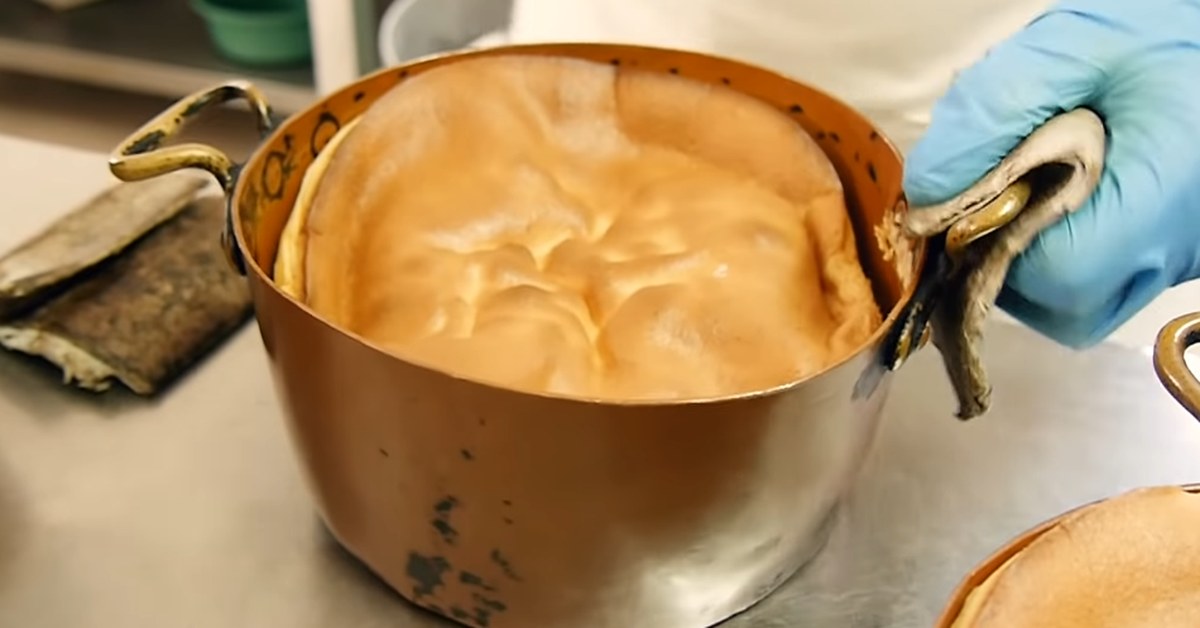
You push a spoon in and your first thought is that something has gone wrong. The top is golden, firm, reassuring. Underneath, it runs: a thick yellow cream, barely set, sliding down the side of the slice, the kind you catch with a finger. In any other European bakery this cake would be a failure and go straight back into the oven. In Portugal it is exactly what you came for.
A cake judged by its centre
On paper, pão de ló is the simplest thing imaginable: eggs, mostly yolks, sugar, flour. No butter, no milk, no baking powder. Everything rests on the beating: the air worked into the eggs is the only thing that will lift the batter. At the Casa do Pão-de-Ló de Alfeizerão the eggs are still cracked one by one and beaten with sugar for close to three quarters of an hour before the batter goes into copper moulds and into the oven.
After that, it comes down to a handful of minutes. Let the cake bake all the way through and you get a light, dry sponge that slices cleanly, perfectly respectable. Pull it out too early, deliberately too early, and the centre stays liquid, somewhere between custard and sabayon. The Portuguese call that unbaked heart the pito. It is not a flaw tolerated out of habit: it is the standard the cake is measured against.
Where does the name "pão de ló" come from?
The word puzzles people in Portugal too. Pão is bread. But ló? The steadiest trail leads back to the French pain de lof, with lof itself borrowed from Dutch nautical vocabulary. A cake named in the ports, then, like so much else in Portugal.
The same cake long went by other names at home: pão de Castela, pão de Hespanha. And it was under the latter that it made the longest journey in the history of pastry. In the sixteenth century Portuguese merchants landed at Nagasaki carrying this recipe of beaten eggs, which survives a sea crossing. The Japanese adopted it, adapted it, and turned it into castella, a cake still sold by the boxful in Japanese railway stations today. Pão de ló may well be the most widely copied Portuguese pastry in the world, with almost nobody remembering where it came from.
Ovar: a sheet of paper folded by hand
In the north, between Porto and Aveiro, the small town of Ovar has made this cake a matter of civic pride. Its trail there runs well back before the eighteenth century: a document from 1781 already mentions pães de ló de Ovar offered to priests during a procession. In the nineteenth century several families in the town lived from it, and Luís de Oliveira Gomes organised its distribution at Christmas and Easter, still the two moments when most of it is sold.
The gesture itself has not changed. The mould is lined with a sheet of paper folded by hand, a more delicate job than it looks: that paper is what gives the cake its irregular pleats, its crumpled collar, the silhouette you recognise from across a shop. Someone stays with the oven throughout, because the window is narrow. Then the cake cools and the paper is trimmed away with scissors all around.
The know-how is protected: the European Commission entered Pão de Ló de Ovar in the register of protected geographical indications under Regulation (EU) 2016/1407 of 12 August 2016. Only cakes made in the town's parishes: Esmoriz, Cortegaça, Maceda, Arada, Ovar, S. João, S. Vicente and Válega, may carry the name.
Alfeizerão: the legend of the king and the hurried cook
Two hundred kilometres south, on the road linking Lisbon to Porto, Alfeizerão tells a different story, and that one starts in a convent.
The recipe is said to have arrived from the monastery of Santa Maria de Cós, a female Cistercian community founded in the twelfth century in the territory of Alcobaça. When the religious orders were dissolved in the nineteenth century, several nuns found refuge a little further south, in Alfeizerão, carrying what Portuguese convents did best: sweets built on egg yolks. It is the same lineage as the ovos moles of Aveiro or the pastel de Tentúgal: doçaria conventual, the pastry born behind monastery walls.
Then comes the legend the whole village tells. King Carlos I, who reigned from 1889 to 1908, stayed regularly at Alfeizerão with his friend Vitorino Froes, and was fond of the house pão de ló. One day the kitchen was caught short: the cake came out ahead of time, its centre still liquid. It was served to the king with a heavy heart. The king found it better that way and declared, so the story goes, that he would never eat any other kind again.
The "failed" recipe passed to the women of the village, then became a business: the Casa do Pão-de-Ló de Alfeizerão opened in 1925, founded by Father João de Matos Vieira and his family, on the main Lisbon–Porto road. The present building dates from the 1940s and has kept its original azulejos. Two versions are still made there: the creamy one, the king's, and a drier one, faithful to the recipe of the Cós monastery. The house, in other words, still serves the accident and the original side by side.
A map of Portugal in two camps
Pão de ló divides the country more than you would expect. In Ovar and Alfeizerão it runs. In Margaride, near Felgueiras, or in Arouca, it is firm, blond, almost crumbly, cut into slices you dip into coffee. Neither is the "real" one: they are two different ideas of the same cake, and each region defends its own with the seriousness other places reserve for football.
One point of agreement, though: it is almost never eaten alone. It calls for a glass of sweet wine, or a small tight cup, the bica the Portuguese order at the counter, whose straight bitterness stands up to all those egg yolks.
Tasting it in Brussels
It is a pastry that travels badly and explains itself badly: nobody in Brussels orders a cake they are promised is underbaked. You have to see it. We carry the pão de ló from Alfeizerão in all four of our shops, on the Rue des Tongres in Etterbeek as well as in Stockel, Uccle and Waterloo. Take a slice, let it open on the plate, and you will understand what the king understood.
One serving tip while we are at it: take it out of the fridge half an hour ahead. The centre relaxes, turns molten again, and the cake goes back to being what it was when it left the copper mould.
For a birthday or a family celebration, we make birthday cakes to order in Brussels.
Sources: Direção-Geral de Agricultura e Desenvolvimento Rural, “Pão-de-Ló de Alfeizerão”; RTP, “Pão-de-ló de Alfeizerão a caminho de ser marca certificada”; Wikipédia (pt), “Kasutera”.
Read next
Bica: What the Portuguese Actually Order at the Counter
Thirty seconds at the counter, one word, a small cup. Portuguese coffee is not a break: it is a punctuation mark in the…
Empada, chamuça, rissol: which is which?
Empada, chamuça, rissol, empanada: four parcels that look alike and have almost nothing in common. How to tell them…
Salame de chocolate: the Portuguese chocolate salami
It looks like a salami, is sliced like a salami, and contains not a gram of meat. What it is, where it comes from, and…
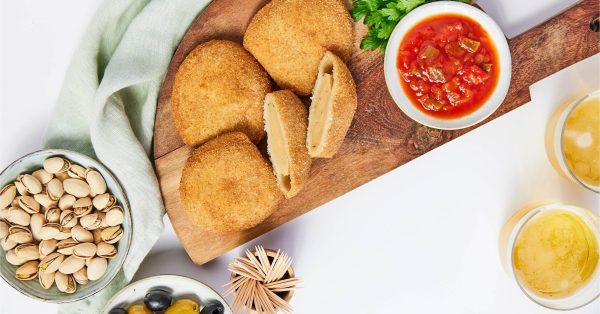
Rissóis: the Portuguese fried turnover, and its recipe
Rissol, rissóis, rissoles: the most misspelled breaded snack in Portugal. What it actually is, the two classic…
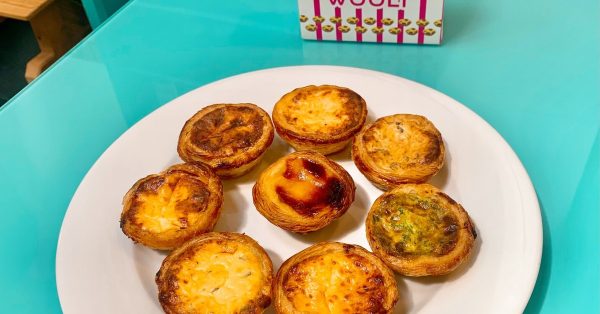
Pastéis de Nata Recipe: The Traditional One, Step by Step
This is not our house recipe but the traditional Portuguese one: the proportions that work, the steps that matter, and…
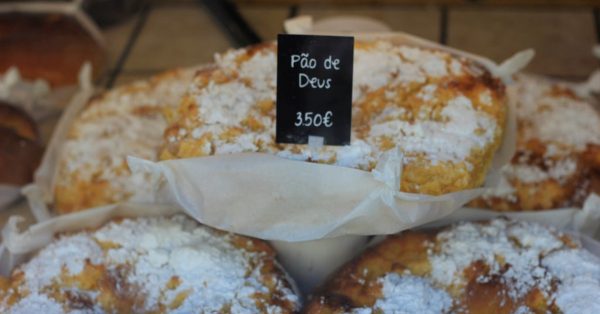
Pão de Deus: The Bun That Smells Like Every Portuguese Morning
Warm crumb, almost stretchy when you tear it open, topped with a soft, lightly golden layer of coconut: that's often…
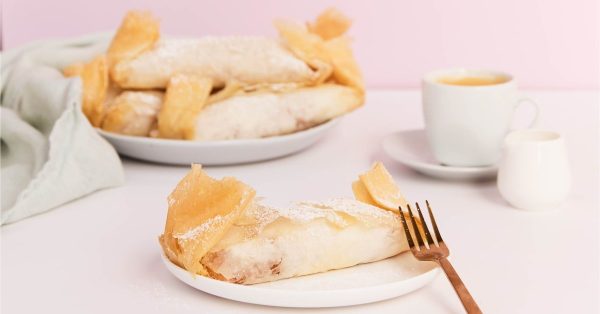
The Pastel de Tentúgal, Portugal's Most Delicate Pastry
It cracks before you've even touched it: paper-thin pastry, warm egg cream spilling out. Meet the pastel de Tentúgal,…
Morgado: the Algarve's Hand-Sculpted Fig and Almond Secret
A hand presses a small ball of almond paste, folds it closed around a dark, fragrant filling. That's how a morgado is…
Find our artisan pastries in our Brussels stores or order online.
Order now Our foodtruck for your events Our stores