
Pastel de feijão: the Portuguese pastry that hides beans
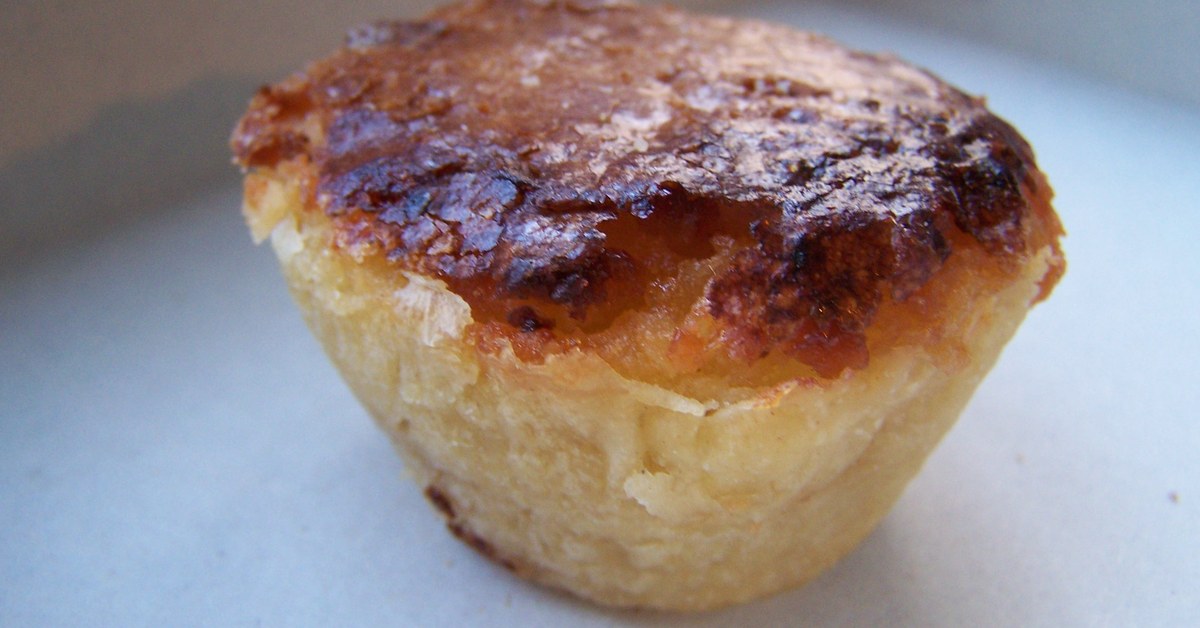
It is small, barely wider than a two-euro coin, with a thin crust that splits across the top like dry ground. Underneath sits a pale yellow paste, dense and faintly sticky, smelling of toasted almond and egg yolk. You could eat ten of them and never guess what is inside. And what is inside is white bean.
The pastel de feijão, literally "bean pastry", is the sweet of Torres Vedras, a town some fifty kilometres north of Lisbon. It belongs to that family of Portuguese cakes that ask a question before they give you pleasure: why on earth put a legume in a dessert?
One town, one cake, and a written trace since 1840
The first documented proof that it was being made dates to 1840. By 1894, the local press already calls it the town's speciality, not as a curiosity, but as a matter of course. Two years later, in 1896, it appears among the thirty-eight "doces característicos de localidades", the characteristic sweets of Portuguese towns, selected for the programme marking the fourth centenary of Vasco da Gama's voyage.
Thirty-eight cakes to represent an entire country: each town was staking its reputation. Torres Vedras walked in with its beans.
What is actually in it
The recipe has two parts, and both of them have a name.
The first is the shell. In Torres Vedras it is called forra, or capa, or else lençol, the bedsheet. Wheat flour, water, butter or vegetable fat, salt. Nothing else. It is rolled so thin that it turns almost translucent: through it, you can make out the filling before you have even bitten.
The second is that filling, known as the espécie. Four ingredients carry the whole thing: white beans, freshly blanched almonds, egg yolks and sugar, bound with water. The bean is cooked, sieved, reduced to a smooth purée, then sweetened until it becomes a kind of jam. At that point it has neither the taste nor the smell of a bean.
Why a bean
Because it holds. It really is that simple. The white bean gives body, density, that full texture which makes a single mouthful enough. The almond and the egg yolk give the flavour and the colour. The first disappears so that the others can exist.
This is no isolated case in Portuguese baking. The country has a long habit of making unexpected ingredients sing in a dessert: squash candied into threads, stale bread, rice. In the convents, where many of these recipes were worked out, people cooked with whatever was at hand and in very large quantities, hence those cakes drenched in egg yolk, from Aveiro to the Algarve. The pastel de feijão itself is not conventual: it was born in a house in Torres Vedras, at a time when cooking and counting were still the same gesture.
Yet it shares a flavour family with the great almond cakes of the convents, or with the morgado of the Algarve: almond, sugar, egg yolk. The Portuguese trio par excellence.
May 2025: Europe puts the name under protection
In May 2025, the European Commission entered the Pastel de Feijão de Torres Vedras into the register of Protected Geographical Indications. In practice: no cake may be sold under that name without following the specification, and without being produced inside the delimited area, which corresponds exactly to the administrative boundaries of the municipality of Torres Vedras.
It is late recognition for a pastry with more than a hundred and eighty years of written history. But above all it is a way of saying: this cake belongs to one precise place, and that place matters.
And in Brussels?
We do not make pastel de feijão at Wooly: it is a cake of Torres Vedras, and it deserves to be sought out there. But its trio of flavours has always been with us. Our ovos de coco, with coconut or almond, rest on exactly the same idea: almond and egg yolk carried by a measured sweetness, in a shape that fits in the hand.
If you want to understand from the inside what this Portuguese pastry made of little and much patience is about, come and see us: our four shops in and around Brussels (Etterbeek on rue des Tongres, Stockel, Uccle and Waterloo) are open seven days a week. We will happily tell you why a cake can be made of beans without ever tasting of them.
Sources: Direção-Geral de Agricultura e Desenvolvimento Rural, “Caderno de especificações – Pastel de feijão de Torres Vedras IGP”; Câmara Municipal de Torres Vedras, “Pastel de Feijão de Torres Vedras”; Wikipédia, “Pastel de feijão”.
Read next
Toucinho do céu: the cake named after an ingredient it no longer contains
Its name means "bacon from heaven". The lard disappeared from the recipe long ago, but the name stayed, and so did the…
Sericaia: the Portuguese dessert that has to crack to be right
In the Alentejo, this dessert is never turned out of its dish, never smoothed over, never rescued. It comes out of the…
Pão de Ló: The Portuguese Cake Pulled From the Oven Too Soon
You push a spoon in and the middle runs. In any other European bakery this cake would be a failure. In Portugal it is…
Bica: What the Portuguese Actually Order at the Counter
Thirty seconds at the counter, one word, a small cup. Portuguese coffee is not a break: it is a punctuation mark in the…
Empada, chamuça, rissol: which is which?
Empada, chamuça, rissol, empanada: four parcels that look alike and have almost nothing in common. How to tell them…
Salame de chocolate: the Portuguese chocolate salami
It looks like a salami, is sliced like a salami, and contains not a gram of meat. What it is, where it comes from, and…
Rissóis: the Portuguese fried turnover, and its recipe
Rissol, rissóis, rissoles: the most misspelled breaded snack in Portugal. What it actually is, the two classic…
Pastéis de Nata Recipe: The Traditional One, Step by Step
This is not our house recipe but the traditional Portuguese one: the proportions that work, the steps that matter, and…
Find our artisan pastries in our Brussels stores or order online.
Order now Our foodtruck for your events Our stores