
Toucinho do céu: the cake named after an ingredient it no longer contains
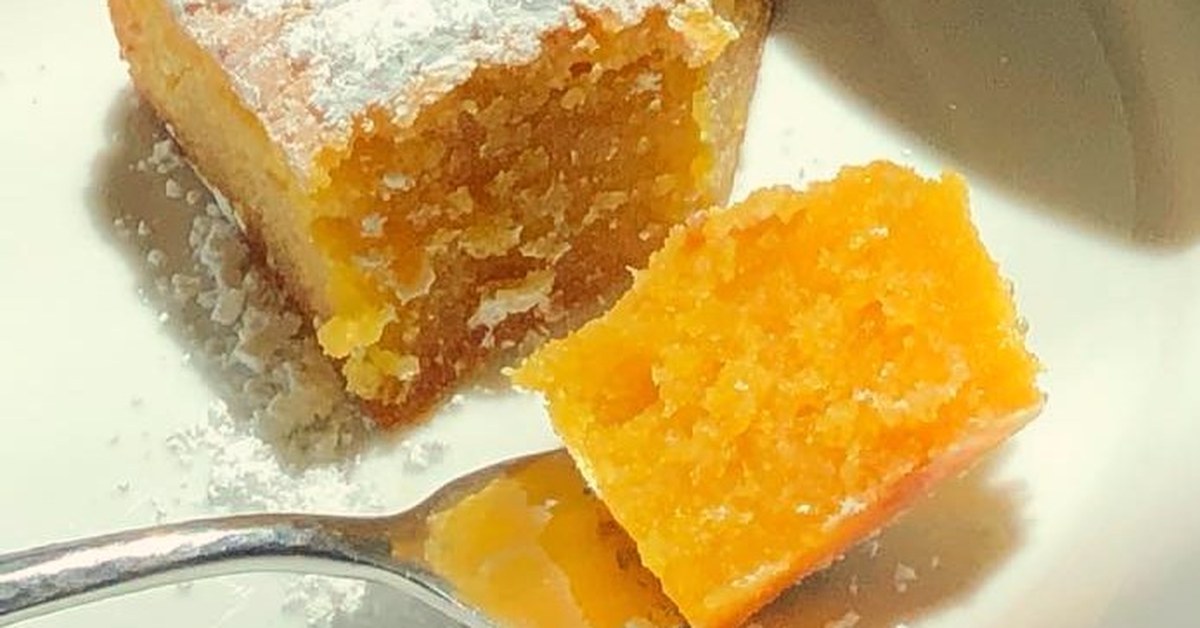
It arrives as a thick wedge, yellow verging on orange, dusted with icing sugar as though someone had tried to make it look demure. The fork sinks in without resistance: underneath, the paste is moist, dense, almost fondant. It doesn't really behave like cake. And yet this dessert carries the name of the most earthbound thing in Portuguese cooking, pork fat.
"Bacon from heaven": a name that no longer fits
Toucinho do céu translates literally as "bacon from heaven". Toucinho is pork fat, the kind you render to cook with. Do céu is heaven's share, the convent's share. Two worlds stitched together in three words.
The explanation you hear most often in Portugal is a simple one: the oldest recipes really did contain lard, worked into the almond paste to enrich it and help it keep. The pork fat has gone, replaced by butter or by nothing at all. The name stayed put. That is a constant in Portuguese baking, recipes drift, words hold.
Why convents were buried in egg yolks
To understand where this cake comes from, look at what a Portuguese convent had too much of between the sixteenth and eighteenth centuries. Egg whites went out by the litre: they were used to starch religious habits and to clarify wine. What remained were the yolks, in mountains, in kitchens where nothing was thrown away.
Out of that surplus grew a whole family of sweets, the doçaria conventual, built on three things: egg yolk, sugar, almond. It is the same root that produced Aveiro's ovos moles, the Algarve's morgado and the pastel de Tentúgal. Toucinho do céu may be the most candid of them all: no pastry, no decoration, nothing but the substance.
Murça or Guimarães: two towns, one claim
Ask where it comes from and the answer depends on who is speaking.
In Murça, in Trás-os-Montes, it is tied to the Benedictine nuns who lived in the local convent until the end of the nineteenth century. The toucinho-do-céu de Murça appears in the official inventory of traditional Portuguese products, its recipe set down in black and white. The town even gave it a brotherhood, founded in 2017 to protect the historic version.
In Guimarães, in the Minho, it is tied to the Santa Clara convent, founded in the sixteenth century, and the local version is at least as famous. The two accounts don't cancel each other out: the story goes that a nun made the journey between the convents of Braga and Guimarães with her recipe in hand. Convents traded sisters, and sisters took their notebooks with them.
In Murça they add a detail that says a great deal about how these recipes survived the closing of the convents: the knack went out through the kitchen door, learned by a household employee, then handed down within her family, generation after generation. Without those domestic leaks, most of these cakes would have vanished along with the religious orders.
What is actually in it
Murça's official recipe runs to five ingredients: sugar, almond, doce de gila, eggs and wheat flour. Everything else is technique.
- The sugar goes on the heat with a little water until the ponto de fio, the stage where the syrup, pinched between two fingers, pulls a thread. That is where it is won or lost: stop short and the cake weeps, go too far and it sets hard.
- The doce de gila is a jam made from a stringy squash, the chila, which falls apart into translucent threads as it cooks. It is what keeps the paste moist for days.
- The almond, grated and thoroughly dry, goes in next: it is the frame.
- The egg yolks arrive only at the end, off the heat, once the mass has cooled a little, otherwise they cook and curdle.
- The flour is never mixed in: it is spread across the bottom of the greased tin like a bed. It stops the cake sticking and forms the fine pale sole you can see on a cut slice.
Then the oven, not to bake, but to dry. The result is a rectangular slab of deep yellow, dusted with icing sugar once cold and cut into squares or diamonds.
How it is eaten
Not as a towering dessert. Toucinho do céu is served in a small piece beside a short, strong coffee, and it improves if you let it sit a day or two: the almond and the gila finish meeting each other. The excess of icing sugar at the moment of serving isn't clumsiness: it's the tradition.
At Wooly, the same family
We don't make toucinho do céu in Brussels. But that whole convent lineage sits in our counter: the almond and coconut eggs rest on the same trio of egg yolk, sugar and almond, and the pastel de Tentúgal comes out of exactly the same convent kitchens. If you want to understand that flavour, start there: rue des Tongres in Etterbeek, rue de l'Église in Stockel, rue Xavier De Bue in Uccle or chaussée de Bruxelles in Waterloo. Our four shops are open seven days a week.
Photo: Chedlund808, Wikimedia Commons, licence CC BY-SA 4.0.
Sources: Direção-Geral de Agricultura e Desenvolvimento Rural (Produtos Tradicionais Portugueses), “Toucinho-do-Céu”; Wikipédia, “Toucinho do céu”.
Read next
Sericaia: the Portuguese dessert that has to crack to be right
In the Alentejo, this dessert is never turned out of its dish, never smoothed over, never rescued. It comes out of the…
Pão de Ló: The Portuguese Cake Pulled From the Oven Too Soon
You push a spoon in and the middle runs. In any other European bakery this cake would be a failure. In Portugal it is…
Bica: What the Portuguese Actually Order at the Counter
Thirty seconds at the counter, one word, a small cup. Portuguese coffee is not a break: it is a punctuation mark in the…
Empada, chamuça, rissol: which is which?
Empada, chamuça, rissol, empanada: four parcels that look alike and have almost nothing in common. How to tell them…
Salame de chocolate: the Portuguese chocolate salami
It looks like a salami, is sliced like a salami, and contains not a gram of meat. What it is, where it comes from, and…
Rissóis: the Portuguese fried turnover, and its recipe
Rissol, rissóis, rissoles: the most misspelled breaded snack in Portugal. What it actually is, the two classic…
Pastéis de Nata Recipe: The Traditional One, Step by Step
This is not our house recipe but the traditional Portuguese one: the proportions that work, the steps that matter, and…

Pão de Deus: The Bun That Smells Like Every Portuguese Morning
Warm crumb, almost stretchy when you tear it open, topped with a soft, lightly golden layer of coconut: that's often…
Find our artisan pastries in our Brussels stores or order online.
Order now Our foodtruck for your events Our stores