
Doçaria de feira de Vouzela: the doceiras who sold their sweets at fairs
Picture a festival square in Lafões on a romaria day. Under a parasol or a simple table, women lay out dry sweets in baskets. These are not cakes you cut into slices. They are biscuits and small dry bolos you nibble while walking, between two glasses of wine.
A whole family of biscuits
Vouzela's doçaria de feira is not a single cake. It is a family: caladinhos, bolinhos de gema, belindres or melindres, raivas de Fataunços, cavacas, passarinhas and beijinhos. All of them rest on the same simple base: wheat flour, sugar and eggs. What sets them apart is their shape, their texture and their glaze.
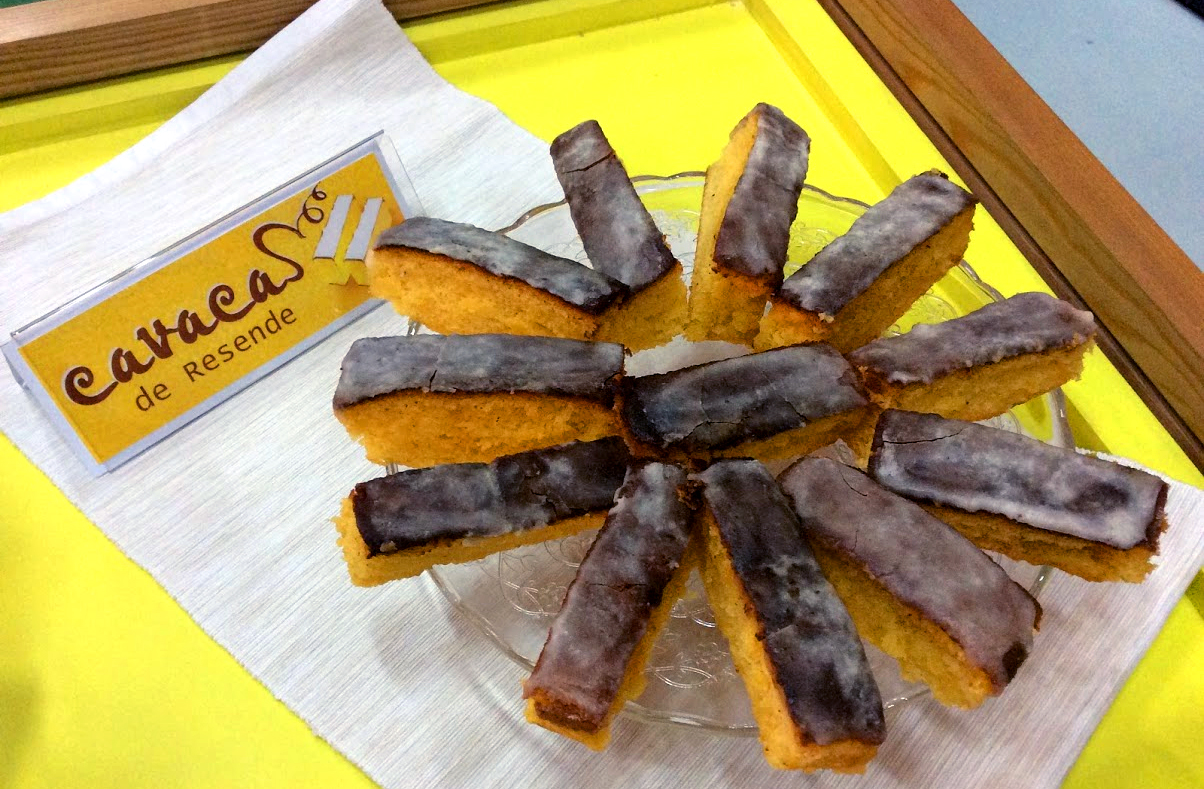
The DGADR sheet, the register of traditional Portuguese products, gives their sizes. The caladinho is a flattened disc about 12 cm across, with a crisp crust. The belindre is smaller, about 8 cm, and stays dry and firm. The raiva takes the shape of a horseshoe about 10 cm long, with more golden tips. The cavaca, the most spectacular, has the size and shape of a bowl: it can reach 35 cm. The beijinhos, small and hollow, measure about 4 cm.
The secret lies in the wood oven
The recipes are simple, the sheet says, and the result depends above all on the temperature of the wood oven and how steady it stays. For the caladinho, whole eggs are beaten with sugar, a pinch of salt, cinnamon, lemon zest and lemon juice, until the mixture turns pale and forms small "eyes". The flour is added, the dough is kneaded, and spoonfuls of it are dropped onto a buttered and floured tray.
Belindres are made in the same way, without lemon or cinnamon. Bolinhos de gema follow the belindre recipe. Once baked and cooled, they are covered with a fine veil of sugar syrup cooked to the "thread stage", whipped until white, and drawn in circles or spirals.
Cavacas for drinking wine
Cavacas are baked until they take the shape of bowls, then glazed both inside and out. Until the middle of the 20th century, red wine was served in these biscuits in the taverns of the region. They were hard enough and watertight enough to hold the liquid, recalls the Pastéis de Portugal sheet, in its "Sabia que…" section.
The women who sold
The sale of these doces at local fairs is documented between the late 19th and the early 20th century. Photographs of the Nossa Senhora do Castelo festival in 1904 already show women with their baskets of doçaria. The DGADR notes that the doceiras were in great demand, especially at the big religious festivals, because few families knew how to make doces and had access to the recipes. After 1940, production grew and became an important economic activity, above all for women.
A local story, never proven by any document, credits the spread of these recipes to two sisters settled in Porto, living in a convent of Poor Clares, who supposedly came to Vouzela after 1834, the year the religious orders were abolished in Portugal. The Pastéis de Portugal sheet repeats it: it is a hypothesis handed down by tradition, not a proven fact.
The communal oven
The DGADR also describes a detail of everyday life. For a long time Vouzela had a communal oven, where bread was baked in large quantities, but also the region's doçaria. Women came there on foot, from the town and the neighbouring parishes, with their heavy masseiras, the large kneading troughs, balanced on their heads.
Where to taste them today
In Vouzela, doces de feira can be found in pastry shops, at markets and at the town's festivities. The caladinhos, the gemas, the belindres, the cavacas and the beijinhos are still displayed at the exhibitions in Fataunços. The passarinhas mostly return on feast days, where the tradition holds on. The guide's tip: a coffee or a red wine from the Dão.
And in Brussels?
We do not claim to bring these recipes back exactly as they were. In Brussels, however, our kitchen follows the same logic: a simple recipe, basic ingredients, and constant attention to the baking. In our shops in Etterbeek, Uccle and Waterloo, you will find everyday Portuguese pastry, starting with the pastel de nata. We deliver to your home in Brussels, and the addresses of our shops are on our website.
The doceiras of Vouzela turned the fair into a workshop: the dough was made at home, the selling took place outdoors, in full view of everyone.
Sources: DGADR, “Doçaria de Feira de Vouzela” ; Pastéis de Portugal, “Doçaria de Feira de Vouzela” ; Câmara Municipal de Vouzela, “Doçaria tradicional”.
Photo: Wikimedia Commons, « Cavacas, Doçaria Regional », CC BY-SA 4.0.
Read next
Folar: the Portuguese Easter cake a godparent gives their godchild
On Easter Sunday in Portugal, a cake arrives at the table with a whole egg set on top, cooked in its shell and set in…
Jeropiga: the sweet wine you stop with brandy, poured at the magusto
Some wines you let ferment and some you stop. Jeropiga belongs to the second group. In Trás-os-Montes it is made in a…
Papo-seco: the Portuguese breakfast roll, minus its maminhas
It crackles under your thumb and is almost always eaten in the morning. The papo-seco, called carcaça or molete…
The doces were not born in convents: the myth that won't die
Cloistered nuns, egg yolks beaten by the dozen: the convent legend clings to Portuguese pastry. Historian João Pedro…
Palha de Abrantes: the golden straw the Tagus carried to Lisbon
On the Tagus, at Abrantes, a sweet took its name from the straw barges carried to Lisbon. Golden egg threads, an almond…
Bilharacos: the pumpkin Christmas sweet from Lousada to Aveiro
A kitchen in Lousada, a Christmas evening, a woman listing her ingredients from memory. Bilharacos are a pumpkin sweet,…
Tremoços: the poor man's seafood that goes with beer
On the table of a tasca, before the beer even arrives, there is often a small bowl of yellow seeds. Raw, tremoços are…

Tomar's Trays Festival: bread carried on the head
Every four years in Tomar, in central Portugal, young women in white dresses walk through the streets with a tray…
Find our artisan pastries in our Brussels stores or order online.
Order now Our foodtruck for your events Our stores