
Folar: the Portuguese Easter cake a godparent gives their godchild
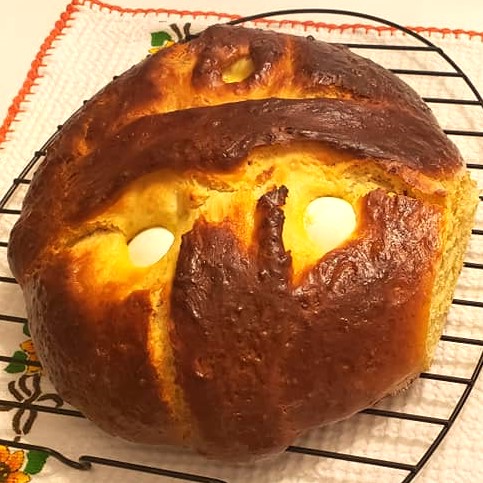
On Easter Sunday in Portugal, the folar arrives at the table with a whole egg set on top, cooked in its shell and pressed into the dough. The cake is lightly sweetened, a little dry and scented with spices. Yet nobody eats it as a simple dessert. It is received, it is given, and it says a great deal about the family that shares it.
An egg left in plain sight
The egg is the first thing you notice. It is hard-boiled and set on the crust, right where everyone can see it. The website OF Portugal describes exactly this detail: it is the egg planted on top that gives the folar its particular look, and sets it apart from the country's other sweet breads.
The meaning given to this egg is symbolic. It evokes rebirth and the Resurrection that the feast celebrates. Wikipedia recalls it too: the folar is sometimes served with a hard-boiled egg, which stands for this return to life.
The godparent, the godchild and the violets
By tradition, the folar is first of all a godparent's gift. On Palm Sunday, the godchild brings their godmother a bunch of violets. On Easter Sunday, the godmother gives a folar in return. The gesture matters as much as the cake: it is a bond renewed every year, between a child and the adult who looks out for them. The folar does not need to be perfect, it needs to be given.
Godfathers and godmothers give the folar to their godchildren, and the size of the cake follows the habits of each family. The gift is part of the celebration, just like Mass and the meal that follows.
An origin nobody can date
There are many stories about how the folar began, and they do not agree. The Portuguese sites that tell them admit themselves that they do not know the date of this tradition. Legends exist, but none can be dated with certainty, which is a common fate for festive cakes: they pass from house to house long before anyone writes them down.
A few theories circulate, without historical proof. One links the egg to an ancient goddess of spring, whose symbols the Church would have taken over at Easter. Another sees the egg as an agricultural gesture: eggs were once buried in the fields to bring a good harvest. These explanations are appealing, but they remain guesses. Better to keep them for what they are.
The savoury folar of Chaves
There is another folar, very far from the sweet Easter cake. Around Chaves and Valpaços, in the north-east of the country, the folar is savoury. The dough holds pork, ham, salpicão and linguiça. The sugar disappears, but the word and the feast stay the same.
Depending on the region, then, the folar is savoury or sweet, and it changes with the local produce. One name can cover two dishes that have almost nothing in common, as long as the feast brings them together.
A plain taste, and spices
The sweet folar is not very sugary and is even a little dry, according to the description given by OF Portugal. It is the spices that give it its character. It remains a celebration cake, not a convent pastry with elaborate sugar work, and that is precisely what makes it so distinctive.
What the folar says about Easter
The folar is unlike any other Portuguese dessert. It is neither a convent pastry nor a sweet from a popular summer festival like the arraiais. It is a family bread that takes the shape of a gift. The egg, the crust, the spice and the bunch of violets all say the same thing: the feast is shared, and those who give count as much as those who receive.
It is also a tradition that survives because it is repeated. Every year the same gesture comes back: a child bringing flowers, a godmother giving a cake, an egg shared at the table. Nothing spectacular, and yet this is the kind of ritual that holds a family together.
And in Brussels?
In Brussels, the folar is not a given on the table. At Wooly, in Etterbeek, Uccle and Waterloo, the Portuguese treat to discover first remains the pastel de nata. To see it up close, our pastel de nata category gathers the shop's variations, and home delivery in Brussels is explained separately.
For the story of our Brussels shops, read Le pastel de nata à Bruxelles : nos boutiques Wooly. The addresses of the three shops are on the stores page.
Photo: Chedlund808, Wikimedia Commons, CC BY-SA 4.0
Sources: OF Portugal, “Folar de Páscoa - História, Lenda e Receitas” ; Wikipédia, “Folar”.
Read next
Jeropiga: the sweet wine you stop with brandy, poured at the magusto
Some wines you let ferment and some you stop. Jeropiga belongs to the second group. In Trás-os-Montes it is made in a…
Papo-seco: the Portuguese breakfast roll, minus its maminhas
It crackles under your thumb and is almost always eaten in the morning. The papo-seco, called carcaça or molete…
The doces were not born in convents: the myth that won't die
Cloistered nuns, egg yolks beaten by the dozen: the convent legend clings to Portuguese pastry. Historian João Pedro…
Palha de Abrantes: the golden straw the Tagus carried to Lisbon
On the Tagus, at Abrantes, a sweet took its name from the straw barges carried to Lisbon. Golden egg threads, an almond…
Bilharacos: the pumpkin Christmas sweet from Lousada to Aveiro
A kitchen in Lousada, a Christmas evening, a woman listing her ingredients from memory. Bilharacos are a pumpkin sweet,…
Tremoços: the poor man's seafood that goes with beer
On the table of a tasca, before the beer even arrives, there is often a small bowl of yellow seeds. Raw, tremoços are…

Tomar's Trays Festival: bread carried on the head
Every four years in Tomar, in central Portugal, young women in white dresses walk through the streets with a tray…
Fogaça: the sweet bread that young girls carry on their heads
You don't cut it like a cake: you carry it. Every 20 January in Santa Maria da Feira, young girls walk the streets with…
Find our artisan pastries in our Brussels stores or order online.
Order now Our foodtruck for your events Our stores