
Cavacas: The Hollow Cake the Cavaqueiras Sold From Wicker Baskets
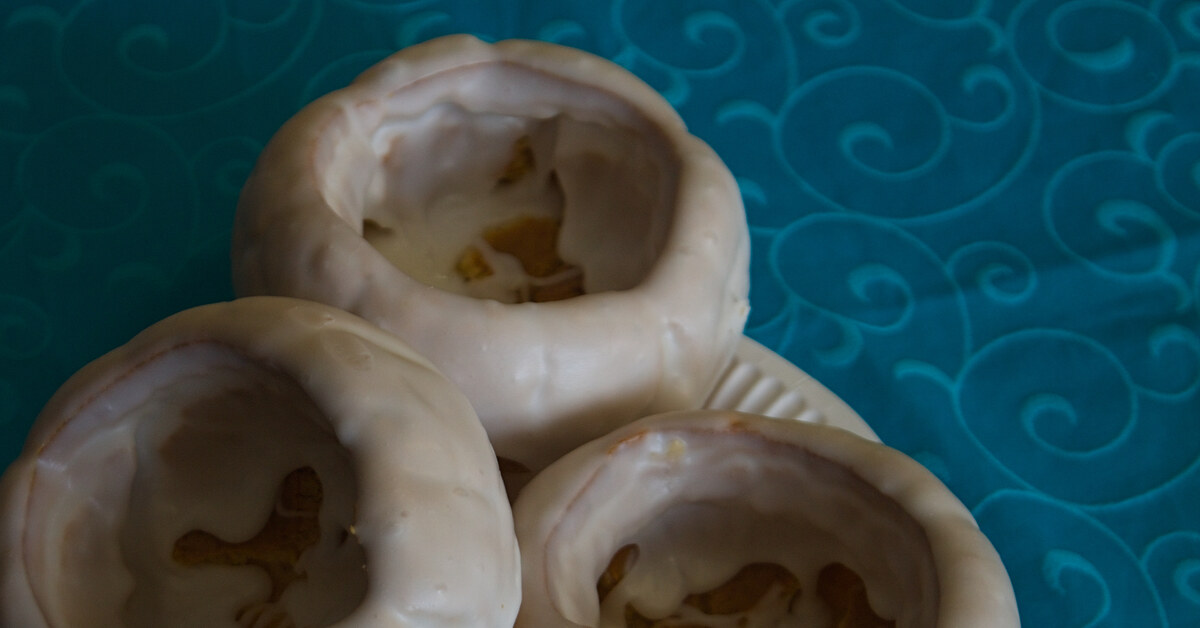
You bite into it and there is nothing inside. A golden shell, a white glaze that breaks away in shards, and at the centre an empty little cave. The cavaca is a cake built around its own hole, and that is precisely why it was sold by the roadside: it does not squash, it does not melt, it survives an entire day of festivities at the bottom of a wicker basket without losing a thing.
Caldas da Rainha, a town born of a hot bath
To understand the cavaca you have to travel about a hundred kilometres north of Lisbon, to a town that owes its name to a queen. At the end of the fifteenth century, Queen Leonor had a thermal hospital built there, around sulphurous springs. The town grew up around the building and kept its founder's name: Caldas da Rainha, the queen's hot baths. For centuries people came to take the waters. They left with a box of cakes.
Local tradition holds that the recipe came down from the parish of São Gregório, on the edge of town, carried by two sisters: Rosalina and Gertrudes Carlota, court confectioners who returned home after the assassination of King Carlos I in 1908. They are said to have set up on the Largo do Hospital Termal, right outside the entrance used by the spa patients, and to have sold their cavacas there. Ever since, the cake has been the town's sweet calling card.
A cake that hollows itself out
The batter holds no secret at all: eggs, flour, a little fat, a pinch of salt. No yeast, no baking powder, nothing. The egg, beaten at length, does all the work. Piped into small moulds, the batter goes into a very hot oven, around 220 °C, before finishing more gently. Under the shock of the heat it swells, lifts, tears open at the top and empties out from within. The cake hollows itself while it bakes.
Then comes the gesture that makes a cavaca: the glaze. Sugar, egg white and lemon juice, beaten until opaque, then poured over the cooled cake. As it dries the glaze turns matt, hard, almost chalky, a white armour that protects the shell and gives it its flavour, sharply lemony. In Caldas they distinguish two schools:
- the cavaca saloia, larger, with a single coat of glaze and the lemon well forward: the one you find at the fairs of Santarém, Golegã and Cartaxo;
- the cavaca fina, smaller, with two layers of glaze one over the other: the one in pastelaria windows.
The cavaqueiras and their wicker baskets
Long before it was a shop-window cake, the cavaca was a cake of the road. You bought it from the cavaqueiras, women who carried them by the dozen in large wicker baskets and followed the fairs and the romarias, the village pilgrimages that give the Portuguese summer its rhythm. They kept no shop: they walked where the celebration walked.
That detail explains the shape. A cream pastry does not survive an August day on a festival field, between the dust, the heat and the journey there. A hollow, glazed shell does. The cavaca did not become empty out of elegance; it became empty because it had to travel. The same logic gave Portugal its fairground fritters, the farturas of the August festivities: you make what will still be standing by nightfall.
In Aveiro, they throw them off the chapel
The cavaca has a northern cousin that pushed this logic to the point of absurdity, and it is glorious. Every January in Aveiro, the feast of São Gonçalinho gathers the Beira Mar quarter around a small baroque chapel. From its dome, cavacas are thrown into the crowd, several tonnes over a single weekend. Below, people stretch out their hands, turn their umbrellas inside out to use them as nets, or hold up nassas, the shrimp traps of the lagoon.
Legend has it that the saint brought bread to the sick who were kept apart, throwing it to them from a distance to avoid contagion. The gesture stayed, the bread became cake. Those cavacas are deliberately rock-hard: they have to survive the fall. The tradition is now listed on Portugal's national inventory of intangible cultural heritage.
August, the month Portugal takes to the road
There is no better moment to talk about cavacas than mid-August. It is the heart of the romaria season: 15 August, the Feast of the Assumption, opens two weeks of processions, brass bands, costumes taken out of wardrobes and tables laid outdoors. In Viana do Castelo, the Romaria de Nossa Senhora d'Agonia, born in the eighteenth century out of the devotion of the fishermen, runs this year from 15 to 23 August. Everywhere else, hundreds of villages do the same on their own scale, and along every one of those roads someone is selling something sweet.
The same gesture, in Brussels
We do not make cavacas at Wooly: it is a speciality of Caldas, and it deserves to be left where it was born. But the family it comes from, the cakes that rest on nothing but eggs, flour and sugar, is very much present in our windows in Brussels: pão de ló, the cake deliberately pulled from the oven too soon, or ovos de coco, direct heirs of the convent sweet-makers. Nothing but the same handful of ingredients, worked another way.
If you want to understand what a long-beaten egg really does, come to Rue des Tongres in Etterbeek, to Stockel, to Uccle or to Waterloo: our four shops are open, and the pão de ló waits there for its moment much as the cavacas once waited for theirs along the roads of Portugal.
Sources: Direção-Geral de Agricultura e Desenvolvimento Rural (Produtos Tradicionais Portugueses), “Cavacas das Caldas”; Gazeta das Caldas, “Doces que são maravilhas”.
Read next
Torta de Azeitão: the golden roll that came from the Alentejo
The fork meets no resistance, the thin sheet of sponge gives way, and the egg cream appears. A torta de Azeitão hides…
Meias-luas of Viana: the pastry you bought without seeing a soul
A coin laid on a wooden tray, a half turn, and the pastry appears without you ever seeing the hand that made it. In…
Doce de gila: the squash you smash on the ground to make a dessert
You do not cut it open, you throw it on the ground. And what comes out of the broken squash looks nothing like a…
Pastel de feijão: the Portuguese pastry that hides beans
You bite into it looking for almond, and you find almond. What you never find is the white bean that makes up half the…
Toucinho do céu: the cake named after an ingredient it no longer contains
Its name means "bacon from heaven". The lard disappeared from the recipe long ago, but the name stayed, and so did the…
Sericaia: the Portuguese dessert that has to crack to be right
In the Alentejo, this dessert is never turned out of its dish, never smoothed over, never rescued. It comes out of the…
Pão de Ló: The Portuguese Cake Pulled From the Oven Too Soon
You push a spoon in and the middle runs. In any other European bakery this cake would be a failure. In Portugal it is…
Bica: What the Portuguese Actually Order at the Counter
Thirty seconds at the counter, one word, a small cup. Portuguese coffee is not a break: it is a punctuation mark in the…
Find our artisan pastries in our Brussels stores or order online.
Order now Our foodtruck for your events Our stores