
Fios de Ovos: The Portuguese Egg Thread That Conquered Siam
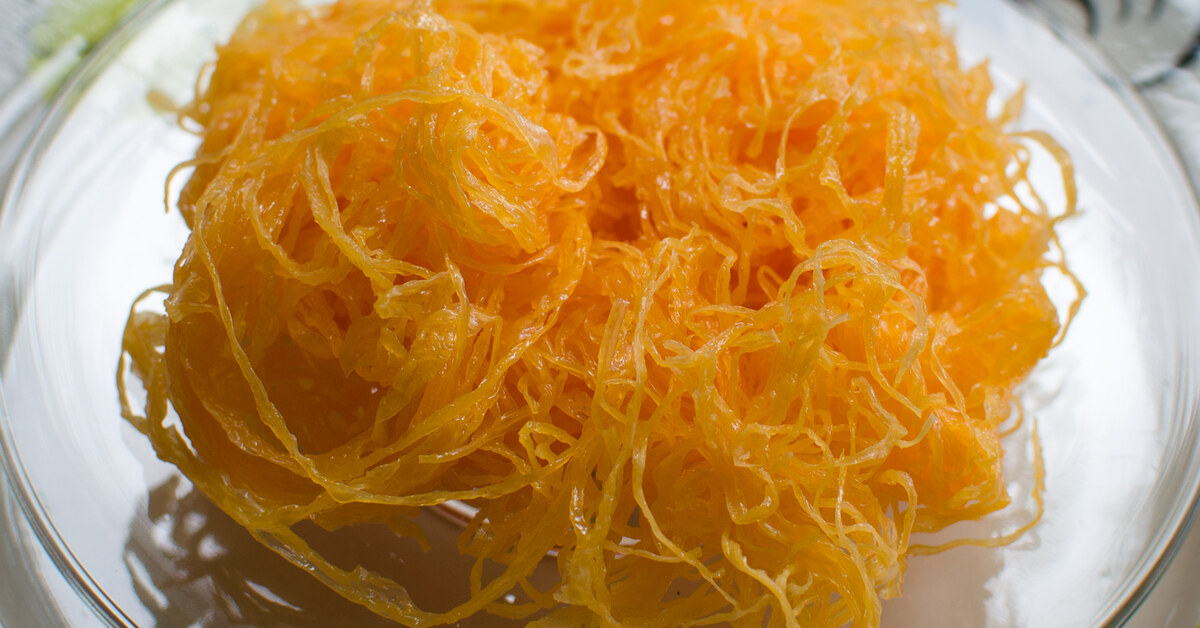
You have to watch it once to understand. The yolk, pushed through a sieve and poured into a funnel with several fine spouts, falls in steady streams into barely simmering sugar syrup. The thread sets in seconds. You lift it out with a skimmer, lay it aside in a skein, and start again. After an hour the table is covered in golden strands that shine like silk yarn. The Portuguese call them fios de ovos: egg threads.
Why the convents had too many yolks
All of Portuguese convent pastry rests on one imbalance. Convents used large quantities of egg whites: to starch habits and collars, and to clarify wine, a genuine practice in wine-growing regions. What remained were the yolks, by the hundred, and throwing them away was unthinkable.
So the nuns invented an entire cuisine around egg yolk and sugar, then plentiful thanks to the colonies. That is where the ovos moles of Aveiro come from, and the toucinho do céu, the papos de anjo, and fios de ovos, perhaps the purest demonstration of the principle: nothing but yolk, sugar and water.
One thread, three temperatures
The difficulty is not in the recipe but in the hand. The yolks must be separated cleanly, the faintest trace of white gives lumps instead of threads. The syrup must hold its temperature: too hot and the thread breaks and curls up, too cool and it dissolves and clouds the sugar. And the movement must be steady, in small circles above the pan, at the same height from beginning to end.
The tool even has its own name: the funil de fios de ovos, a funnel pierced with several fine holes, in copper or tin, still turning up in Portuguese flea markets and in museum collections. The oldest convent kitchens kept several, each a different calibre depending on the fineness wanted.
What they are used for, in Portugal and Spain
In Portuguese pastry, fios de ovos are almost never eaten alone: they dress things. They cover tortas, they finish celebration cakes, they sit as a tuft on a slice of toucinho do céu or on an almond dessert. They bring texture (slightly elastic, frankly sweet) more than flavour.
- In Portugal they belong to wedding cakes, christenings and Christmas;
- in Spain, under the name huevo hilado, they took an unexpected turn: they are served with ham, charcuterie and pâté, as a sweet-savoury contrast;
- in Brazil they traditionally accompany festive desserts, a direct inheritance from Portuguese doçaria.
The journey east
This is where the story grows. The technique left with the Portuguese ships.
In Japan, sweets of Portuguese origin formed a whole family of pastries called nanbangashi, "the sweets of the southern barbarians". The egg threads became keiran sōmen, literally "egg noodles", still a speciality of Fukuoka today.
In Thailand they are called foi thong, "golden threads", and they are among the country's most recognisable desserts. We owe them to one woman: Maria Guyomar de Pinha (1664-1725), born in Ayutthaya of Portuguese, Japanese and Bengali descent, a cook at the court of King Narai. After the political upheaval of 1688 she ended her life in the royal kitchens, but she left behind a complete doçaria, from which Thais still make their festive desserts. There she is remembered as the queen of sweets. What Portuguese convents invented so as not to waste egg yolks became, on the other side of the world, what is served at weddings: one long thread, left uncut, to wish a long life.
The same family, in Brussels
We do not spin egg threads at Wooly: it is long workshop work at the pan, and it keeps badly. But the family fios de ovos come from (the convent sweets, egg yolk, sugar, almond and nothing else) is very much the one in our windows in Brussels. The ovos de coco and ovos de amêndoa descend from it directly, and pão de ló rests on exactly the same three ingredients.
If you want to taste what an egg yolk does when taken seriously, come to Rue des Tongres in Etterbeek, to Stockel, to Uccle or to Waterloo: our four shops are open, and those cakes tell the same story as the golden thread of Bangkok, they simply travelled fewer kilometres.
Our pastéis de nata, in seven flavours, can also be ordered online, with home delivery in Brussels and to neighbouring countries.
Sources: Wikipédia, “Maria Guyomar de Pinha”.
Read next
Cavacas: The Hollow Cake the Cavaqueiras Sold From Wicker Baskets
A matt white glaze that shatters under your teeth, and almost nothing underneath. The cavaca is a Portuguese cake built…
Torta de Azeitão: the golden roll that came from the Alentejo
The fork meets no resistance, the thin sheet of sponge gives way, and the egg cream appears. A torta de Azeitão hides…
Meias-luas of Viana: the pastry you bought without seeing a soul
A coin laid on a wooden tray, a half turn, and the pastry appears without you ever seeing the hand that made it. In…
Doce de gila: the squash you smash on the ground to make a dessert
You do not cut it open, you throw it on the ground. And what comes out of the broken squash looks nothing like a…
Pastel de feijão: the Portuguese pastry that hides beans
You bite into it looking for almond, and you find almond. What you never find is the white bean that makes up half the…
Toucinho do céu: the cake named after an ingredient it no longer contains
Its name means "bacon from heaven". The lard disappeared from the recipe long ago, but the name stayed, and so did the…
Sericaia: the Portuguese dessert that has to crack to be right
In the Alentejo, this dessert is never turned out of its dish, never smoothed over, never rescued. It comes out of the…
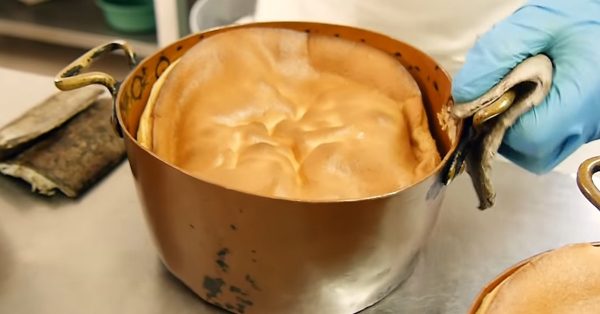
Pão de Ló: The Portuguese Cake Pulled From the Oven Too Soon
You push a spoon in and the middle runs. In any other European bakery this cake would be a failure. In Portugal it is…
Find our artisan pastries in our Brussels stores or order online.
Order now Our foodtruck for your events Our stores