
Pudim Abade de Priscos: the Portuguese pudding with no milk
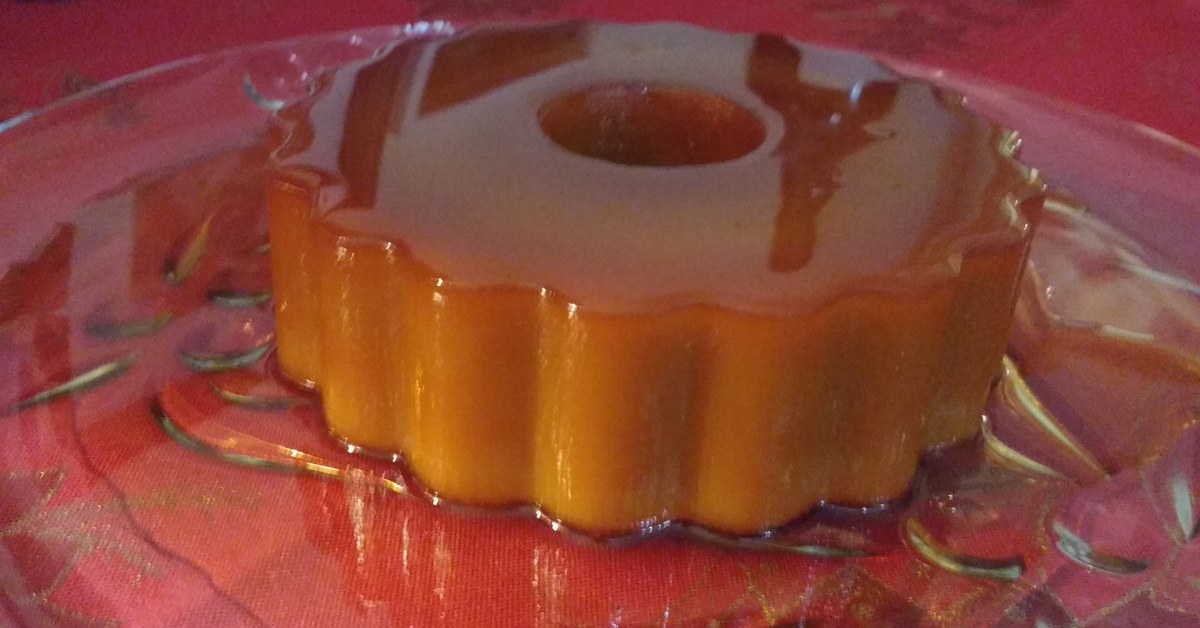
The spoon goes in without resistance and comes out coated in a caramel that is almost black. The texture belongs to no flan you know: tighter, slower, sitting on the tongue instead of dissolving on it. Then the aftertaste arrives, a warmth of fortified wine that has no business being in an egg dessert. That is the moment you decide something is missing, and you are right. The milk is missing.
A Portuguese pudding without milk
The pudim Abade de Priscos is probably the Portuguese dessert that most unsettles anyone who thinks they know flan. Where an ordinary pudim rests on milk and whole eggs, this one is built on a sugar syrup, some fifteen egg yolks, port wine, and toucinho, pork fat, cut into thin slivers and melted into the boiling syrup.
The idea startles today. It was nothing eccentric in nineteenth-century Portugal, where animal fat played exactly the role butter plays in French pastry: it brings softness, it lengthens the texture, it holds moisture. You do not taste the fat. You notice it in the way the dessert stays supple for days rather than stiffening.
It is the same logic as toucinho do céu, the convent cake whose name still carries the trace of an ingredient that eventually vanished from it. In the pudim of Priscos, the fat stayed.
Priscos, a parish of Braga
Priscos is a small freguesia in the municipality of Braga, in northern Portugal, an hour's drive from Porto. Nothing destines such a place to lend its name to a famous dessert, except the man who was its parish priest: Manuel Joaquim Machado Rebelo, remembered by a single title, Abade de Priscos, the Abbot of Priscos.
He served that parish for forty-seven years. And he cooked, not as a Sunday amateur, but well enough for his reputation to travel far beyond his parish boundaries. In the Portugal of that period, a cooking clergyman was nothing incongruous: convents had been the great laboratories of sugar and egg yolk for centuries, and recipes moved from sacristy to sacristy more reliably than through books.
The banquet of 3 October 1887
The episode everyone in Braga still tells takes place on 3 October 1887. King D. Luís I and the royal family were travelling through the north of the country. For the banquet held at Póvoa de Varzim, on the coast, it was the Abbot of Priscos who was called into the kitchen.
It is hard to imagine now what such a commission meant for a country priest: serving a royal table, with everything that implied in courses, sauces and sugar, in an Atlantic seaside town. The pudding that carries his name comes out of that world. It is a dessert designed to close a formal meal: dense, glossy, sweet to the very edge, and scented with port because port was the most prestigious thing northern Portugal had to offer.
How the recipe left the presbytery
The recipe was not published by its author. It became public through an almost administrative detour: Pereira Júnior, director of the Magistério Primário feminino of Braga (the women's teacher-training college, housed in the former Convento dos Congregados) asked the Abbot of Priscos for recipes to use in teaching.
That is how a banquet dessert ended up in a school notebook. Without that request, the pudim would likely have followed dozens of convent preparations lost along with the people who made them. We owe one of the great Portuguese sweets to a school director who wanted teaching material.
The method, as it is written down
The version the parish of Priscos gives as the original recipe runs to very few lines, and every one of them counts:
- half a litre of water and half a kilo of sugar, brought to the boil in a brass or copper pan;
- a strip of lemon peel, a cinnamon stick, and fifty grams of finely sliced toucinho, left to melt into the syrup until it reaches the right point;
- fifteen egg yolks, added off the heat;
- a glass of port, an aged tawny for preference;
- half an hour in a bain-marie, in a caramel-lined mould.
No milk, no cream, no flour. Everything rests on the balance between syrup and yolks, and on the exact point of the caramel, a failed pudim de Priscos is one that has grained or turned bitter. It is a dessert of patience, from the same technical family as pão de ló de Alfeizerão, where everything also comes down to a single minute in the oven.
Doces de ovos, in Brussels
We do not make the pudim Abade de Priscos in our display cases: it is a table dessert, turned out of its mould and shared, not a counter pastry. But the whole family it belongs to is there: the doces de ovos, the sweets built on egg yolk and sugar that form the heart of traditional Portuguese pastry. The same grammar, one generation apart.
You will find them in our four shops around Brussels and Walloon Brabant: rue des Tongres in Etterbeek, in Stockel, in Uccle and in Waterloo. Addresses and opening hours are on our shops page, and if you pass by rue des Tongres, ask what has just come out of the oven. It remains the best way to choose.
As for the pudim of Priscos, it has to be earned. A mould, fifteen yolks, a bain-marie and a Sunday ahead of you. The Abbot had forty-seven years of parish life to practise.
Photo: Rvilaverde, CC BY-SA 4.0, via Wikimedia Commons.
Sources: Direção-Geral de Agricultura e Desenvolvimento Rural (Produtos Tradicionais Portugueses), “Pudim do Abade de Priscos”; Wikipédia, “Manuel Joaquim Machado Rebelo”.
Read next
Fios de Ovos: The Portuguese Egg Thread That Conquered Siam
Egg yolk falling in a thin stream into boiling syrup, and coming out as golden thread. Fios de ovos may be the most…
Cavacas: The Hollow Cake the Cavaqueiras Sold From Wicker Baskets
A matt white glaze that shatters under your teeth, and almost nothing underneath. The cavaca is a Portuguese cake built…
Torta de Azeitão: the golden roll that came from the Alentejo
The fork meets no resistance, the thin sheet of sponge gives way, and the egg cream appears. A torta de Azeitão hides…
Meias-luas of Viana: the pastry you bought without seeing a soul
A coin laid on a wooden tray, a half turn, and the pastry appears without you ever seeing the hand that made it. In…
Doce de gila: the squash you smash on the ground to make a dessert
You do not cut it open, you throw it on the ground. And what comes out of the broken squash looks nothing like a…
Pastel de feijão: the Portuguese pastry that hides beans
You bite into it looking for almond, and you find almond. What you never find is the white bean that makes up half the…
Toucinho do céu: the cake named after an ingredient it no longer contains
Its name means "bacon from heaven". The lard disappeared from the recipe long ago, but the name stayed, and so did the…
Sericaia: the Portuguese dessert that has to crack to be right
In the Alentejo, this dessert is never turned out of its dish, never smoothed over, never rescued. It comes out of the…
Find our artisan pastries in our Brussels stores or order online.
Order now Our foodtruck for your events Our stores