
Malassada: the Azorean doughnut that became a Hawaiian icon
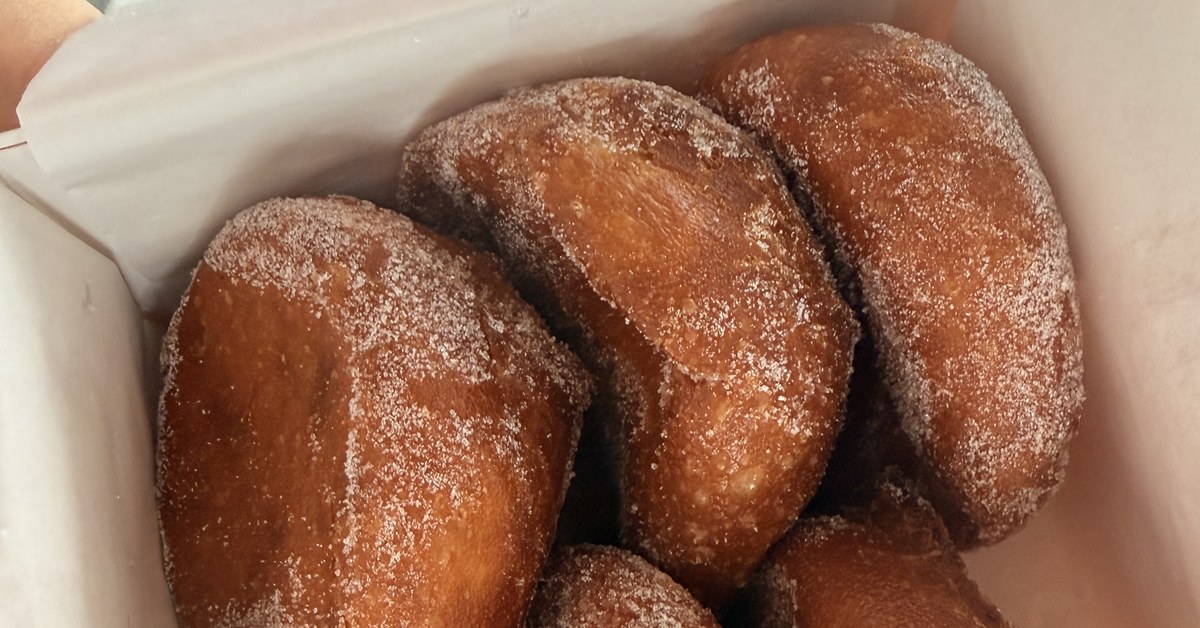
The sugar sticks to your fingers before the first bite. No hole in the middle, no glaze, no decoration: just a ball of risen dough, dropped into hot oil, lifted out golden and rolled in sugar while it is still steaming. The malassada looks like nothing much. Yet it is one of the Portuguese pastries that has travelled the furthest: all the way to the middle of the Pacific, where it now counts as a local classic.
A name that says exactly what it is
In Portuguese the word reads as it is written: mal assada, "badly baked". The name comes from what the thing actually is. The dough never sees an oven; it goes into the fryer, and its centre stays soft, almost damp, where a cake would be firm. What other traditions would have corrected, Portuguese baking embraced and turned into a signature, much like the pão de ló pulled from the oven too early, whose molten heart is the whole point.
The malassada belongs to the islands: the Azores and Madeira both claim it, and every island rolls it its own way: sugar alone, sugar and cinnamon, sometimes lemon zest in the dough. The shape varies too: a round ball for some, a stretched, irregular disc for others. What never changes is the frying, and the sugar on top.
Entrudo: frying to empty the cupboards
To understand why the malassada exists, look at the calendar rather than the recipe. It is eaten on Terça-feira Gorda, Shrove Tuesday, the last day of Entrudo, the old Portuguese name for Carnival, from the Latin introitus, "the entrance". The entrance to what? To Lent, which begins the next morning and imposes forty days of going without.
Hence a very practical logic: before the fast, the house has to be emptied of everything that will not keep. Lard, sugar, eggs, milk — precisely what makes a malassada dough. The doughnut is not a festive whim, it is a storage problem that turned into a ritual. The same mechanism explains most of Europe's Carnival frying, and it runs through all of Portuguese pastry: you find the same thrift in the farturas of the summer festivals, spun straight over the oil.
In the villages the day had its own choreography. A large cauldron was heated, often outdoors or in a shared kitchen, and batches were fried far beyond what one family could eat. The surplus went to the neighbours. The malassada was as much a thing to exchange as a dessert.
Packed in the emigrants' trunks
In the late 1870s the sugar cane plantations of Hawaii were looking for hands. Recruitment was done by contract, and it targeted the Portuguese archipelagos first, where land was scarce and families were large. Between those first departures and 1913, around 27,000 Portuguese, Azoreans and Madeirans for the most part, crossed the Atlantic and then the Pacific to work the cane, the coffee, the sweet potato and the orchards.
The journey took months. People took little with them: tools, holy pictures, a few seeds — and recipes, which weighed nothing because they travelled in the head. The malassada was among them. It had everything needed to survive exile: flour, sugar, eggs, fat, a deep pan. Not one impossible ingredient, not one specialist's tool, unlike the convent sweets of the Azores, which demand a touch handed down on the spot.
In June 1882 the British sailing ship Monarch landed a couple from São Miguel on Maui: Arsenio and Amelia DoRego, under contract for the cane fields. Their story resembles thousands of others. It simply left a more visible trace, for a reason that would only appear seventy years later.
1952: Honolulu adopts the doughnut
That year Frank Leonard Rego — grandson of the couple who arrived in 1882 — opened a bakery in Honolulu with his wife Margaret. It was his mother who suggested the idea: why not make malassadas for Shrove Tuesday, the way it was done back home? He was not sure a city in Hawaii would want an Azorean doughnut. He made them anyway.
The bet held far beyond one Shrove Tuesday. Today, in Hawaii, the day before Ash Wednesday is called Malasada Day, and the Portuguese doughnut is no longer a community curiosity: it has become a Hawaiian pastry in its own right, alongside pão doce, Portuguese sausage and bean soup, all three now part of everyday island cooking.
What is striking in this story is the reversal. The Azorean families did not leave in order to export a recipe; they left because there was no work. The pastry followed, quietly, with no plan behind it. And it is the pastry that, a century and a half later, still tells the journey — better than the contract registers do.
The same gesture, in Brussels
A Portuguese community that settles somewhere always brings the same luggage: the language, the feast days, and the gestures of the kitchen. Brussels saw that arrival much later than Hawaii did, but the mechanism is identical, which is why a Portuguese pastelaria is never quite an ordinary shop. At Wooly, in Etterbeek as in Stockel, Uccle or Waterloo, we work with that memory every day: the cinnamon we dust over our pastéis de nata as they come out of the oven is exactly the one that scents the malassadas of Shrove Tuesday. Come and smell it in one of our Brussels shops.
The malassada, for its part, stays tied to its one day of the year. That may be exactly what saved it: a pastry you do not eat every day is a pastry you do not forget.
Photo: Sherbeey, Wikimedia Commons, CC0.
Read next
Portokali: the orange named after Portugal, from Athens to Tehran
Ask for an orange at a market in Athens and you will be handed a portokali. In Istanbul, a portakal. All across the…
Castanhas de ovos: the chestnuts of Viseu made from egg yolks
Small golden chestnuts, ridged, a little scorched on top. None of them has ever seen a chestnut tree: in Viseu they are…
Pão de rala: the fake loaf of Évora that the nuns offered a king
It has the shape of a country loaf and the name of a poor man's flour. Under its crust, though, there is nothing but…
Pêra Rocha: the pear that turned up by accident in a Sintra garden
It has a neck, a skin freckled with russet, and it reaches Portuguese market stalls in September. Every Rocha pear in…
From Flagey to Stockel: how Portuguese pastry reached Brussels
The hiss of the coffee machine, the cup set down with a click, two words of Portuguese across the counter: that counter…
Bolo Dona Amélia: the maize cake where the spices stopped
A veil of icing sugar, a dense crumb the colour of maize, a scent of cinnamon and clove. The bolo Dona Amélia comes…
Madeira sugar: the sweet route that linked Funchal to Bruges
In a display case in Funchal stands a cone of hardened sugar, greyish white, as tall as a forearm. That was the shape…

Fatias de Tomar: the sweet that demands a pan with a chimney
They look like slices of bright yellow bread left behind in syrup. They contain no flour, no leavening, and never see…
Find our artisan pastries in our Brussels stores or order online.
Order now Our foodtruck for your events Our stores