
Castanhas de ovos: the chestnuts of Viseu made from egg yolks
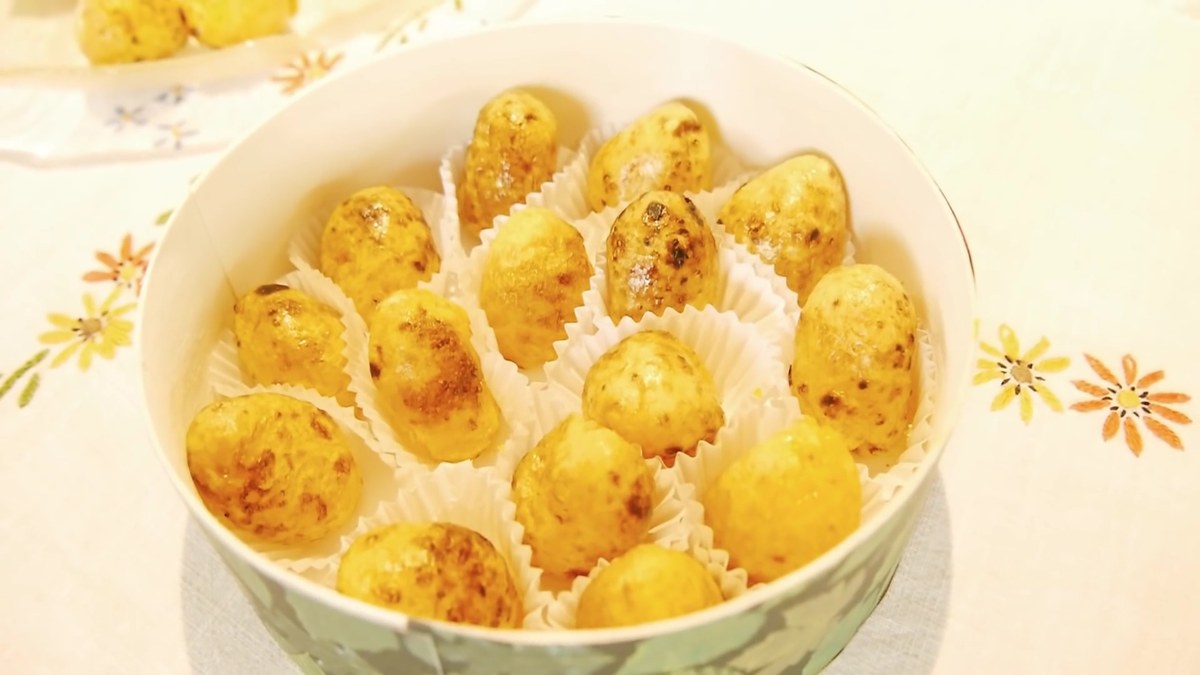
They sit in their pleated paper cases, neatly lined up at the bottom of a round box, and you would swear they were chestnuts. The same size, the same rounded back, the same brown skin, darkened in spots where the heat has bitten. You pick one up, and it gives under your teeth like a firm custard. Not a trace of chestnut: egg yolk, sugar, and the memory of a flame. In Viseu, in central Portugal, they are simply called castanhas de ovos, egg chestnuts.
A secret from Ferreira de Aves
The story begins north of the city, in a village in the municipality of Sátão: Ferreira de Aves. It was home to the monastery of Santa Eufémia, a house of enclosed Benedictine nuns founded in the early twelfth century. That, according to the Viseu historian Alberto Correia, is where the region's doces de ovos were born, "chestnuts above all the rest".
In 1592 a new religious house opened in Viseu itself, on the north-east side of the city: the monastery of Bom Jesus. To found it, Santa Eufémia sent an abbess of noble family, a prioress, porter nuns, a mistress of novices and a chantress. In their luggage was the secret way of making castanhas. The recipe changed towns, not hands.
Whites for the altar, yolks for the table
The mechanism is familiar, and it was the same in every Portuguese convent: wherever egg whites are used in quantity, yolks are left over. The booklet the city of Viseu devoted to castanhas says so plainly: the nuns could use the whites to starch certain altar linens — corporals, palls — and to make cavacas, dry cakes with a sugar glaze. The yolks went into the sugar.
You still had to be able to afford it. What Portugal calls conventual pastry required rare and costly ingredients, available only to palace kitchens and to monasteries wealthy enough, sustained by gifts from kings and lords. Castanhas de ovos were a festive treat, making up for strict fasts and breaking the everyday silence.
They were also a currency of courtesy. Arranged in small wooden boxes lined with tissue paper cut like lace, they became the gift with which mother abbesses thanked a generous bishop or a benefactor.
The craft: a syrup, a furrow, a flame
The method has barely changed, and it comes down to three moments. First the sugar: it is boiled with a little water to the ponto de voar, one of those syrup stages Portuguese pastry cooks judge by finger and eye — we have written elsewhere about the ponto de açúcar, the gesture that decides everything. The long-beaten yolks, a lovely old-gold colour, are poured in and stirred without stopping with a wooden spoon, scraping the mixture off the bottom and sides. The paste is ready when a furrow drawn with the spoon stays open, "like a road", as the recipe published by the city nicely puts it.
Then the shape. Once cooled on the marble, the paste is rolled into a log on a lightly floured surface and cut into pieces, each weighed on a small scale: twenty to twenty-five grams apiece. Between the palms, every piece becomes a little elongated loaf with rounded ends. With the back of a knife, a few parallel lines are marked across the top. That detail makes the chestnut.
Finally the colour. The tops are brushed with beaten egg and passed over a flame until they take on the thin skin whose shade, Alberto Correia writes, recalls "the bright tone of a chestnut in autumn". In the monastery, castanhas browned patiently above the embers of clay braziers, held on little sticks of bay laurel. Then came the paraffin flame, and now the gas torch. They are lifted off with a knife and set in their cases. Done.
1834, and Rua Formosa
In 1834 a law of 28 May abolished the religious orders in Portugal. At Bom Jesus, as elsewhere, no more novices were admitted; the nuns stayed on until the end of their days, and the house closed for good in 1896. But the secret did not stay locked in a chest. Keepers whose names have been forgotten passed it on, and castanhas left the cloister for Easter tables, christenings and patron-saint feasts.
They found a new home on Rua Formosa, Viseu's shopping street, given that name on 20 October 1910. People came for the pharmacy, the tailor, the tea room and the pastelarias. Each had its signature, and among the doces de ovos of the street, the castanha of Pastelaria Horta was, according to Alberto Correia, the most renowned, from the oldest house, founded in 1873. The same counter also held papos de anjo, almond rosettes and nichos filled with fios de ovos.
A chestnut before the chestnuts
There is something delightfully Portuguese about the idea: making a chestnut out of the most precious things you had, instead of picking one up under the tree. In a few weeks, around St Martin's Day, all of Portugal will be roasting the real ones. In Viseu there is no need to wait for November: castanhas are served all year round, with a coffee, a small glass of ginjinha, or a late-harvest Dão wine whose colour matches their own.
The same yolks, in Brussels
Castanhas de ovos rarely travel far from the Dão, and we do not make them. But the grammar that invented them — egg yolks, a syrup cooked to exactly the right point, a flame that marks the surface — is the grammar of all Portuguese pastry, and it is the same one behind a good pastel de nata, with its custard dotted with scorched spots. In our shops in and around Brussels — Rue des Tongres in Etterbeek, Stockel, Uccle and Waterloo — that convent heritage fills the display case every morning.
And if the road ever takes you to Viseu, walk into a pastelaria and ask for a box of castanhas. You will be handed chestnuts. Bite in anyway.
Photo: No Ponto, "Castanha de Ovo, Sátão", CC BY 3.0, via Wikimedia Commons. Main source: Alberto Correia, "Castanhas de ovos. Doces de ovos de Viseu", Município de Viseu, 2020.
Read next
Pão de rala: the fake loaf of Évora that the nuns offered a king
It has the shape of a country loaf and the name of a poor man's flour. Under its crust, though, there is nothing but…
Pêra Rocha: the pear that turned up by accident in a Sintra garden
It has a neck, a skin freckled with russet, and it reaches Portuguese market stalls in September. Every Rocha pear in…
From Flagey to Stockel: how Portuguese pastry reached Brussels
The hiss of the coffee machine, the cup set down with a click, two words of Portuguese across the counter: that counter…
Bolo Dona Amélia: the maize cake where the spices stopped
A veil of icing sugar, a dense crumb the colour of maize, a scent of cinnamon and clove. The bolo Dona Amélia comes…
Madeira sugar: the sweet route that linked Funchal to Bruges
In a display case in Funchal stands a cone of hardened sugar, greyish white, as tall as a forearm. That was the shape…
Fatias de Tomar: the sweet that demands a pan with a chimney
They look like slices of bright yellow bread left behind in syrup. They contain no flour, no leavening, and never see…
Ameixa d'Elvas: the green plum named after a French queen
It is green, and that is not a flaw. In Elvas, in the Upper Alentejo, this plum is picked deliberately hard, before it…
Rebuçados da Régua: the hand-folded sweet of the Douro pilgrimages
They smell of hot lemon and cooked sugar. At the foot of Lamego's baroque stairway, women still fold their sweets one…
Find our artisan pastries in our Brussels stores or order online.
Order now Our foodtruck for your events Our stores