
Portokali: the orange named after Portugal, from Athens to Tehran
You peel it with your thumb and the zest stings your fingers a little. A drop squirts out, and the scent arrives before the first bite. Nothing is more ordinary than an orange. And yet, ask for one at a market in Athens and you will be handed a portokali. In Istanbul, a portakal. In Bucharest, a portocală. From one end of the eastern Mediterranean to the other, and all the way to Iran, this fruit from Asia still carries the name of a small country on the edge of the Atlantic: Portugal.
How does an orange end up named after a kingdom? To understand it, you have to travel back along two roads: the road of words and the road of ships.
A word that set out from India
In Portugal itself, nobody calls an orange "Portugal". It is a laranja, and the word has come a long way. It goes back to the Sanskrit nāraṅga, the orange tree, which passed into Persian as nārang and into Arabic as nāranj. From there came the Spanish naranja, the Portuguese laranja and the English "orange", which lost its n along the way: in several languages it was mistaken for the tail end of the article in front of it.
The etymology already tells most of the story. The orange was not born in Europe. It comes from Asia, from a region between India and Southeast Asia, and it walked west from one language to the next.
First came the bitter orange
The first orange tree to settle in Europe was not the one we bite into today. It was the bitter orange, the Seville orange. Arabs brought it to Sicily in the ninth century, and to the Iberian Peninsula, where they also planted lemons and limes. In Portugal, orange trees gradually spread from the Minho to the Douro, around Coimbra, Lisbon and Setúbal, into the Alentejo, the Algarve and out to the Azores — in orchards, but also in monastery gardens and the gardens of great houses.
That orange was hardly something you ate raw. It was grown for other reasons: its peel, leaves and blossom gave essential oil and orange blossom water, and its flowers were turned into sweets that were counted, at the time, among the remedies. Hardy as it was, it also served as rootstock. The orange tree belonged as much to the apothecary as to the orchard.
Then the sweet orange arrived by sea
Everything changed when the sweet variety landed. It was unknown around the Mediterranean until the late fifteenth or early sixteenth century, when Italian and Portuguese merchants brought orange trees there. This is the age of the great voyages: Portuguese ships now sailed from Lisbon to India, and later to China. The municipality of Silves, in the Algarve, sums it up in one sentence: the sweet orange was only introduced to Europe in the sixteenth century, by Portuguese merchants. Historians still debate its exact route, from India or from China, and new Chinese varieties kept arriving in Portugal in the centuries that followed.
The same sea routes had put the Portuguese on the trail of another precious bark — we have told how they found Ceylon cinnamon. This time the treasure was eaten fresh, and it grew beautifully under the Portuguese sun.
Success came quickly. By the middle of the seventeenth century, the sweet orange was known throughout Europe. Botanists took an interest: the Italian Giovanni Battista Ferrari in 1646, then the Frenchman Joseph Pitton de Tournefort in 1694, singled out a "Lisbon orange". Not everyone was won over: in 1702 the physician Louis Lémery still rated the bitter orange higher, and suspected the sweet one of weakening the stomach.
From Athens to Tehran, they say "Portugal"
For the ports of the eastern Mediterranean, those sweet fruits came from one specific place: they were oranges "from Portugal". The name stuck to the fruit and never came off. It still survives today in a dozen or so languages:
- in Greek, portokali;
- in Turkish, portakal, and in Azerbaijani, portağal;
- in Romanian, portocală;
- in Bulgarian and Macedonian, portokal, in Albanian, portokall;
- in Georgian, p'ort'okhali;
- in Arabic, burtuqāl, and in Persian, porteghâl.
Even in Italy, some dialects once called an orange portogallo. There is a lovely irony in it: the Arabic word nāranj brought the bitter orange to Europe, and another Arabic word, burtuqāl, now names the sweet one — a nod to the country that set it travelling.
And in Brussels, an apple from China
Further north, people chose a different address. There, what stuck was not the sailors' country but the fruit's homeland. In Dutch, an orange is a sinaasappel, a "China apple"; in Flanders people happily say appelsien. In German it is an Apfelsine, in Swedish an apelsin. French, too, once spoke of a pomme de Chine.
So in Brussels, the very same fruit can change its name just by crossing the street: orange on one side, appelsien on the other. Both words tell the same story, seen from the two ends of the journey.
When the orange goes into the batter
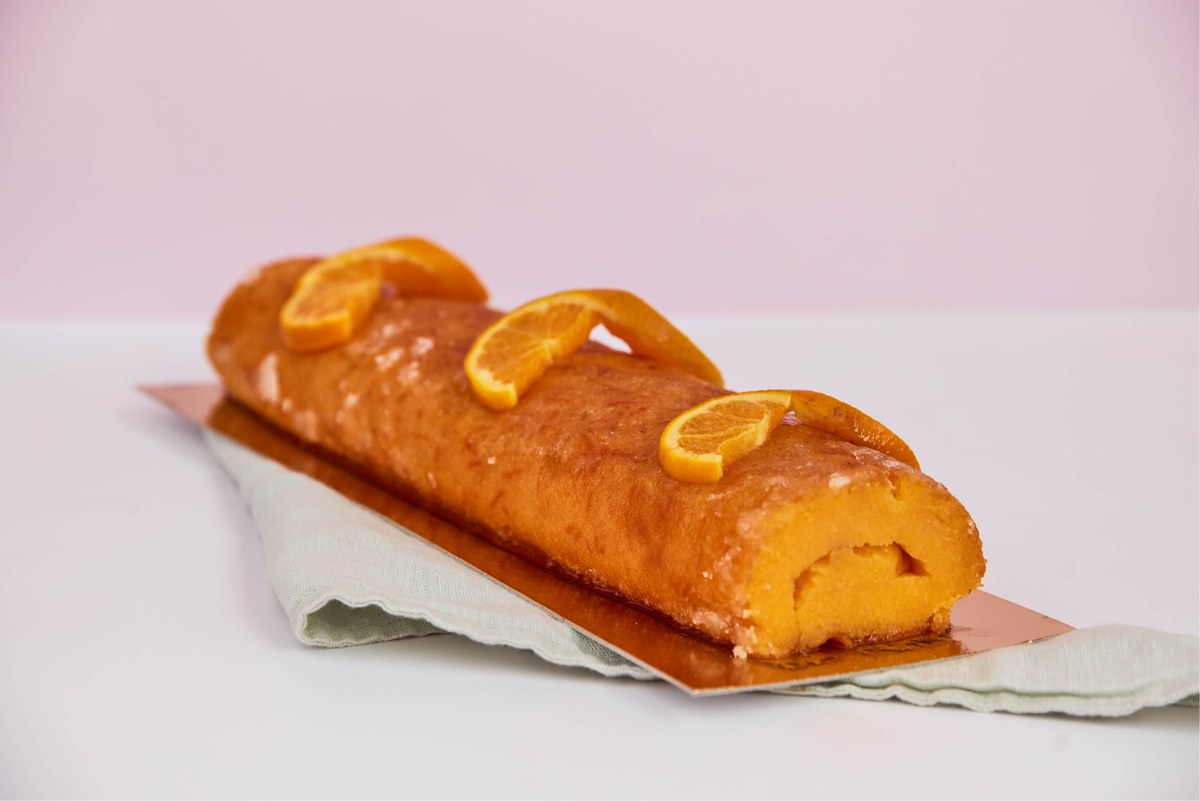
In Portugal, the land of eggs and sugar, the orange found its way into pastry quite naturally. Its juice and zest lift batters rich in egg yolks and cut through the sweetness of syrup. The torta de laranja is the best-loved example: a thin, golden, deeply fragrant sponge rolled up on itself like a long ribbon. It is a citrus cousin of the torta de Azeitão, the country's other famous roll.
A piece of that journey, in Brussels
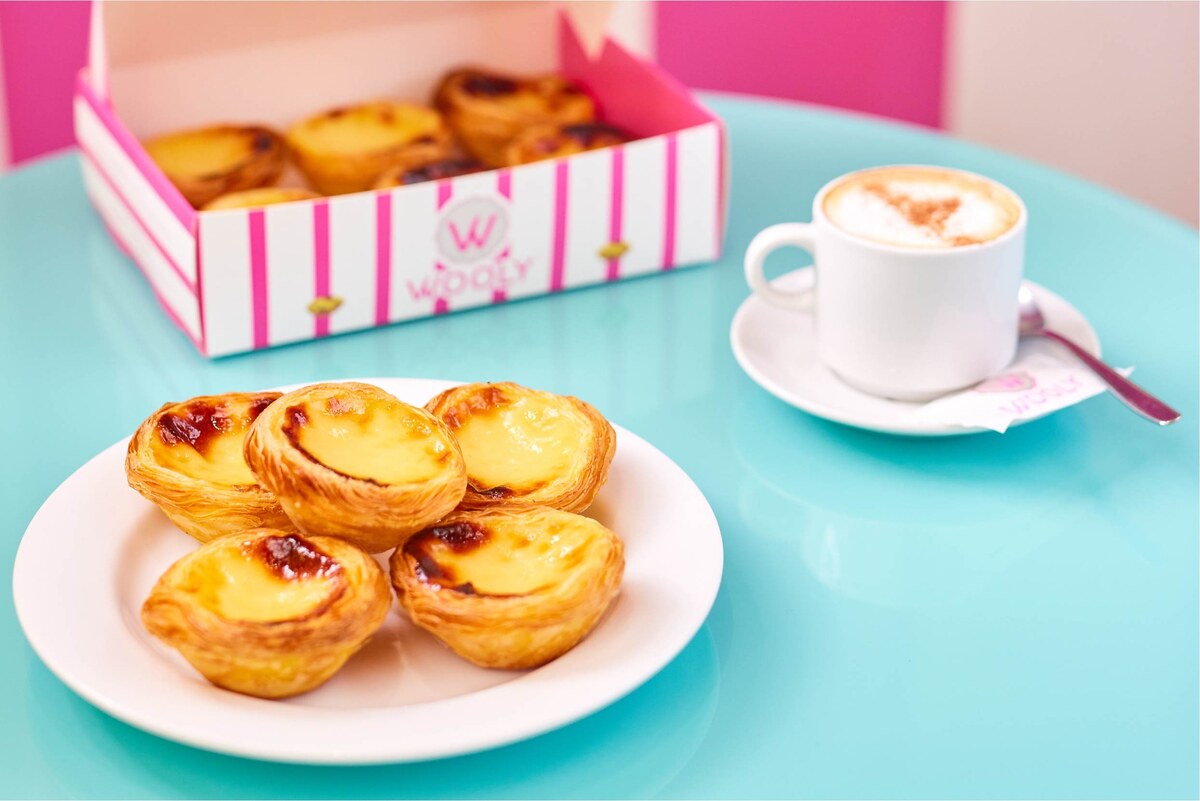
At Wooly, this whole story fits into our orange roll, a Portuguese-style torta de laranja made with fresh oranges. You will find it in our shops in and around Brussels — on Rue des Tongres in Etterbeek, in Stockel, Uccle and Waterloo — right next to the morning's pastéis de nata.
Next time you peel an orange, remember: somewhere between Athens and Tehran, someone is peeling a little piece of Portugal.
Photo: Wooly Pâtisserie. Sources: University of Coimbra (ReSEED project, "Oranges from Portugal"); Município de Silves, "História da laranja".
Read next
Castanhas de ovos: the chestnuts of Viseu made from egg yolks
Small golden chestnuts, ridged, a little scorched on top. None of them has ever seen a chestnut tree: in Viseu they are…
Pão de rala: the fake loaf of Évora that the nuns offered a king
It has the shape of a country loaf and the name of a poor man's flour. Under its crust, though, there is nothing but…
Pêra Rocha: the pear that turned up by accident in a Sintra garden
It has a neck, a skin freckled with russet, and it reaches Portuguese market stalls in September. Every Rocha pear in…
From Flagey to Stockel: how Portuguese pastry reached Brussels
The hiss of the coffee machine, the cup set down with a click, two words of Portuguese across the counter: that counter…
Bolo Dona Amélia: the maize cake where the spices stopped
A veil of icing sugar, a dense crumb the colour of maize, a scent of cinnamon and clove. The bolo Dona Amélia comes…
Madeira sugar: the sweet route that linked Funchal to Bruges
In a display case in Funchal stands a cone of hardened sugar, greyish white, as tall as a forearm. That was the shape…
Fatias de Tomar: the sweet that demands a pan with a chimney
They look like slices of bright yellow bread left behind in syrup. They contain no flour, no leavening, and never see…
Ameixa d'Elvas: the green plum named after a French queen
It is green, and that is not a flaw. In Elvas, in the Upper Alentejo, this plum is picked deliberately hard, before it…
Find our artisan pastries in our Brussels stores or order online.
Order now Our foodtruck for your events Our stores