
Pastel de Chaves: the recipe bought from a stranger in 1862
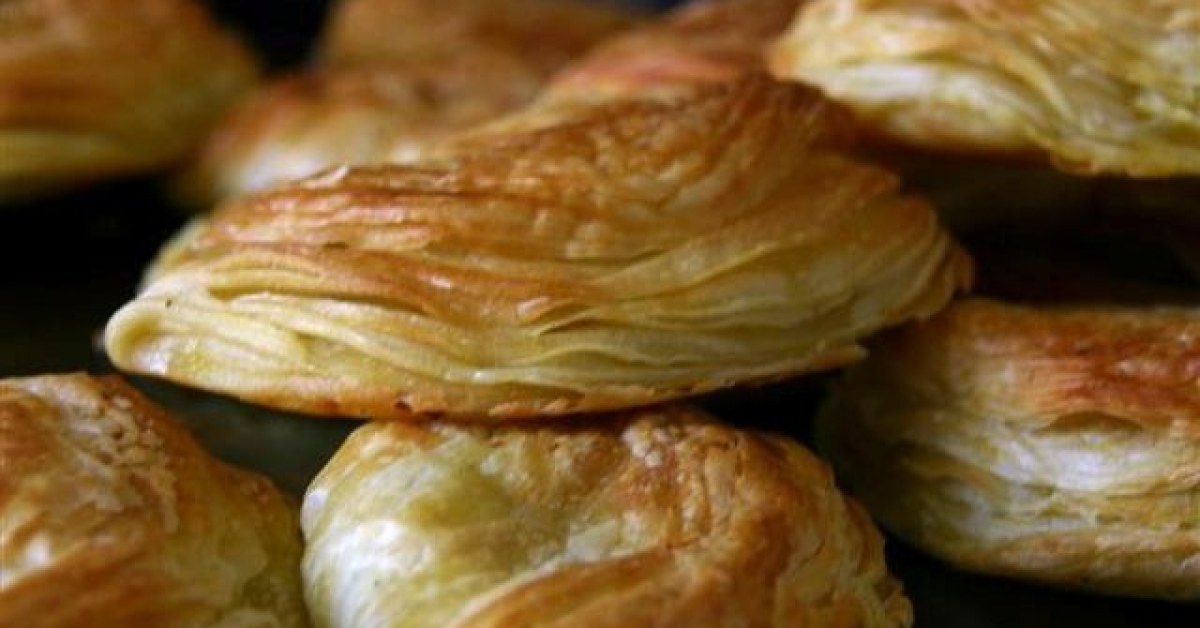
It looks like nothing you expect from a pastry shop. No sugar, no cinnamon, no beaten egg yolk: a golden half-moon, laminated so finely that it splits under your thumb, and a veal filling that steams at the first bite. Yet the pastel de Chaves carries the word pastel, just like the convent sweets. And the strangest thing about it is not where you would look for it: nobody knows who invented it.
1862: a stranger, a basket, one pound
The story begins in the streets of Chaves, at the very top of Portugal, a few kilometres from the Spanish border. A street seller, whose name and origin are both unknown, walks the town with a basket of little folded pastries of an unusual shape. She never has enough for everyone who wants one.
Teresa Feliz Barreira, who would go on to found the Casa do Antigo Pasteleiro, offers her one pound for the recipe. The seller accepts, then vanishes from the record. We know nothing of her face, of where she came from, of what became of her. All she left behind is a fold and a filling. And a whole town still making them, more than a hundred and sixty years later.
It is the exact reverse of every other story Portugal tells about its pastries. The doces conventuais descend from convents you can name, from nuns whose order and town are on record. Here, nothing: a street transaction between two women, a sum of money, and silence.
What happens between the layers
The pastel de Chaves is a half-moon of finely laminated puff pastry filled with a preparation based on minced veal. The filling is not smooth: you can see the pieces of meat and onion, and you clearly taste the olive oil. That irregularity is its signature, a blended filling would feel nothing like it.
The whole pleasure is in the contrast. Outside, a firm, brittle pastry that cracks as it opens. Inside, a thick, moist, melting filling that stays hot long after the crust has cooled. It is a savoury you eat standing at the counter, often before noon, holding the paper under your chin to catch the shards.
Chaves itself has something to do with it. The Romans called the town Aquae Flaviae (they came for its hot springs) and its people are still flavienses. This is a land of smokehouses and charcuterie, a region where meat is never an afterthought. The pastel is no pastry chef's whim: it comes from a place that knows what to do with a piece of veal.
A pastry that cannot move house
In July 2013, a file makes its way to Brussels: the other Brussels, the institutional one. On 27 May 2015, the European Commission enters the Pastel de Chaves in the register of protected geographical indications. Since then, only pastéis produced inside the boundaries of the concelho of Chaves may carry the name.
The consequence is blunter than it sounds. A baker setting up an oven fifty kilometres away, with the same pastry, the same filling and the same gesture, would have no right to put those three words in the window. The name belongs to the place, not to the recipe. What is protected is not a craft: it is a craft somewhere.
There is a quiet irony in that. The one thing this whole story is certain about is a municipal boundary. The woman who invented it remains untraceable.
The wider family of salgados
The pastel de Chaves belongs to what the Portuguese call salgados: savoury bites eaten on the move, at any hour, in any pastelaria. It is a world of its own, where every shape has its own name and method: fried or baked, folded or rolled, with meat, cod or shrimp.
From the outside they are easy to mix up. We already tried to untangle the three best known in empada, chamuça, rissol: which is which?. The question comes back at every counter. The pastel de Chaves adds a fourth answer: baked puff pastry, half-moon shaped, with a veal filling you can spot by eye.
And in Brussels?
We do not make pastel de Chaves, and we will not: the name does not travel, which is the entire point of its protection. But its counter cousins are here. Our meat chamuças and the rest of our Portuguese appetisers come from the same habit: something savoury and hot, held in the hand, eaten standing between two errands.
You will find them in our four shops in and around Brussels: Stockel, Uccle, Waterloo, and Etterbeek, rue des Tongres. Ask for them warm, then wait thirty seconds before biting: what comes out of the oven keeps its heart hot far longer than its crust.
As for the seller of 1862: she sold her recipe for one pound, and Portugal has been remaking it every morning since. It was a bad price. It is also the longest afterlife a single coin can buy.
Photo: Carlos Botelho, CC BY 2.5 licence, via Wikimedia Commons.
Sources: Direção-Geral de Agricultura e Desenvolvimento Rural (Produtos Tradicionais Portugueses), “Pastel de Chaves IGP”; Wikipédia, “Pastel de Chaves”.
Read next
Leite-creme: the red-hot iron that cracks Portuguese custard
You hear it before you taste it: the spoon presses, the sugar crust gives way with a dry crack, and underneath there is…
Pudim Abade de Priscos: the Portuguese pudding with no milk
A dark, dense Portuguese pudding born in a presbytery near Braga, whose original recipe contains not a drop of milk.…
Fios de Ovos: The Portuguese Egg Thread That Conquered Siam
Egg yolk falling in a thin stream into boiling syrup, and coming out as golden thread. Fios de ovos may be the most…
Cavacas: The Hollow Cake the Cavaqueiras Sold From Wicker Baskets
A matt white glaze that shatters under your teeth, and almost nothing underneath. The cavaca is a Portuguese cake built…
Torta de Azeitão: the golden roll that came from the Alentejo
The fork meets no resistance, the thin sheet of sponge gives way, and the egg cream appears. A torta de Azeitão hides…
Meias-luas of Viana: the pastry you bought without seeing a soul
A coin laid on a wooden tray, a half turn, and the pastry appears without you ever seeing the hand that made it. In…
Doce de gila: the squash you smash on the ground to make a dessert
You do not cut it open, you throw it on the ground. And what comes out of the broken squash looks nothing like a…
Pastel de feijão: the Portuguese pastry that hides beans
You bite into it looking for almond, and you find almond. What you never find is the white bean that makes up half the…
Find our artisan pastries in our Brussels stores or order online.
Order now Our foodtruck for your events Our stores