
Papos de anjo: the egg-yolk cake that is cooked twice
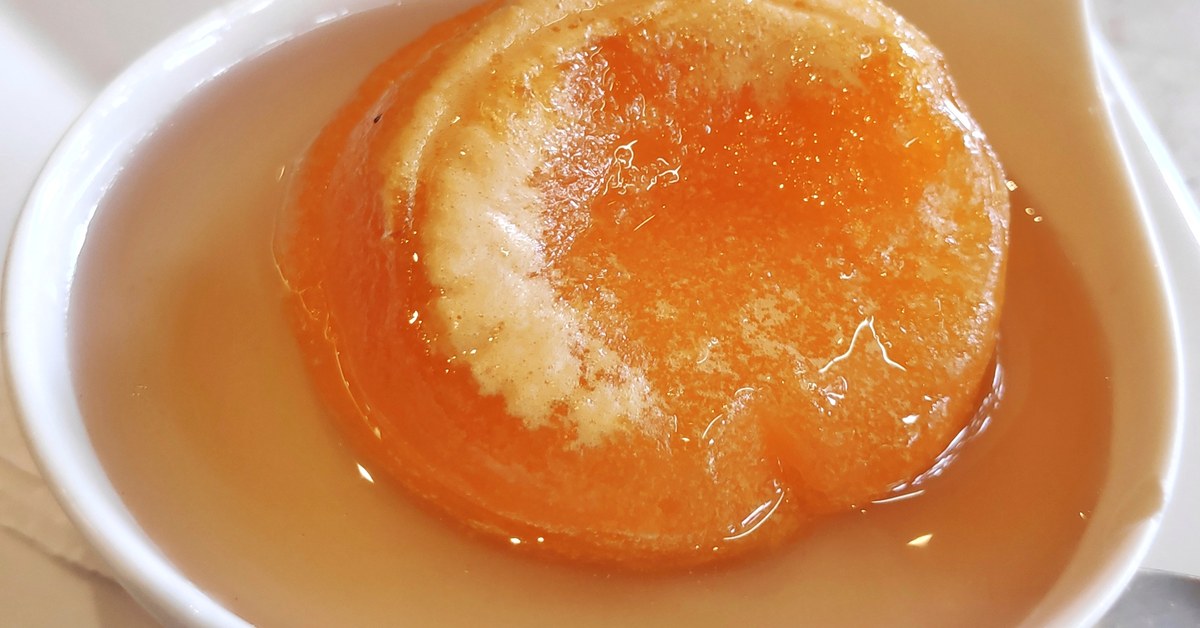
It leaves the oven baked, golden and domed, and yet nothing is finished. The papo de anjo is turned out of its little mould and dropped into a pan of warm syrup, where it drinks, swells and grows heavy. By the time it reaches the table it no longer quite holds its shape: it sits in an amber pool, and the spoon goes in without resistance.
Two cookings, then. Not a pastry chef's whim, but the legacy of a time when Portugal had far too many egg yolks on its hands.
Too many whites, too many yolks
The doçaria conventual, the pastry tradition born in Portuguese convents, rests on a very practical imbalance. Inside the monasteries, egg white rarely reached the table: it was used to starch linen and religious habits, and the cellars used it to clarify wine, a fining technique still in use today. What was left were yolks, by the bowlful.
At the same time, sugar stopped being a luxury. The cane planted on Madeira, and later in Brazil, made it plentiful from the fifteenth century onwards. Surplus yolks, abundant sugar, nuns with time and an oven: the whole of Portuguese sweet-making comes out of that meeting. So do the fios de ovos, whose journey all the way to Siam we told in an earlier piece.
The papo de anjo may be the barest expression of that logic. Yolks, sugar, a little water. Nothing else, no flour, or barely any.
The gesture: whisk, bake, then drown
It starts with long whisking. The yolks are beaten until they double in volume, until they turn into a pale mousse that falls back in ribbons. That trapped air, and nothing else, is what makes the cake rise: there is no raising agent and no whipped white to help it along.
The mousse is poured into small buttered moulds and given a short spell in the oven. What comes out are tiny springy domes, honestly a little too dry to eat as they are.
Then comes the second cooking, the one that defines the sweet: a calda, a sugar syrup flavoured differently from house to house, lemon or orange zest, a cinnamon stick, sometimes a spoonful of vinho do Porto. The domes simmer gently and absorb the syrup right through. They go from dry to translucent, changing texture so completely that you would swear you were eating a different dessert.
It also explains how well they keep: saturated with sugar, they last far longer than anything filled with cream, no small matter before refrigeration, in convents that sold their sweets through a turntable in the wall.
Four towns, four papos
As so often in Portugal, one name covers cakes that are not quite alike. The versions most often cited come from Viseu, Mirandela and Amarante, three towns in the north and centre where convent sweet-making survived as a street trade, and from the island of Terceira in the Azores.
- Viseu, Amarante: the classic line, small domes of beaten yolk, baked, then left to steep in their syrup.
- Mirandela: a version that clearly departs from the model, with papos richer in whole eggs, loosened with a spoonful of jam and scented with cinnamon, which are not steeped in syrup.
- Terceira: the Azorean version, served by island families on important occasions.
None of them is right at the expense of the others. These are convent recipes that became household recipes, and each region kept the gesture it had to hand.
Where the odd name comes from
"Papo de anjo" translates literally as "angel's crop". In Portuguese, the papo is a bird's crop, that round taut pouch under the throat, and that is the explanation usually given: the plump shape of the cake, its smooth stretched skin.
The name belongs to a whole family of convent christenings that raise a smile: toucinho do céu (bacon from heaven), barrigas de freira (nun's bellies), orelhas de abade (abbot's ears). We have already met the first of those, the cake named after an ingredient that vanished from it. The convents had a sense of humour, and they already knew that a name sticks better than a recipe.
The same gesture, in Brussels
We do not make papos de anjo at Wooly. But the gesture behind them, whisking yolks until they turn to mousse, and asking that air alone for lightness, is exactly the one behind the pão de ló ouro we bake, and behind the custard of our pastéis de nata. Once you know where this family of sweets came from, a Portuguese shop window in Brussels reads differently: that deep yellow, everywhere, is not a colour but an economy.
Our four shops, rue des Tongres in Etterbeek, Stockel, Uccle and Waterloo, whisk the same yolks several times a day. Come and ask what has just come out of the oven: it is still the best introduction to Portuguese pastry there is.
Photo: Melsj, CC BY-SA 4.0, via Wikimedia Commons.
Sources: Wikipédia, “Papo de anjo”.
Read next
Jesuíta: the crackling triangle Santo Tirso guards so fiercely
Some pastries announce themselves by sound. The jesuíta of Santo Tirso starts with a thin crust of sugar that gives way…
Pastel de Chaves: the recipe bought from a stranger in 1862
A half-moon of puff pastry, a veal filling, and a recipe bought for one pound from a street seller whose name nobody…
Leite-creme: the red-hot iron that cracks Portuguese custard
You hear it before you taste it: the spoon presses, the sugar crust gives way with a dry crack, and underneath there is…
Pudim Abade de Priscos: the Portuguese pudding with no milk
A dark, dense Portuguese pudding born in a presbytery near Braga, whose original recipe contains not a drop of milk.…
Fios de Ovos: The Portuguese Egg Thread That Conquered Siam
Egg yolk falling in a thin stream into boiling syrup, and coming out as golden thread. Fios de ovos may be the most…
Cavacas: The Hollow Cake the Cavaqueiras Sold From Wicker Baskets
A matt white glaze that shatters under your teeth, and almost nothing underneath. The cavaca is a Portuguese cake built…
Torta de Azeitão: the golden roll that came from the Alentejo
The fork meets no resistance, the thin sheet of sponge gives way, and the egg cream appears. A torta de Azeitão hides…
Meias-luas of Viana: the pastry you bought without seeing a soul
A coin laid on a wooden tray, a half turn, and the pastry appears without you ever seeing the hand that made it. In…
Find our artisan pastries in our Brussels stores or order online.
Order now Our foodtruck for your events Our stores