
Pinhoada: the honey and pine nut diamond from Alcácer do Sal's roads
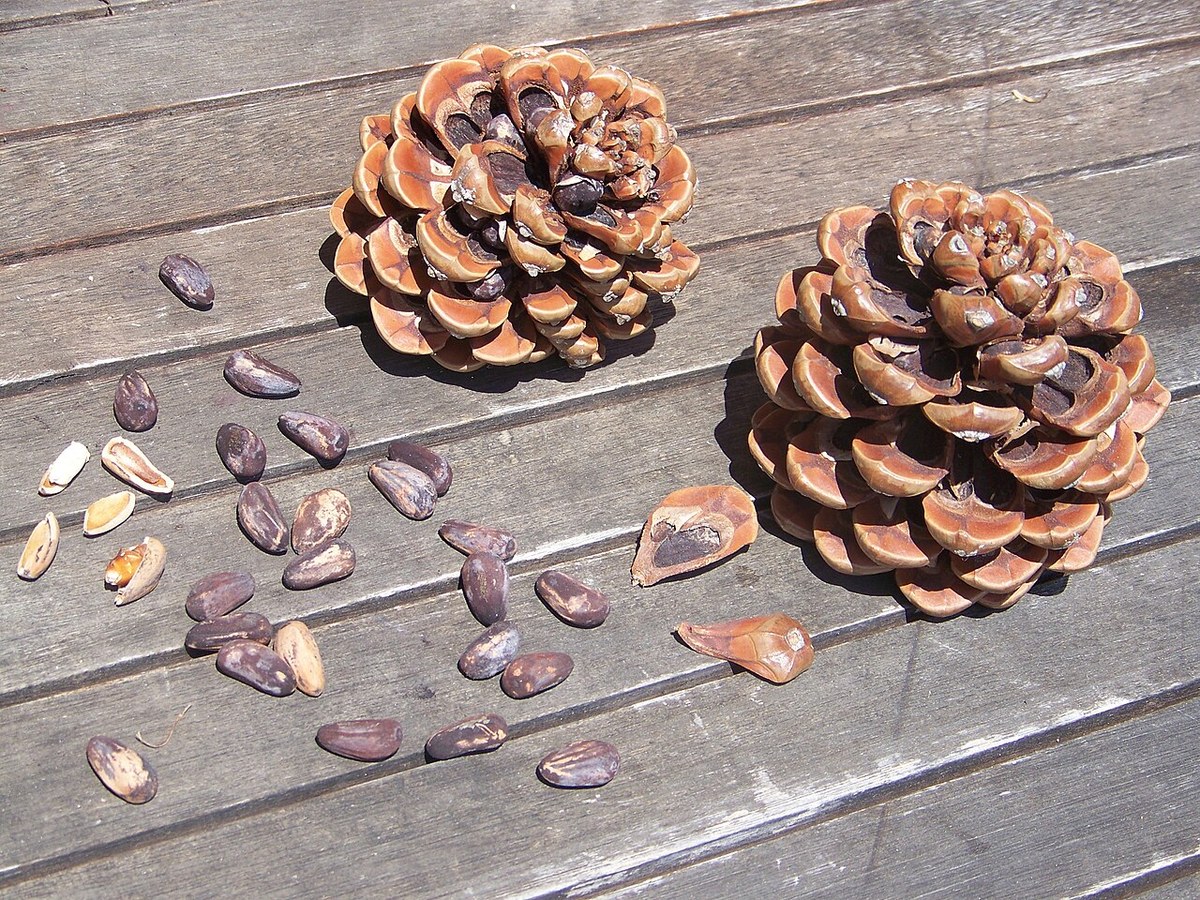
You hear it before you taste it. A small, dry snap as the diamond breaks in two, then the honey clinging to your teeth for a moment before it gives way. In between, golden pine nuts packed tightly together. The pinhoada from Alcácer do Sal has no cream, no pastry and no flour: honey, pine nuts, and a craft that fits into a handful of gestures.
It is one of the simplest doces in Portugal. It is also one of those that tells a landscape best.
A town among the pines
Alcácer do Sal sits on the river Sado, in the coastal Alentejo, south of Lisbon. The soil around it is sandy, poor for many crops but ideal for one tree: the pinheiro manso, the stone pine, Pinus pinea to botanists. Its umbrella-shaped outline belongs to the whole region's scenery, and its heavy cones hold what the Portuguese call pinhão: the pine nut.
Trade in pine nuts has always mattered here, so much so that it earned a nickname: white gold. Portuguese navigators of the Age of Discoveries already carried them, like other nuts, because they keep for a long time and pack plenty of energy into a small volume.
A winter harvest
Pine nuts are not picked in summer. The season opens on 1 January. Pickers climb the trees with very simple tools and pull the cones off by hand, then spread them out in the sun on the eiras, the open-air drying floors.
In the heat, the scales open. The cones are shaken until the seeds fall out, still wrapped in a hard brown shell. That shell has to be cracked, the fragments sorted, everything washed and dried. What is left at the end of the chain is a small, ivory, elongated kernel, tender, both sweet and resinous. It takes a great many cones and a great many hands: hence the nickname.
Three gestures and a wet marble slab
The pinhoada recipe, as described in the official inventory of traditional Portuguese products, fits into a few lines.
- The shelled, skinned pine nuts go into the oven first, until golden.
- The honey is heated; once it boils, the nuts go in and everything cooks until the mixture thickens.
- The scalding mass is poured onto a moistened marble slab and spread with a rolling pin, also wet.
- Once cool, it is cut with a heated knife.
The water on the marble and the rolling pin is no detail: it stops the honey from sticking to everything. The hot knife cuts cleanly instead of shattering the slab. The result is a hard sheet half a centimetre thick, cut into diamonds of about three by five centimetres, brown, with every pine nut still visible.
Then there is the wrapping, almost part of the recipe: thick white paper, folded so that it holds two diamonds per fold. You unwrap them one by one, the way you would open a letter.
From fairground treat to travelling treat
The pinhoada began as a popular sweet, sold and eaten at fairs. What made it known across the country was geography. Alcácer do Sal is one of the great road junctions of southern Portugal: you pass through it heading down to the Algarve, over to the Alentejo coast, or back up to Lisbon.
Travellers stopped, so did travelling merchants, and everyone left with a few diamonds in white paper. A sweet that fears neither heat nor the jolts of the road was made for this. From fair to fair and car to car, the pinhoada became the speciality people associate with the town.
It is made above all for Christmas, when it joins the festive table, but its reputation means you can find it in the region all year round. It is eaten at any time of day, with a coffee, by the roadside or on the way home.
A cousin of the almond sweets
The pinhoada belongs to a family southern Portugal knows well: sweets built on a nut grown in the region. In the Algarve, it is the almond, worked into marzipan and sculpted into tiny fruits, as we described in our story on doce fino. In the Alentejo, it is the pine nut, coated in honey. Two regions, two trees, one idea: take what the land gives in abundance and turn it into something that keeps and can be shared.
And in Brussels?
You will not find pinhoada in our display cases: it belongs to its town, its fairs and its roads, and that is as it should be. But it says something we recognise in our four shops in and around Brussels, on Rue des Tongres in Etterbeek, in Stockel, in Uccle and in Waterloo: the best Portuguese sweets often come from a single local product and a gesture repeated a thousand times. The same goes for the torta de Azeitão, also born south of the Tagus, which you will find with us. Our addresses and opening hours are on our shops page.
A treasure in folded paper
There is something touching about a sweet that never tried to impress. No decoration, no icing, no clever shape. Just honey, pine nuts and a fold of white paper. The white gold of Alcácer's pines, wrapped for the road.
Photo: stone pine cones and pine nuts — Pomme de pin pignon, by Asabengurtza, CC BY-SA 3.0, via Wikimedia Commons.
Read next
Batata-doce de Aljezur: a legend three centuries too early
It comes out of the ground still wearing its sand, heavy and oddly fragrant. In Aljezur they say it won a battle in…
Malassada: the Azorean doughnut that became a Hawaiian icon
The sugar sticks to your fingers before the first bite. No hole in the middle, no glaze: just a golden ball, still…
Portokali: the orange named after Portugal, from Athens to Tehran
Ask for an orange at a market in Athens and you will be handed a portokali. In Istanbul, a portakal. All across the…
Castanhas de ovos: the chestnuts of Viseu made from egg yolks
Small golden chestnuts, ridged, a little scorched on top. None of them has ever seen a chestnut tree: in Viseu they are…
Pão de rala: the fake loaf of Évora that the nuns offered a king
It has the shape of a country loaf and the name of a poor man's flour. Under its crust, though, there is nothing but…
Pêra Rocha: the pear that turned up by accident in a Sintra garden
It has a neck, a skin freckled with russet, and it reaches Portuguese market stalls in September. Every Rocha pear in…
From Flagey to Stockel: how Portuguese pastry reached Brussels
The hiss of the coffee machine, the cup set down with a click, two words of Portuguese across the counter: that counter…
Bolo Dona Amélia: the maize cake where the spices stopped
A veil of icing sugar, a dense crumb the colour of maize, a scent of cinnamon and clove. The bolo Dona Amélia comes…
Find our artisan pastries in our Brussels stores or order online.
Order now Our foodtruck for your events Our stores