
Batata-doce de Aljezur: a legend three centuries too early
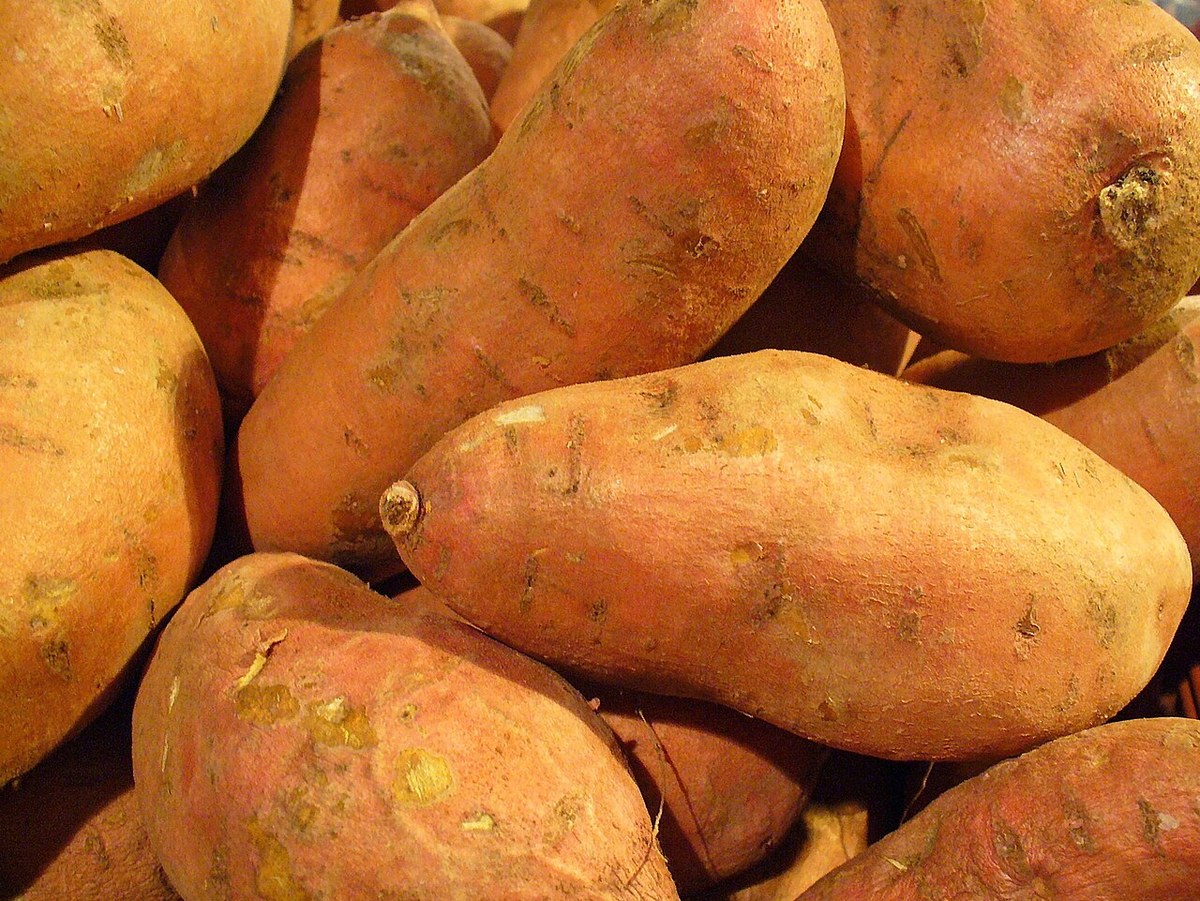
It comes out of the ground still wearing its sand. Rub it with a thumb and a skin appears underneath, somewhere between red and brown, almost purple in places. Break it in half and it is bright yellow, damp, and it smells faintly of chestnut. This is the batata-doce de Aljezur, and in this south-western corner of Portugal it is not a vegetable. It is a character.
A character with a biography that is just a little too good.
The legend of 1249
The story told in Aljezur runs like this. Before taking the castle that sits above the village, the knights of the Order of Santiago are said to have drunk a preparation made from sweet potato. A potion, according to the enthusiasts. Enough to get through the day, according to the sober. The castle falls in 1249, and the root enters the account of the conquest.
It is a fine story. It has one flaw: the sweet potato was not there.
Ipomoea batatas is American. It had been growing for millennia in the warm lands of that continent, and it only crossed the Atlantic after the voyages of the late fifteenth century. In 1249 no European knight could have seen one, let alone eaten one. The legend runs almost three centuries ahead of its subject.
What is striking is that nobody hides this. The official product record itself flags the anachronism, without deleting the legend. The two live side by side, which is very Portuguese: you keep the story because it tells the truth about something else. It says that this root feeds people, that it fills them, that it was trusted on hard days. Those are facts, even if the date is wrong.
What actually happened
The real arrival is later and less heroic, but it tells Portugal better. It was Portuguese ships that moved the plant from continent to continent, from Brazil to Africa, to Asia, and to the ports of the peninsula. Like sugar, like cinnamon, like so many things that ended up in the doces, the sweet potato entered Portugal by sea.
Then it found its place. And not just any place: the south-west, the Costa Vicentina, that strip of sandy ground wedged between hills and ocean, where the salt wind discourages almost every delicate crop. Sand, a defect nearly everywhere else, is exactly what was needed here: the root develops without twisting and without turning fibrous.
A tiny territory, and a European protection
The territory of the batata-doce de Aljezur fits on a pocket map. It covers the municipality of Aljezur, in the district of Faro, and five parishes of neighbouring Odemira on the Alentejo side: S. Teotónio, S. Salvador, Zambujeira do Mar, Longueira-Almograve and Vila Nova de Milfontes. Together they match the Mira irrigation perimeter — roughly 420 hectares: 220 on the Aljezur side and 200 on the Odemira side.
That is not much. It was enough to bring Brussels into it, quite literally: since the European regulation of 17 August 2009, the batata-doce de Aljezur carries a Protected Geographical Indication. The name now belongs to this stretch of coast, and to nowhere else.
The variety has a name too: Lira. An elongated pear shape, purple or reddish-brown skin, distinctly yellow flesh. One root weighs between 50 and 450 grams and measures from 8.5 by 4 centimetres up to 16.5 by 7. Raw, it tastes of chestnut; cooked, it turns sweet and melting, with almost no fibre.
The gesture that decides everything: eight days in the sun
The calendar of the batata-doce begins in February, in the nursery. In April or May the young plants go out into the field. Then comes the waiting. Harvest opens in September and continues deep into autumn, but the heart of it is October, when the root is ripe and the soil has finished drying.
And then comes the gesture that outsiders almost always miss. The roots are not brought in. They are left where they are, lying on the earth that grew them, for about eight days. This drying, the cura, is neither carelessness nor a saving on labour: it seals the small wounds of lifting and turns part of the starch into sugar. A sweet potato lifted and stored straight away does not taste the same. It has not yet finished becoming itself.
Only then does it go inside, into a ventilated room at around 13 to 14 °C. Handled properly, it keeps until the following spring. An autumn crop that feeds people into April: in a poor, windswept region, you understand at once why it became a character.
From soup to dessert
In the south-west the batata-doce goes everywhere. It sits beside fish, it thickens winter dishes, it is eaten roasted under the ashes. But above all it earned its place in the region's traditional doçaria, the country baking that never needed rare ingredients to be good.
The reasoning is the same as for the other sweets of the Portuguese south: you start with what grows there. The almond gives the morgado, the carob gives its dark flour, the fig tree gives its dried fruit, and we have told elsewhere how alfarroba is still harvested with a long pole. The sweet potato brings what egg yolks and sugar cannot give on their own: texture. Something dense and yielding that stays moist for days.
Every late November, Aljezur devotes a festival to it: three days in which a rural municipality of the Costa Vicentina becomes, for one weekend, the capital of a root. The 2026 edition is announced for 28 to 30 November.
What we take from it at Wooly
We do not sell batata-doce de Aljezur in Brussels: its growing area is too small and its season too short for that. But its story says exactly what we try to do in our four shops, on rue des Tongres in Etterbeek, in Stockel, in Uccle and in Waterloo: Portuguese baking that starts from a product and a gesture rather than a shortcut. It is the same spirit that makes an ovos de coco taste like nothing else, and that keeps an egg yolk beaten with sugar at the base of half our counter to this day. Our addresses and opening hours are on our shops page.
The legend was right about what mattered
The knights of 1249 never tasted sweet potato. But the idea the village held on to, that a root out of the sand can decide what happens next, is not absurd. For centuries, on this stretch of Atlantic coast, that is precisely what it did: it got people through the winter.
Sometimes a legend gets the date wrong and still hits the mark.
Photo: raw sweet potatoes, Ipomoea batatas 006, by Llez, CC BY-SA 3.0, via Wikimedia Commons.
Read next
Malassada: the Azorean doughnut that became a Hawaiian icon
The sugar sticks to your fingers before the first bite. No hole in the middle, no glaze: just a golden ball, still…
Portokali: the orange named after Portugal, from Athens to Tehran
Ask for an orange at a market in Athens and you will be handed a portokali. In Istanbul, a portakal. All across the…
Castanhas de ovos: the chestnuts of Viseu made from egg yolks
Small golden chestnuts, ridged, a little scorched on top. None of them has ever seen a chestnut tree: in Viseu they are…
Pão de rala: the fake loaf of Évora that the nuns offered a king
It has the shape of a country loaf and the name of a poor man's flour. Under its crust, though, there is nothing but…
Pêra Rocha: the pear that turned up by accident in a Sintra garden
It has a neck, a skin freckled with russet, and it reaches Portuguese market stalls in September. Every Rocha pear in…
From Flagey to Stockel: how Portuguese pastry reached Brussels
The hiss of the coffee machine, the cup set down with a click, two words of Portuguese across the counter: that counter…
Bolo Dona Amélia: the maize cake where the spices stopped
A veil of icing sugar, a dense crumb the colour of maize, a scent of cinnamon and clove. The bolo Dona Amélia comes…
Madeira sugar: the sweet route that linked Funchal to Bruges
In a display case in Funchal stands a cone of hardened sugar, greyish white, as tall as a forearm. That was the shape…
Find our artisan pastries in our Brussels stores or order online.
Order now Our foodtruck for your events Our stores