
Ameixa d'Elvas: the green plum named after a French queen
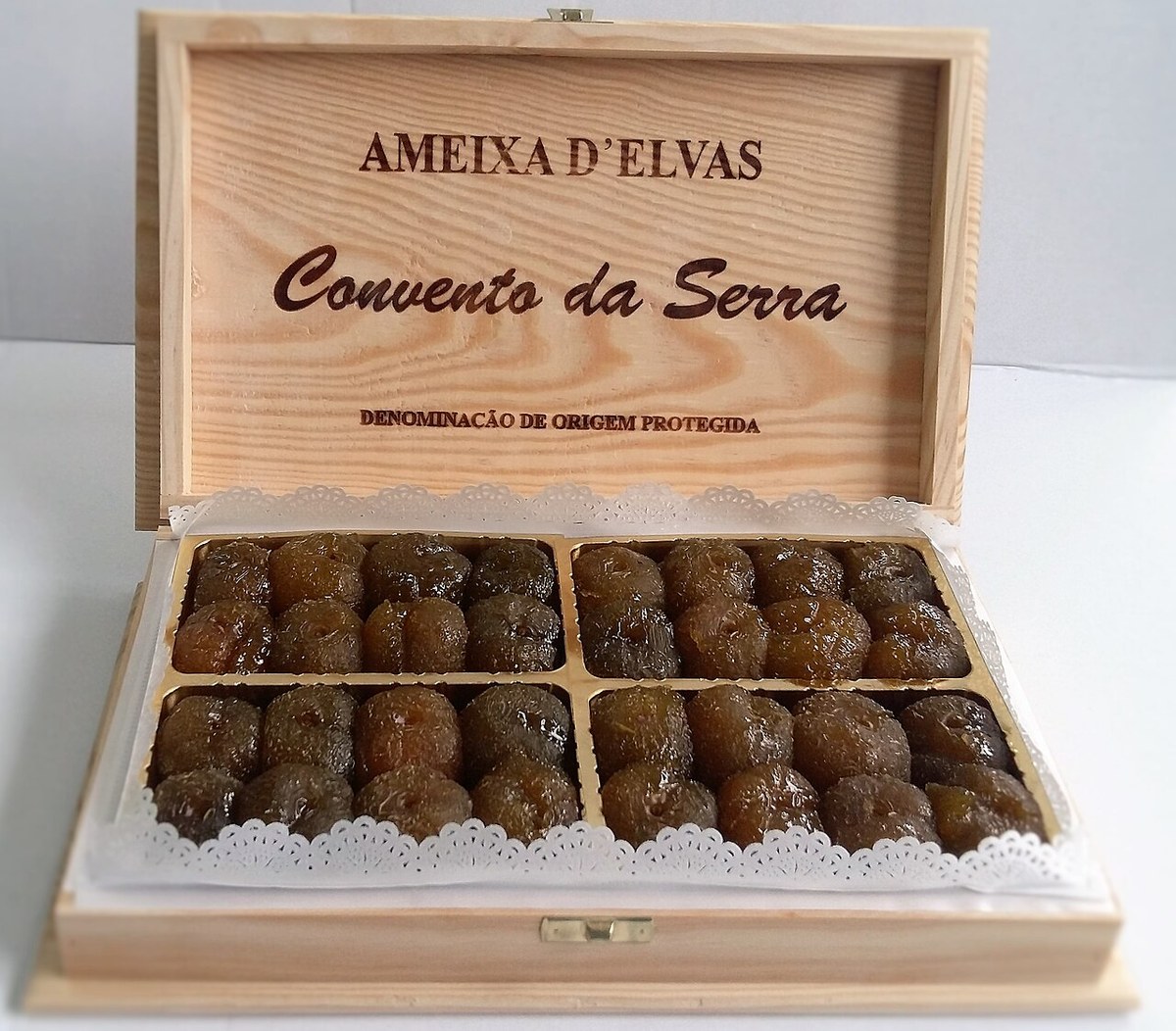
It is green, and that is not a flaw. An Elvas plum held between two fingers at harvest is firm, almost hard, a green that promises nothing sweet. Bite into it and you will be disappointed. That is precisely the state in which it has to be picked.
The fruit is called ameixa d'Elvas, and behind the name sits a variety gardeners here know well: the Rainha Cláudia, the greengage. The resemblance stops there. What the Alentejo does with it has little left in common with an orchard plum.
A French queen in an Alentejo orchard
The variety takes its name from Claude of France (1499-1524), daughter of Louis XII, Duchess of Brittany and later Queen of France. The tree is said to have reached Portugal as an ornamental, planted for its foliage long before anyone cared about its fruit. In the Upper Alentejo it found a climate that suited it: long dry summers, nights that cool down, soil that does not hold water.
The protected designation of origin that now carries its name covers eight municipalities: Elvas, Campo Maior, Monforte and Sousel in the district of Portalegre, Alandroal, Borba, Estremoz and Vila Viçosa in that of Évora. A rectangle of countryside pressed against the Spanish border, where the same families have grown the tree and worked the fruit for generations.
The fruit itself is small and oval, a green that turns golden once it truly ripens. The flesh is extremely juicy, the aroma intense, and the stone comes away on its own — a detail that sounds like nothing until you have several hundred kilos to prepare.
The gesture: picking it before it is ready
Harvest falls in June and July, and that is where the doce is won or lost. The plum is picked slightly green, still hard, only just entering ripeness. A ripe plum, full of water and sugar, would not survive what comes next: it would collapse in the syrup, the skin would split, and what remained would be compote.
That decision to pick early governs the whole calendar. The fruit reaches the workshop and is processed the same day. No storage, no waiting: the plum keeps ripening in its crate, and every hour lost brings it closer to the point where it will no longer hold.
Two cookings, two sugar stages
The traditional method comes in two stages, and they are nothing alike.
- The first cooking is in water alone. No sugar at all. It softens the fruit and prepares the flesh for what follows — it releases exactly the firmness that was so carefully preserved at harvest.
- The second is in syrup, and the syrup passes through two successive cooking points. That second bath sets the fruit. From then on the plum keeps for years: sugar has taken the place of water.
The equipment has not changed: tachos de cobre, the wide copper cauldrons that spread heat without forcing it, a skimmer, basins for resting. Nothing a thermostat can settle. The sugar stage is read by eye and by finger, exactly as in the rest of Portuguese pastry — the famous ponto de açúcar, the gesture that decides everything and that no timer replaces.
Depending on where you stop, the plum ends up in one of three states: fresh, em passa (dried, wrinkled, concentrated) or in syrup, translucent in its jar.
From the convents of Elvas to the world's shop windows
Like almost all Portuguese doçaria, this one begins behind a convent wall. As early as the 16th century, documents record that the Poor Clares and the Dominican nuns of Elvas were preparing sweetened and coated plums, and that those plums were sought after. The recipe for ameixas em calda appeared in the recipe book of the convent of Nossa Senhora da Consolação, the Dominican house.
For a long time the doce stayed inside that circle: convents, wealthy tables, gifts. It took until 1834 and José Guerra for large-scale production to turn a convent recipe into an export. After that it moved quickly: a bronze medal at the 1855 Paris Exposition, then the first crates shipped to America from 1875. An Alentejo plum, in jars, on other continents.
The town still makes room for it. Elvas's great fair, the Expo São Mateus, runs at the Parque da Piedade from 18 to 27 September 2026: ten days of music, religious festival and food, where the local doces keep their counter as they have for as long as the fair has existed.
Where the plum finds a dessert again
The ameixa d'Elvas is not only eaten by the spoonful from its syrup. In the Alentejo it traditionally accompanies sericaia, the egg-and-cinnamon dessert that is only a success when it cracks. The pairing is no accident of menu writing: sericaia is sweet, warm and rich; the plum brings the acidity and freshness that stop it from sitting heavy. Two specialities from the same region, on the same plate, correcting one another.
A craft that speaks about our own
At Wooly, in Brussels, we do not candy plums. But the story of the ameixa d'Elvas says something we recognise in the kitchen every day: the timing of the harvest, reading sugar with a fingertip, refusing to wait one more day. It belongs to the same family of gestures as the ones that give a pastel de nata its layers and its filling that trembling custard. These are trades of narrow windows.
Our four shops — Rue des Tongres in Etterbeek, Stockel, Uccle and Waterloo — work with that Portuguese pastry: the kind that came out of the convents, crossed the centuries with its egg yolks, its sugar and its cinnamon, and never needed a shortcut.
Next time you come across a jar of small translucent green plums in a Portuguese grocery in Brussels, you will know what it took: picking them hard, cooking them in water, then twice in sugar, and letting time do the rest.
Photo: Bacomgm, Wikimedia Commons, CC BY-SA 4.0.
Read next
Rebuçados da Régua: the hand-folded sweet of the Douro pilgrimages
They smell of hot lemon and cooked sugar. At the foot of Lamego's baroque stairway, women still fold their sweets one…
Pastéis de Santa Clara: the cake from a convent that drowned
In Coimbra the nuns spent three centuries raising their floors before leaving the convent to the river. The building…
Why Portuguese pastry is so yellow: the wine took the whites
Crack an egg and separate it. In Portugal, for centuries, the white and the yolk went their separate ways: one to the…
O lanche: the Portuguese afternoon snack that borrowed an English name
Late in the afternoon, Portugal puts down whatever it is holding and sits for ten minutes. The moment carries a…
Marmelada: the Portuguese quince that gave marmalade its name
Raw quince is inedible. Cooked with sugar it becomes a paste you cut with a knife — and a word that left Portugal and…

Desfolhada: the night when a red corn ear was worth a kiss
In late September, northern Portugal husked its corn after dark. Village work, sung and washed down with wine, and one…
The suitcase home: what Portuguese families bring back in August
In late August the same scene plays out in kitchens all over Brussels: a suitcase open on the tiles, a bathroom scale…

Doce fino: the Algarve's fruit, sculpted entirely from almonds
A banana, an ear of corn, two white rabbits and a carrot complete with its leafy top, all laid out on a paper doily.…
Find our artisan pastries in our Brussels stores or order online.
Order now Our foodtruck for your events Our stores