
Trouxas de ovos: the little egg bundle you bring home from Caldas da Rainha
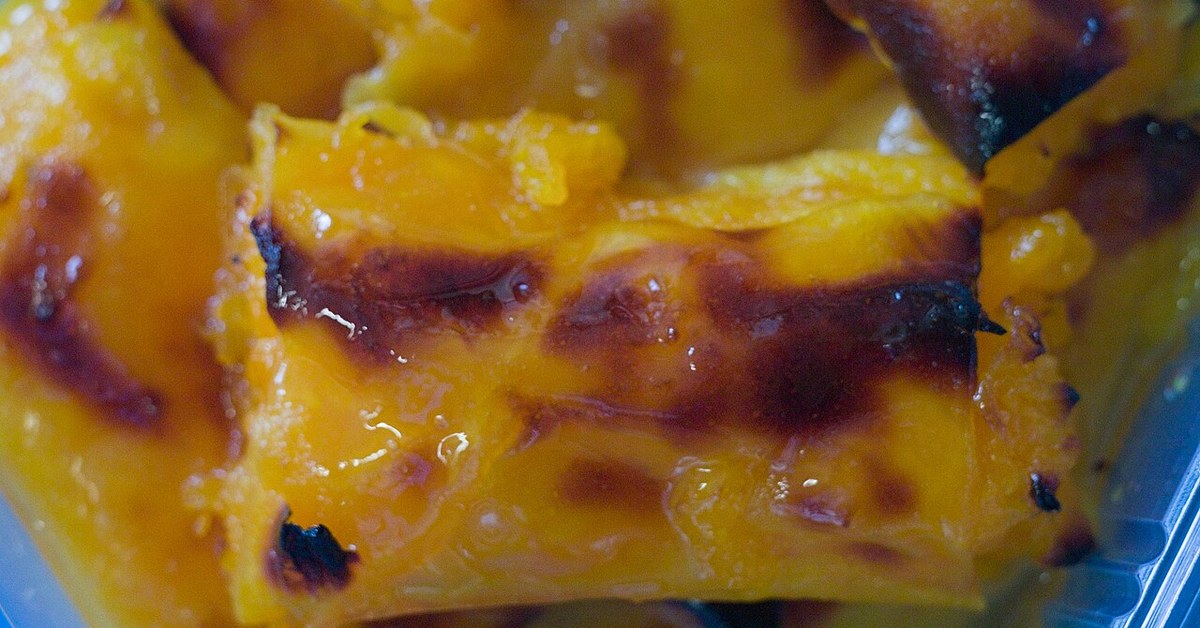
The spoon sinks in without resistance. Syrup seeps from the folds, the egg sheet half unrolls, supple, almost silky, and reveals a denser, even yellower heart. It is sweet, properly sweet, and that is the point: you don't eat a trouxa de ovos for its lightness. You eat it slowly, at the end of a festive meal, with a strong coffee as a counterweight.
In Portugal, this bright yellow roll carries the name of a spa town in the Oeste region, an hour north of Lisbon: Caldas da Rainha. And its own name already describes a gesture.
A trouxa is a bundle
In Portuguese, a trouxa is a knotted bundle of laundry, the parcel you carry to the wash house or tuck under your arm when you set off. The word says exactly what the pastry cook does: she wraps. A thin layer of egg is poached in syrup, then folded and rolled around a small, thicker heap of egg, the way you would close a cloth over what it holds.
The ingredients fit in three words: eggs, sugar, water. That is the very definition of doçaria conventual, the confectionery born in Portuguese convents, where yolks were plentiful and sugar came from the islands. We have already told why Portuguese pastry is so yellow: the whites went elsewhere, the yolks stayed behind, and the nuns turned them into an art.
The gesture: a small pan, syrup and patience
The official record of traditional Portuguese products describes the method without frills. Sugar is dissolved in water over the heat until the syrup starts to set. In a small pan, half a cup of that syrup is brought to the boil, then a spoonful of egg is poured in and spreads into a thin sheet. It is turned with a spatula, left to boil a moment longer, and lifted out.
Then comes the gesture that gives the sweet its name. The edges of the sheet are trimmed, and nothing trimmed is wasted: the offcuts go in the centre and the sheet is rolled over them. Nothing is thrown away, everything is wrapped. The rolls are then generously coated with syrup before being packed. A traditional trouxa is about 5 centimetres long and 3 centimetres across.
The whole secret lies in the syrup. Too thin, and the sheet falls apart; overcooked, and it hardens and cracks when folded. This is the famous ponto de açúcar, the sugar stage Portuguese pastry cooks judge by finger and eye, and which decides everything in this family of sweets. More homely recipes push the yolks through a fine sieve and mix them with some of the whites first: every household has its habits, but the principle stays the same.
An origin nobody can pin down
We would love to tell you about the nun who rolled the very first trouxa. The truth is more modest: nobody knows the exact origin of this dessert. Caldas da Rainha made it its speciality, yet no convent in the town is formally linked to it. One frequently cited lead points to the convent of Cós, a nearby Cistercian house of nuns, known for its sweets and said to have supplied the great monastery of Alcobaça. It is a hypothesis, not a certainty, but it puts the trouxa back in its landscape: a region of convents, orchards and pilgrim roads.
What we do know is that by the end of the 19th century the sweet was famous enough to enter literature. Eça de Queiroz, one of Portugal's great novelists, mentions it: his narrator climbs Rua Nova do Carmo, melancholy, his trouxa de ovos in hand, alongside a certain Dr Margaride. That a writer so attentive to the manners of his time included this detail says a lot about what the trouxa meant: a gift you carry, you give away, you don't eat alone.
The town of a queen and her waters
Caldas da Rainha literally means "the queen's hot baths". The town grew around sulphurous springs where Queen Leonor is said to have found relief in 1484. She had a thermal hospital built there, which admitted its first patients in 1488 and is regarded as the oldest purpose-built institution of its kind.
For centuries, people came to Caldas to take the waters, and later on holiday. And they never left empty-handed. The official record puts it plainly: trouxas are traditionally bought as gifts when visiting the town, and served as a refined dessert on special occasions, banquets, weddings, Christmas. Today they are still sold individually or in small round boxes, as many as you ask for.
The town has other sweet claims to fame. Cavacas, hollow cakes under white icing, come from here too, as do beijinhos and lampreias de ovos. It all sits between the Praça da Fruta, which hosts an open-air market every day, and shop windows full of ceramics in the tradition of Rafael Bordalo Pinheiro, who made Caldas a capital of Portuguese pottery.
How to enjoy one
- Small: one trouxa is enough. It is dense and very sweet, a dessert for the end of a meal, not a treat to eat one after another.
- With coffee: a strong bica or unsweetened tea balances the syrup.
- With a spoon: the syrup runs, and that is fine. Scoop it up from the bottom of the plate.
- With family: it is a dessert for long tables, christenings and Christmas Eve, made for sharing.
In Brussels
The trouxa belongs to the great family of egg-yolk sweets that defines Portuguese pastry. In Brussels, at Wooly, you can taste that convent tradition in the pastel de Tentúgal, an almost transparent sheet of pastry rolled around an egg cream, another story of convents and patience. You will find it in our shops on Rue des Tongres in Etterbeek, in Stockel, in Uccle and in Waterloo. And if you ever pass through Caldas da Rainha, do as everyone does: leave with your own little bundle of egg.
Photo: o_andras, CC BY-SA 4.0, via Wikimedia Commons.
Read next
Pastel de bacalhau: the salt cod shaped between two spoons
It comes out of the oil golden, with three sharp ridges and a soft centre. Behind the pastel de bacalhau lies a fish…
Pastel de Vouzela: the recipe nobody ever wrote down
Very thin pastry, a cream of egg yolks, a veil of icing sugar. The pastel de Vouzela came out of a Porto convent, is…
Bolo de mel: the Madeira cake you break by hand, never with a knife
A low, dark, dense disc studded with almonds and walnut halves. On Madeira it is baked on 8 December so that it is…
Pinhoada: the honey and pine nut diamond from Alcácer do Sal's roads
A brown diamond, hard as a tile, folded two by two into thick white paper. The pinhoada from Alcácer do Sal is made of…
Batata-doce de Aljezur: a legend three centuries too early
It comes out of the ground still wearing its sand, heavy and oddly fragrant. In Aljezur they say it won a battle in…
Malassada: the Azorean doughnut that became a Hawaiian icon
The sugar sticks to your fingers before the first bite. No hole in the middle, no glaze: just a golden ball, still…
Portokali: the orange named after Portugal, from Athens to Tehran
Ask for an orange at a market in Athens and you will be handed a portokali. In Istanbul, a portakal. All across the…
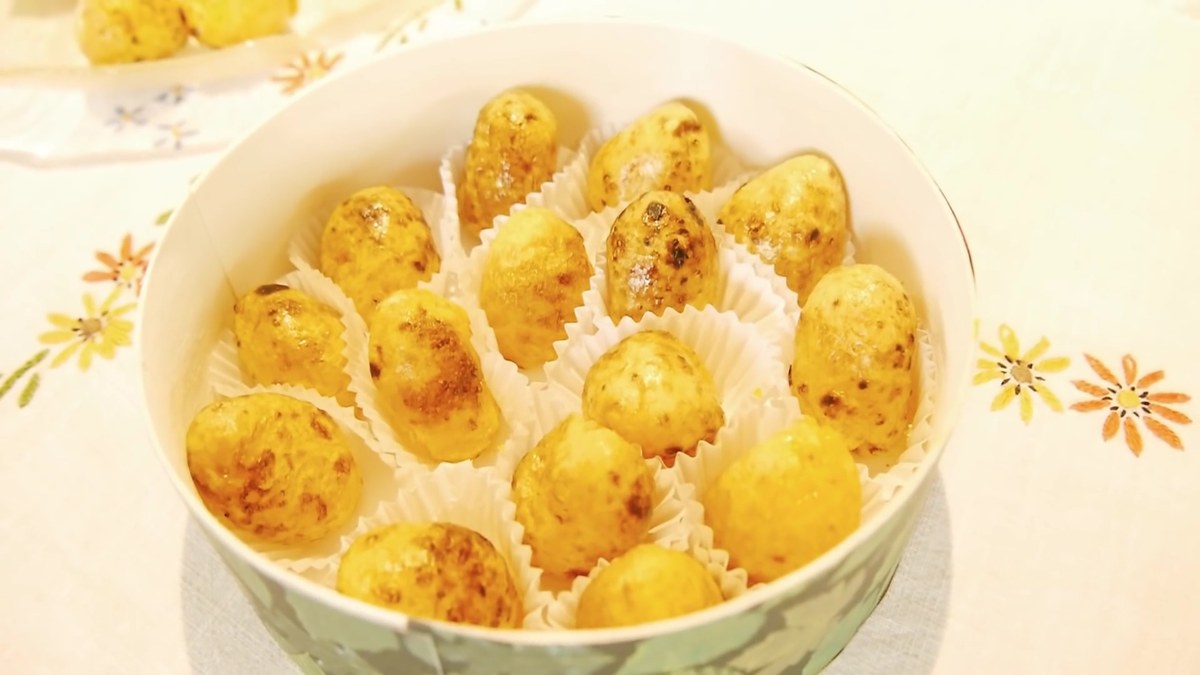

Castanhas de ovos: the chestnuts of Viseu made from egg yolks
Small golden chestnuts, ridged, a little scorched on top. None of them has ever seen a chestnut tree: in Viseu they are…
Find our artisan pastries in our Brussels stores or order online.
Order now Our foodtruck for your events Our stores